
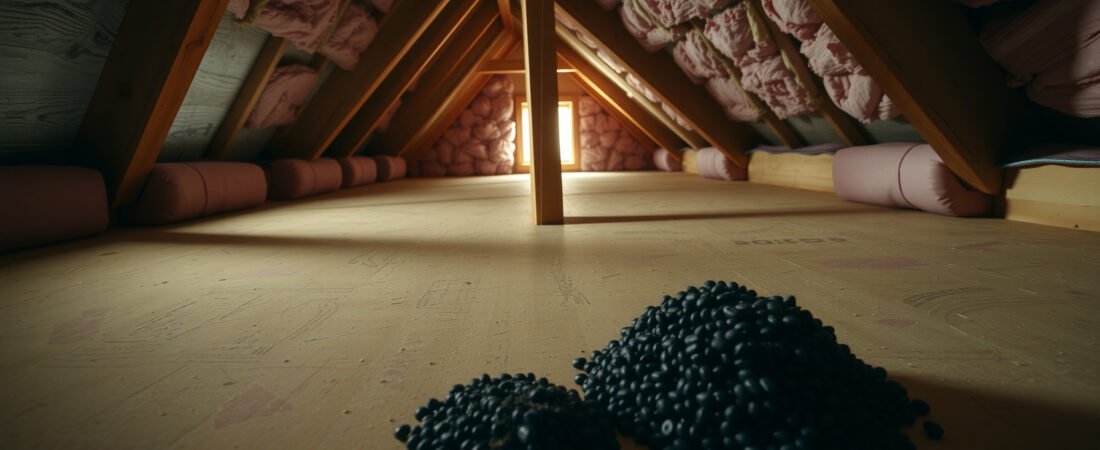
Finding small dark droppings in your attic, garage, or along baseboards feels like a mouse problem — and nine times out of ten, homeowners treat it like one. The real issue is that bat droppings and mouse droppings look remarkably similar at first glance, and misidentifying them doesn’t just waste money on the wrong treatment. It means a bat colony keeps growing undisturbed in your walls while you’re setting snap traps that will never catch anything.
Here’s the short version: bat droppings (called guano) crumble to a fine powder when crushed and contain insect fragments you can actually see. Mouse droppings stay solid, smear slightly, and are smooth throughout. That one physical test — pressing a dropping with a pen cap or toothpick — tells you more than color or size ever will. Everything else in this article builds on that single distinction.
Why the Shape-and-Size Comparison Most Articles Use Will Mislead You
Every basic guide online leads with the same chart: bat guano is slightly larger, mouse droppings are tapered at the ends, blah blah blah. The problem is that both animals produce droppings that range pretty widely depending on diet, age, and species. A young mouse leaves droppings barely 3mm long. A well-fed big brown bat leaves guano nearly 12mm long. There’s real overlap in that range, and relying on size alone will get you to the wrong answer at least 30% of the time.
Shape is similarly unreliable on its own. Both bat guano and mouse droppings tend to be elongated and dark brown to black. Fresh mouse droppings look almost identical to fresh bat guano — shiny, dark, cigar-shaped. The distinguishing feature that actually holds up under scrutiny is internal composition, not external dimensions. Bat guano is made almost entirely of digested insects, which gives it a segmented, almost sparkly texture when you look closely. Mouse droppings are smooth and uniform because mice are omnivores eating grains, fats, and proteins that digest more completely.

This close-up comparison shows exactly why texture and internal structure — not just size or color — are the features that separate bat guano from mouse droppings when you’re dealing with an actual sample in low attic light.
The Crush Test: The One Field Method That Actually Works
Picture this: you’re in your attic with a flashlight, looking at a pile of droppings near the ridge vent. You have no idea if this is a mouse problem or a bat colony, and the identification matters enormously because bats are federally protected under the Endangered Species Act — you legally cannot remove them during maternity season, typically May through August. Getting this wrong isn’t just a pest control mistake, it’s potentially a legal one.
Put on gloves and a respirator first — both bat guano and mouse droppings carry real health risks including hantavirus from mouse droppings and histoplasmosis from bat guano. Then use a pen, chopstick, or the capped end of a marker to press down on a single dropping. Bat guano will crumble into a fine, dry powder almost immediately — the insect exoskeletons inside make it friable and gritty, and you may even see tiny reflective flakes. A mouse dropping will resist slightly, then smear or break into larger chunks that stay moist longer and don’t powder. That’s it. That’s the test. No magnifying glass required.
Pro-Tip: Always wear an N95 respirator and nitrile gloves before testing or cleaning any unknown droppings. Bat guano can harbor Histoplasma capsulatum fungal spores that become airborne when disturbed — and this risk is real even in small accumulations. Don’t skip this step thinking a brief exposure is harmless.
Location of the Droppings Tells You More Than the Droppings Themselves
Mice move along walls, travel established routes, and leave droppings scattered across a broad area — kitchen floors, behind appliances, inside cabinets, along baseboards in multiple rooms. A mouse infestation creates what’s called a “droppings trail” that maps the animal’s nightly movement. You’ll typically find droppings in 4–8 distinct areas throughout the home if you have an active mouse problem. Bats don’t behave this way at all.
Bat guano accumulates in piles. Bats roost in fixed locations — wall voids, attic peaks, behind shutters — and defecate directly below the roost. So guano piles up in one or two concentrated spots, often directly under a ridge, rafter, or soffit gap. If you find a single mound of droppings several inches deep in one corner of your attic and nothing anywhere else in the house, that pattern alone points strongly to bats. Here’s what to look for when assessing location:
- Concentrated pile directly below a fixed point: strongly suggests bat roost above
- Scattered trail following walls or edges: consistent with mouse activity
- Droppings in kitchen, pantry, or near food storage: almost always mice, bats don’t enter living spaces intentionally
- Droppings in attic only, near ridge vents or gable ends: high probability of bat colony
- Droppings on exterior walls below a gap or crack: bat entry point with guano streaking down the siding
- Droppings mixed with nesting material (chewed paper, insulation fibers): mice build nests, bats don’t
How to Read the Full Evidence Picture: Smell, Staining, and Timing
Bat guano has a distinctive sharp ammonia odor that gets noticeably stronger in warm weather — the urine soaked into the guano off-gasses faster as temperature rises. A large bat colony in a 1,500 square foot attic can produce enough guano in a single summer season to fill several five-gallon buckets, and the smell will eventually penetrate the ceiling below. Mouse infestations also smell, but the odor is muskier, less ammonia-forward, and tends to concentrate near nest sites rather than permeating an entire floor of the structure.
Staining is another underused clue. Bat entry points develop a characteristic brownish-black oily stain called “guano grease” — a mix of body oils and urine that bats deposit on the edges of their entry gaps over repeated use. These stains are visible on exterior siding, fascia boards, and inside attic spaces near gaps. Mice leave grease marks too, but they’re thinner, more linear, and appear at ground level or along baseboards, not up near rooflines. Timing matters also: if you see activity or hear movement at dusk specifically — not overnight — that’s bats exiting to feed. Mice are active from roughly 11pm to 5am.
“Homeowners consistently underestimate how definitive the crush test is. I’ve had clients spend three months dealing with a supposed mouse problem — traps, poison blocks, everything — because nobody bothered to actually test the droppings they were finding. When we finally identified the samples correctly as bat guano, we found a colony of over 200 little brown bats in their knee wall. The mice they’d caught were real, but incidental. The bats were the primary infestation the whole time.”
Dr. Renata Hollis, urban wildlife biologist and NWCOA-certified bat exclusion specialist
What to Do Once You’ve Made the Correct Identification
The response plan for bats versus mice is completely different, and not just tactically — the legal framework surrounding each animal is entirely separate. Mice have no federal protection and can be trapped or poisoned year-round with standard products available at any hardware store. Bats are protected under the federal Migratory Bird Treaty Act and in most states have additional state-level protections. Killing bats — even accidentally — can result in fines. Exclusion during maternity season (May through August in most of the US) is prohibited because it traps flightless pups inside to die.
Once you’ve confirmed the identification, here’s how to proceed based on what you found:
- Confirmed mouse droppings: Set snap traps within 24 hours — mice become trap-shy quickly once disturbed. Place them perpendicular to walls, trigger end facing the baseboard, no more than 6–10 feet apart in active areas.
- Confirmed bat guano: Check your local maternity season dates before doing anything. Outside that window, hire a licensed bat exclusion specialist to install one-way exclusion devices over entry points.
- Guano cleanup (both species): Wet the material with an enzyme-based disinfectant spray before sweeping or vacuuming — never dry-sweep guano or mouse droppings. The dry sweep method aerosolizes pathogens directly into your breathing zone.
- Entry point sealing (mice): Mice can compress their bodies through a gap as small as 1/4 inch. Seal with steel wool packed tightly, then covered with hardware cloth or caulk — steel wool alone degrades and gets pushed out over time.
- Entry point sealing (bats): Do not seal bat entry points until all bats have exited and the exclusion devices have been in place for at least 5–7 days. Premature sealing traps animals inside, which creates both a legal problem and a decomposition odor that is genuinely catastrophic.
One honest nuance worth flagging: in older homes with multiple pest pressures — common in the Northeast and Midwest — you can have both bats and mice active simultaneously in the same structure. Bats roost high in ridge spaces and gable voids; mice work the lower levels and wall cavities. Don’t assume finding guano in the attic clears mice from the kitchen. Treat each level of the home as potentially separate, and test droppings from each distinct location rather than assuming the identification from one spot applies everywhere. If you’re dealing with a multi-pest situation that’s making your home feel genuinely unlivable, it’s worth understanding when that situation crosses a legal threshold — Moving Out Because of Roaches: Is It Legally Justified? covers how pest infestations affect tenant rights in ways that apply to broader wildlife situations too.
Side-by-Side: Bat Guano vs Mouse Droppings at a Glance
Here’s a quick reference table covering the features that actually differentiate the two. Use this alongside physical testing, not instead of it — no chart replaces hands-on examination of what you’re actually dealing with in your specific structure.
| Feature | Bat Guano | Mouse Droppings |
|---|---|---|
| Size | 6–12mm long, varies by species | 3–8mm long, typically tapered |
| Texture when crushed | Crumbles to fine powder with gritty flakes | Stays firm, smears slightly, no powder |
| Internal content | Visible insect fragments, sometimes reflective | Smooth, uniform, no visible inclusions |
| Accumulation pattern | Concentrated pile below roost site | Scattered trail along travel routes |
| Location in home | Attic, wall voids, near roofline gaps | Kitchen, basement, along baseboards |
| Associated staining | Dark oily stain at entry points | Thin grease marks along walls at floor level |
| Odor | Sharp ammonia, stronger in heat | Musky, concentrated near nests |
The counterintuitive reality that almost every identification guide glosses over: the features listed in that table are more useful in combination than in isolation. A single dropping that’s 8mm long with a tapered end could be from either animal. But if that same dropping crumbles to insect-fragment powder, sits in a pile under your ridge beam, and there’s an oily stain on the fascia board six inches from a gap in the soffit — now you have a confident identification, not a guess.
Health risk is another area where the two species diverge in ways that affect how urgently you should act. Bat guano that’s been accumulating for weeks or months in an enclosed attic space creates genuine respiratory risk from Histoplasma capsulatum — a fungal organism that thrives in nitrogen-rich guano and releases airborne spores when disturbed. Hantavirus from mouse droppings is less common but more acutely dangerous, particularly in the western US. Neither is a reason to panic, but both are reasons to not go poking around in attic droppings with bare hands and no respiratory protection. The proper gear matters — and if you’ve been doing related pest research, you may have come across Best Bed Bug Sprays: Tested and Ranked for Mattresses and Furniture, which covers some of the same enzyme-based disinfectants that work well for pathogen deactivation during dropping cleanup.
Get the identification right first, then the rest follows. A correctly diagnosed bat problem gets handled legally, seasonally, and with the right exclusion approach. A correctly diagnosed mouse problem gets hit fast with the right traps in the right locations. The crush test takes about ten seconds and could save you months of treating the wrong animal — which is the kind of mistake that feels minor until you realize a colony of 200 bats has been quietly expanding in your attic while you were resetting mouse traps that were never going to catch anything.
Frequently Asked Questions
What does bat poop look like compared to mouse droppings?
Bat droppings are usually about 1/4 to 3/8 inch long, dark brown or black, and have a segmented or granular texture that crumbles easily when touched. Mouse droppings are similarly sized — around 1/4 inch — but they’re smooth, solid, and taper to a point at one or both ends. The crumble test is one of the fastest ways to tell them apart: bat droppings fall apart into powdery fragments, while mouse droppings stay intact.
where do you find bat droppings vs mouse droppings in your house?
Bat droppings almost always pile up in one spot directly below a roosting area — think attics, behind shutters, or near vents — because bats return to the same location repeatedly. Mouse droppings are scattered along travel paths, near food sources, and in cabinet corners, and you’ll rarely find a concentrated pile in one place. If you’re seeing a heap of droppings in your attic but no gnaw marks or nesting material nearby, it’s more likely bats than mice.
are bat droppings dangerous to humans?
Yes — bat droppings can carry Histoplasma capsulatum, a fungus that causes histoplasmosis, a respiratory illness that can become serious if you breathe in disturbed spores. You should never sweep or vacuum dry bat droppings without wearing an N95 respirator and gloves. Piles larger than a few square feet may require professional remediation rather than a DIY cleanup.
do bat droppings smell different from mouse droppings?
Bat droppings have a strong, musty ammonia smell that gets more intense as the pile grows, especially in enclosed spaces like attics with poor ventilation. Mouse droppings also have a musky odor, but it’s generally milder unless there’s a large infestation or urine is mixed in nearby. If the smell in your attic hits you immediately when you open the hatch, a bat colony is a likely culprit.
how do I tell if droppings in my attic are old or fresh?
Fresh droppings — whether bat or mouse — are dark brown or black and have a slightly moist or shiny surface. As they age, they dry out, fade to a grayish color, and become brittle. For bat droppings specifically, fresh ones will still crumble but won’t be fully powdery yet, while very old ones turn almost dusty and may show insect wing fragments inside them, which is a telltale sign they’re from bats.