

Clover mites are not coming inside because something is wrong with your home — they’re coming in because something is very right with your lawn. That’s the part almost every article skips. These tiny red specks on your windowsills aren’t a sign of filth, structural damage, or a failing garden. They’re a sign that your grass is thick, well-fertilized, and thriving. Understanding that single fact changes everything about how you approach them.
Most people who find clover mites panic, assume they’re dealing with a biting pest, and immediately reach for the spray can. That’s the wrong move. Clover mites (Bryobia praetiosa) are arachnids — relatives of spiders and ticks — but they don’t bite humans, don’t infest furniture, and don’t carry disease. They’re an outdoor plant feeder that wanders inside by accident, usually in spring and fall when populations peak. The real skill here is correctly identifying them before you do anything else.
What Do Clover Mites Actually Look Like Up Close?
Clover mites are about 0.75 mm long — roughly the size of a pinhead — which puts them at the very edge of what most people can see without magnification. Their color is the first thing you’ll notice: a deep brick red or reddish-brown that looks almost burgundy in certain lighting. Under a magnifying glass, you’ll see eight legs (confirming they’re arachnids, not insects) with the front pair dramatically longer than the rest, extending forward like antennae.
That oversized front leg pair is the single most reliable identification feature for clover mites. No other common household pest looks quite like this at close range. Squash one accidentally on a white windowsill and it leaves a rust-red smear — not blood, just their natural body pigment. That stain is one of the most common things people Google before they even know what they’re dealing with.
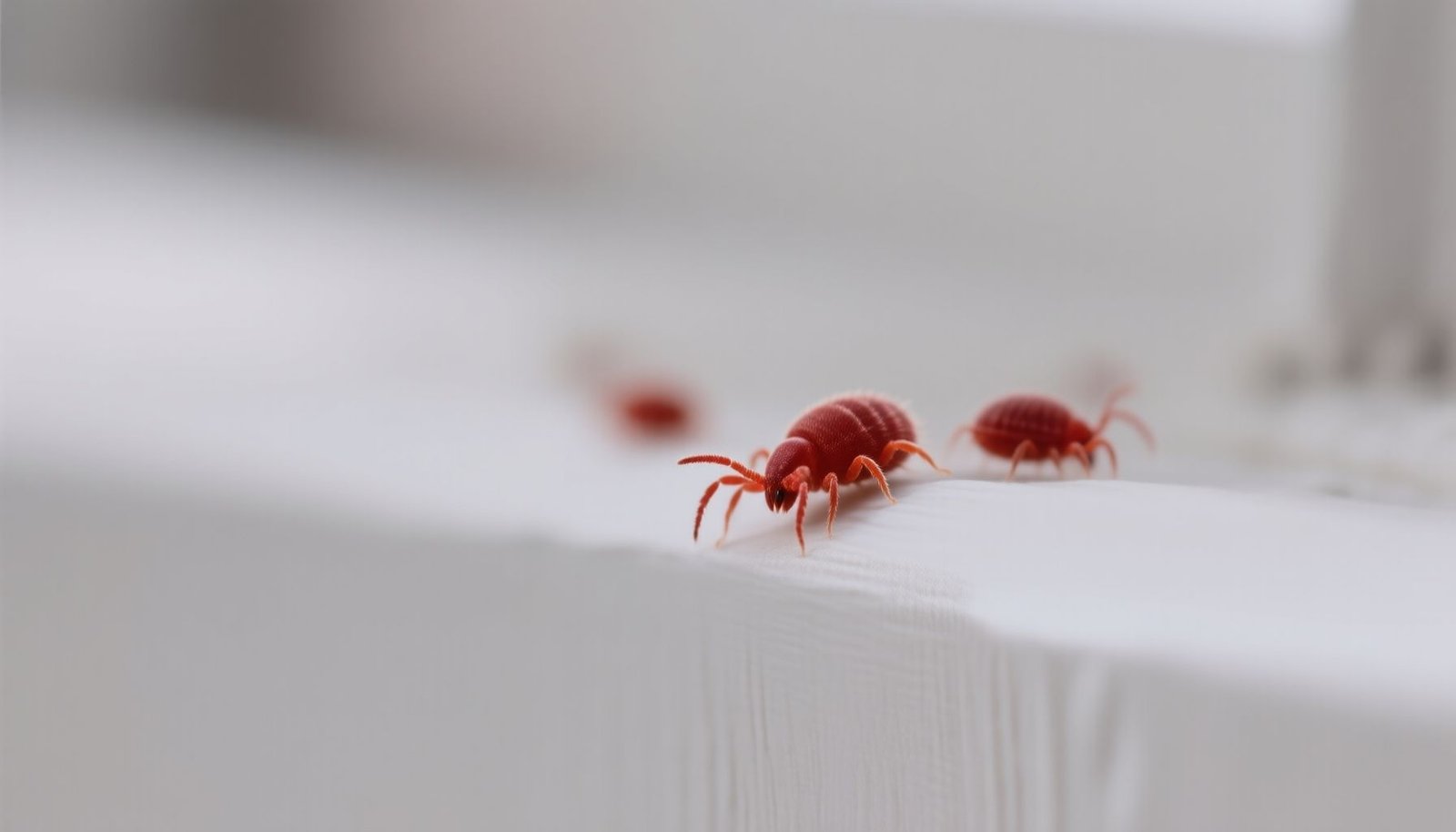
This close-up shows the characteristic elongated front legs and deep red coloring of clover mites on a windowsill surface — two details that separate them from spider mites, chiggers, and other red mites you might otherwise confuse them with.
How Are Clover Mites Different From Other Tiny Red Bugs?
Here’s where homeowners consistently go wrong: they see something tiny and red and assume “mite,” then treat for the wrong thing entirely. There are at least four common tiny red bugs that show up in and around US homes, and clover mites are only one of them. Getting the identification right matters because the treatment approach for each is completely different.
The table below breaks down the key differences between the most commonly confused red mites and bugs found near windows and entry points.
| Pest | Size | Bites Humans? | Where Found Indoors | Key Identifier |
|---|---|---|---|---|
| Clover Mite | ~0.75 mm | No | Windowsills, walls near entry | Long front legs, red smear when crushed |
| Chigger | ~0.2 mm | Yes (larvae) | Rarely indoors | Found on skin after outdoor exposure |
| Spider Mite | ~0.5 mm | No | On houseplants | Webbing on plant leaves |
| Clover Mite vs Bird Mite | ~0.7 mm | Yes | Bedding, walls after nest removal | Translucent when unfed, darker after feeding |
Bird mites are the one red mite that genuinely can cause problems for people — they bite and can cause significant skin irritation. If you’ve recently had a bird nest near a window or vent and you’re suddenly finding tiny red specks AND getting bitten, you’re likely dealing with bird mites rather than clover mites. The distinction matters enormously for treatment. For a broader comparison of mite-like pests that show up in living spaces, the article on What Are the Bugs in My Dog’s Bed? Fleas vs Mites vs Lice walks through how to tell several of these apart in household contexts.
Why Do Clover Mites Show Up on Windowsills Specifically?
The windowsill concentration isn’t random — it’s directly tied to how clover mites navigate your home’s exterior. They enter through the smallest gaps: cracks in window frames, spaces around caulking, gaps where siding meets trim. A clover mite can squeeze through an opening as small as 0.2 mm, which means any gap you can barely see is a viable entry point for hundreds of them at once.
Once inside, they don’t seek out food sources the way cockroaches or ants do. They’re disoriented. They gravitate toward light, which is why you find them clustered on south- and east-facing windowsills more than anywhere else — those get the most sun exposure. Picture this: on a warm afternoon in early spring, a homeowner in a suburb of Columbus, Ohio notices what looks like a dusting of red pepper flakes across her south-facing bedroom windowsill. By the next morning, the same window has hundreds more. That kind of rapid congregation isn’t infestation in the traditional sense — it’s a temporary migration event triggered by outdoor temperature swings.
Pro-Tip: Before you caulk or treat, look at what’s directly outside the affected window. Clover mites almost always enter through windows that are closest to dense, well-fertilized turf, thick ground cover plants like ivy, or heavily mulched garden beds. Clearing a bare strip of soil or gravel 18–24 inches wide around the foundation directly below problem windows is one of the most effective long-term deterrents — and it costs nothing but a weekend afternoon.
When Do Clover Mites Invade — and Why Does Timing Matter for ID?
Timing is actually one of the best identification clues available to you, and most guides barely mention it. Clover mites have two peak activity windows: spring (March through May) and fall (September through November). During summer, populations drop off sharply because clover mites enter a dormant state when temperatures exceed 85°F — they survive as eggs that can withstand extreme heat. In winter, adults die off but eggs persist through freezing temperatures, ready to hatch as soon as conditions warm.
This seasonal pattern means that if you’re finding tiny red bugs on windowsills in July or August, you should look harder at other causes. Clover mites in peak summer are rare. That said, climate and geography do affect the timeline — homes in the Pacific Northwest or northern Midwest may see spring migrations weeks later than homes in the mid-Atlantic or Southeast. The counterintuitive insight here is that an unusually warm fall can trigger a second population spike that catches homeowners completely off guard, because most people only associate this pest with spring.
“Homeowners consistently misidentify clover mites because they’re thinking about insects, not arachnids. Once you train yourself to look for that elongated front leg pair and check the seasonal timing, you can usually make a confident ID without any equipment at all. The spring and fall migration pattern is diagnostic on its own — no other common household mite behaves that way.”
Dr. Marcus Telford, Extension Entomologist and Acarologist, Midwest Cooperative Extension Program
How to Confirm You Have Clover Mites: A Step-by-Step ID Process
You don’t need to send a specimen to a lab to confirm clover mites — you need a systematic look at four things: appearance, location, timing, and behavior. Work through these in order and you’ll have a confident answer within a few minutes.
- Check color and size. Use your phone’s camera in macro mode or a basic 10x hand lens. The bug should be deep red to reddish-brown and no larger than a poppy seed. If it’s orange, pale, or noticeably larger, look at other possibilities.
- Look for the long front legs. This is your definitive marker. A clover mite’s front legs are nearly as long as its entire body and point forward. This is visible under even basic magnification and distinguishes them immediately from spider mites and chiggers.
- Check for a red smear. Gently press one against a white paper towel. A rust-red or burgundy smear — not a dark blood-red — confirms clover mite. Bed bugs leave a very different dark brown-red smear and are far larger. If you’re also finding unexplained marks on walls near the kitchen, it’s worth cross-referencing with the Signs of German Cockroaches: Smell, Droppings and Smear Marks guide to rule out other pest activity happening simultaneously.
- Note the location pattern. Clover mites cluster near windows, on light-colored walls, and along the tops of baseboards near exterior walls. They don’t scatter into kitchens, bathrooms, or bedrooms away from windows the way most household pests do.
- Confirm the season. If it’s spring or fall and you have a healthy, fertilized lawn directly adjacent to the foundation, the probability that you’re dealing with clover mites is extremely high — probably above 90%.
- Check for outdoor evidence. On sunny days, look at the south-facing side of your home’s exterior walls and foundation. During a clover mite migration, you’ll often see them moving across the exterior surface in visible numbers — sometimes in the hundreds — before they find entry points.
One honest nuance worth flagging: if you live in an apartment building or attached townhouse, the entry pattern can be less predictable. Shared wall cavities and gaps in the building envelope give clover mites pathways that don’t follow the typical “adjacent to lawn” pattern. In those situations, you may find them on interior windows that don’t directly face a grassy area, simply because they’ve traveled through the structure from a unit or common area that does.
What Conditions Make Clover Mite Invasions Worse?
The single biggest driver of a serious clover mite migration isn’t the size of your yard — it’s how well-fed your lawn is. Clover mites thrive on plants with high nitrogen content, which means over-fertilized lawns are essentially a population accelerator. A lawn that’s been heavily treated with synthetic nitrogen fertilizer in fall can support clover mite populations dense enough to produce visible migrations the following spring. One study of suburban residential properties found clover mite populations up to 40% higher on heavily fertilized turf compared to unfertilized plots of the same size.
Beyond fertilization, several other conditions consistently make invasions worse:
- Dense ground cover touching the foundation. Ivy, pachysandra, and thick perennial beds right up against the house give mites a protected highway directly to your walls.
- Mulch piled against the foundation. Deep wood chip mulch retains moisture and moderate temperatures — ideal conditions for clover mite egg development throughout winter.
- South-facing walls with dark-colored siding. These walls absorb heat faster in spring, creating warm surfaces that attract mites on the first warm days of the season.
- Old or failing window caulk. Caulk that has shrunk, cracked, or separated from the frame creates gaps that don’t just let clover mites in — they let in a spectrum of small arthropods year-round.
- Homes on slopes with turf running up to the foundation. The grade concentrates mite movement toward the lowest point, which is often right against the house.
None of these conditions means you’ve done something wrong. Many of them are just the reality of maintaining an attractive, well-kept property. The point isn’t to feel bad about your lawn — it’s to understand why the mites are there so you can make targeted adjustments rather than blanketing everything with pesticide and hoping for the best.
Clover mites die within 24–48 hours of entering your home because indoor environments are too dry and warm for them to survive. That’s the piece of information that changes everything about your response strategy. You don’t need to treat the interior of your home for clover mites — you need to address the exterior conditions and seal entry points. Any clover mites already inside will be dead within two days without a single spray of anything. Vacuuming them up (rather than crushing them) is the fastest, cleanest way to remove them from windowsills without leaving stains.
The real prevention work happens outside, in late summer and early fall — before populations peak and migrations start. Recaulking windows, pulling ground cover away from the foundation, and moderating fall fertilization are the three interventions with the highest return on effort. Get those right and next spring’s windowsill problem may not materialize at all. And if you’re dealing with a particularly heavy migration, a perimeter application of a pyrethroid-based product along the foundation — not inside the house — applied before the migration begins is far more effective than anything you’d spray on a windowsill after the fact.
Frequently Asked Questions
what are the tiny red bugs on my windowsill?
Those tiny red bugs on your windowsill are almost certainly clover mites. They’re about 1/30 of an inch long — smaller than a pinhead — and turn a rusty red color, which makes them easy to spot against light-colored surfaces. They don’t bite humans and aren’t harmful to your home, but they do leave a red stain if you crush them.
are clover mites dangerous to humans or pets?
No, clover mites aren’t dangerous to humans or pets — they don’t bite, sting, or transmit diseases. They’re plant feeders that live on grass, clover, and other vegetation outside. The only real nuisance is the red smear they leave behind if you wipe or squash them on walls or windowsills.
why are there so many red bugs on my window all of a sudden?
Clover mites tend to invade in large numbers during spring and fall when outdoor temperatures drop and they migrate indoors seeking shelter. A single egg cluster can contain up to 70 eggs, so populations build up fast. They’re especially drawn to sun-facing windows on the south and west sides of your house.
how do I get rid of tiny red bugs on windowsills without staining?
Don’t crush them — use a vacuum with a hose attachment to suck them up without leaving stains. For window frames and sills, a damp cloth works to pick them up carefully before disposal. Outside, creating a plant-free gravel or mulch barrier at least 18 to 24 inches wide around your foundation helps cut off their entry point.
how do I tell the difference between clover mites and chiggers?
The easiest tell is location — clover mites show up on windowsills, walls, and exterior surfaces, while chiggers stay in tall grass and wooded areas and are only noticed after they bite you. Clover mites are bright red and move slowly, whereas chiggers are barely visible orange-red larvae that cause intense itching. If you’re seeing red bugs crawling around inside your home and nobody’s getting bitten, it’s almost certainly clover mites.