

Bed bug eggs are not what’s going to tell you whether you have an active infestation — the shells are. Most people hunting for bed bugs focus on finding live insects or blood stains, but the shed exoskeletons (called cast skins or molted shells) left behind in mattress seams are far more reliable evidence of an ongoing problem. Eggs are pale, tiny, and disappear fast. Shells accumulate over weeks and months, and they don’t move. If you know what you’re looking at, those translucent husks tucked into a mattress seam tell you more about infestation severity — and how long it’s been going on — than almost any other sign you could find.
What Do Bed Bug Eggs Actually Look Like on a Mattress Seam?
Bed bug eggs are about 1 millimeter long — roughly the size of a pinhead — and they’re white to off-white, with a slightly glossy surface when fresh. A female bed bug glues them to fabric fibers, seam stitching, and tufted corners using a sticky secretion that makes them genuinely hard to dislodge with your fingernail. That adhesive is intentional: it keeps eggs from being brushed away when you shift around in bed at night.
After about 6 to 10 days, the eggs hatch and leave behind a cap — a tiny split in the egg casing. Fresh eggs look solid and opaque. Hatched eggs look collapsed and slightly deflated, often with a visible opening at one end. If you find eggs that appear intact and milky-white, that’s an active infestation with breeding happening right now. If you find only collapsed casings, the hatch may have occurred days or weeks ago — but the insects are still somewhere in your bedroom.
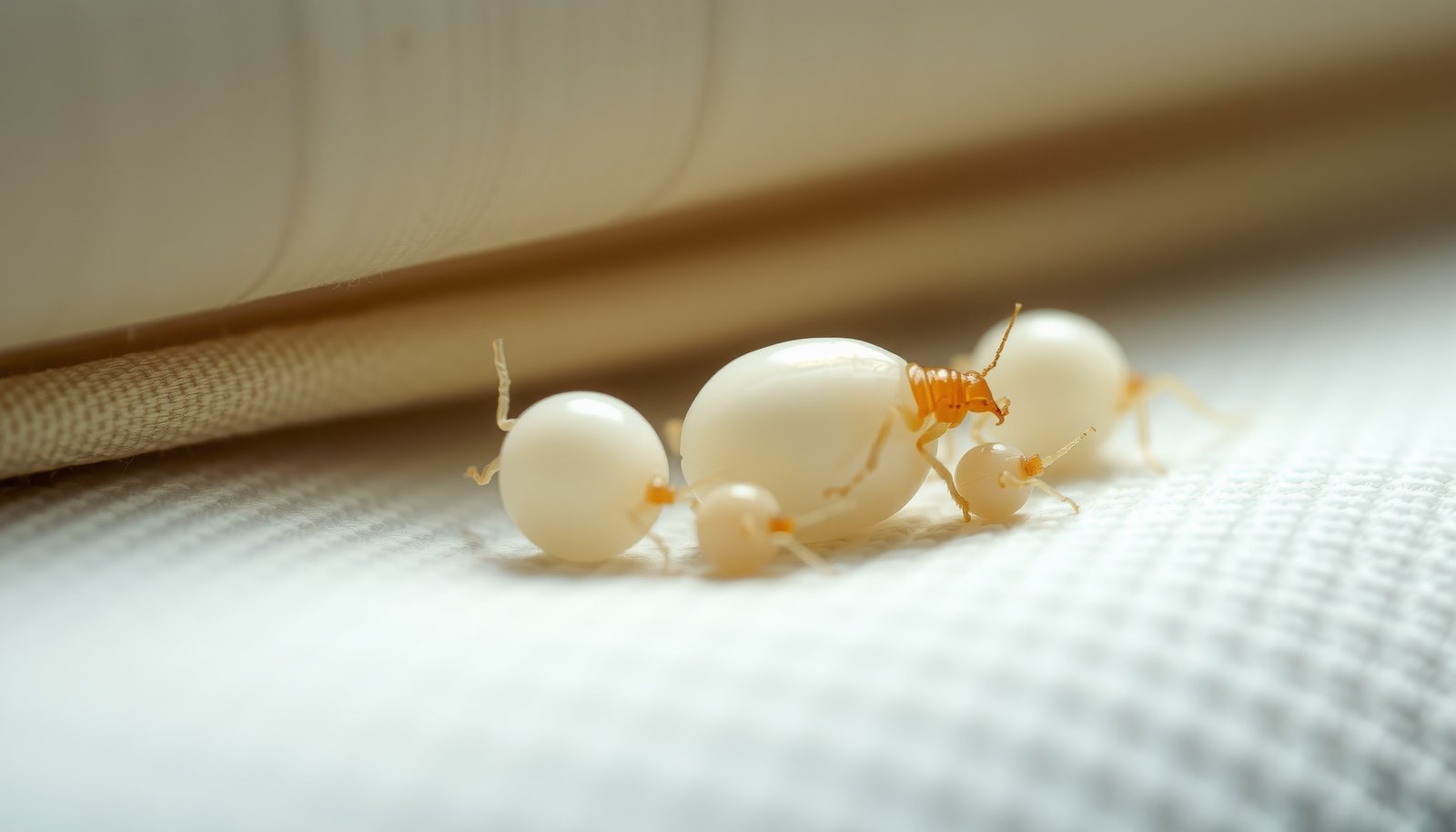
This close-up shows the critical difference between an intact egg (still viable) and a hatched shell with its split cap — distinguishing these two tells you whether your infestation is actively breeding or simply established, which matters enormously when choosing a treatment approach.
What Do Bed Bug Shells (Cast Skins) Look Like vs. Eggs?
This is where most people — and honestly, a lot of online guides — get confused. Bed bug shells aren’t the same thing as egg casings. A cast skin, or nymphal exoskeleton, is shed by the bed bug itself as it grows. Bed bugs go through five nymph stages before reaching adulthood, and they shed their skin at every single stage. That means one single bed bug produces five separate shells over its lifetime before it ever becomes an adult capable of reproducing.
Cast skins are hollow, translucent, and look like a perfectly preserved but empty bed bug — tan to yellowish-brown in color, with a visible body shape including legs and antennae. They’re larger than eggs, ranging from about 1.5 millimeters for early-stage nymphs to nearly 4–5 millimeters for the shells shed just before adulthood. Finding a mix of sizes tells you the infestation has been building for multiple generations. Finding only small shells means you may have caught it early.
| Evidence Type | Appearance | Size | What It Tells You |
|---|---|---|---|
| Fresh bed bug egg | White, glossy, barrel-shaped, intact | ~1 mm | Active breeding happening now |
| Hatched egg casing | Collapsed, split at one end, dull white | ~1 mm | Eggs hatched in past 6–10 days |
| Early nymph cast skin | Translucent, tan, tiny insect shape | 1.5–2 mm | Young infestation or early-stage nymphs present |
| Late nymph cast skin | Amber/brown, clearly bug-shaped, hollow | 3–5 mm | Infestation has been established for weeks or months |
Pro-Tip: Use a credit card to scrape gently along mattress seams into a white piece of paper. Shells and egg casings will fall out intact, making them dramatically easier to examine. A jeweler’s loupe or a 10x magnifying glass lets you see the split cap on hatched eggs clearly without needing a microscope.
Where Exactly on a Mattress Should You Be Looking?
Bed bugs don’t distribute themselves randomly. They cluster in spots where the distance between their hiding place and their food source — you — is shortest and most predictable. On a mattress, that means the seams along the head of the bed are almost always the first place to check, because that’s where your head and neck rest, and where body heat and carbon dioxide are most concentrated while you sleep.
Here’s the inspection order that actually works, starting from highest-probability to lowest:
- Top seam along the headboard edge — the single most common egg and shell deposit site; check every inch of the stitching with a flashlight held at a low angle to create shadows that reveal tiny objects.
- Side seams running the length of the mattress — especially the seam facing the wall or the side you sleep on most; eggs and shells tend to concentrate on the side closest to where you habitually position your body.
- Tufts and buttons — the recessed fabric around decorative buttons creates protected cavities that bed bugs favor; press down on each tuft and look in the crease beneath it.
- Bottom seam where the mattress meets the box spring — often overlooked because it requires lifting the mattress, but this junction is a high-traffic zone for bugs moving between sleeping surfaces.
- Any rips, tears, or loose fabric panels — bed bugs exploit any opening into the interior of a mattress; even a small seam split can harbor hundreds of eggs and dozens of shells inside the mattress padding itself.
One thing that surprises people: a mattress that looks clean on top can have a heavily colonized underside. Flipping your mattress completely and inspecting the bottom surface — especially if you’ve never done it — sometimes reveals evidence that’s been accumulating unseen for months.
Can You Tell How Bad the Infestation Is Just From Eggs and Shells?
Yes — with some important caveats depending on your bedroom layout, how long the mattress has been in place, and whether you’ve vacuumed the seams at any point. A single cluster of 5 or 6 eggs with no shells nearby suggests a very early infestation where a recently-fed female laid her first batch. A combination of multiple egg clusters, hatched casings, and shells in several size ranges tells a different story entirely: the infestation has been through at least two reproductive cycles and likely contains multiple generations of bugs.
Picture this: you pull back your mattress topper for the first time in months and find a long dark smear along the head seam — that’s fecal spotting — plus what looks like scattered dandruff mixed with tiny tan husks. That’s not a minor problem. A female bed bug lays between 200 and 500 eggs over her lifetime, depositing 1 to 5 per day in clusters along seams and crevices. If you’re seeing cast skins across multiple size ranges simultaneously, the math on population size gets uncomfortable fast. A colony that’s been established for 8 to 12 weeks can easily number in the hundreds, even in a single bedroom.
“Cast skins are actually more diagnostic than live bugs for severity assessment. One adult female can produce 5 generations of shed skins before she even starts reproducing — so a handful of shells found in a seam represents far more population activity than most homeowners realize. The mix of shell sizes is like a timeline of the infestation.”
Dr. Patricia Harmon, Board-Certified Entomologist and Urban Pest Management Consultant, Pennsylvania State University Extension
Honest nuance here: severity assessment from shells alone is harder in humid climates or older homes where cast skins can deteriorate more quickly, making it look like less evidence than actually exists. Dry, climate-controlled bedrooms tend to preserve shells for months. A hot, humid room in a coastal area may cause the same shells to break down within weeks. So if you’re in a high-humidity environment and finding only fragments, don’t assume you’re dealing with a small problem.
What to Do Once You’ve Confirmed Eggs or Shells on Your Mattress Seams
Finding eggs or shells confirms one thing with certainty: bed bugs have been using your mattress as a harborage site. The question that follows isn’t “do I have bed bugs?” — you’ve answered that. The question is how established the infestation is and whether the mattress itself is salvageable. A mattress that has eggs deep inside torn seams or within the interior padding is extremely difficult to treat effectively through topical sprays alone, and encasing an actively infested mattress just traps the problem inside with you.
Here’s what your next steps should look like, based on what the evidence tells you:
- Early evidence only (a few intact eggs, no cast skins): The mattress may be treatable. A high-quality mattress encasement that’s bed-bug-rated and fully zippered will trap any hatching nymphs inside and prevent re-colonization from outside. Pair it with targeted treatment of the surrounding bed frame, headboard, and baseboards.
- Mixed evidence (eggs plus shells in multiple sizes): You’re dealing with an established infestation. This almost certainly extends beyond the mattress into the box spring, bed frame joints, and possibly nearby furniture. Don’t buy a new mattress until the room itself is treated — you’ll just re-infest it within days.
- Heavy evidence (dense clusters, multiple shell sizes, dark fecal staining through mattress fabric): Seriously consider discarding the mattress. Bag it completely before moving it through your home, and mark it clearly so no one else brings it inside. Replace it only after professional treatment has been verified as successful.
- Eggs found inside mattress through a rip or open seam: Interior infestation makes surface-spray treatments ineffective. Heat treatment is the only reliable option for penetrating into mattress interiors — you can read a full breakdown of whether heat treatment for bed bugs is worth the cost compared to chemical options before deciding which direction to go.
- Apartment or rental situation: Document every piece of evidence photographically before touching anything. Landlords who minimize or ignore documented bed bug evidence face real legal exposure — similar to situations where a landlord paints over a roach problem instead of actually treating it, cosmetic responses to documented infestations rarely hold up legally.
One counterintuitive thing worth knowing: adult bed bugs can survive over 300 days without feeding under the right temperature conditions. That means even if you’ve been away from home for months, any eggs that hatched before you left may have produced nymphs that are still alive and waiting when you return. Shells don’t decay quickly either. Evidence you find today could represent activity that started long before you ever noticed a bite.
The goal of inspecting for bed bug eggs and shells on mattress seams isn’t just to confirm an infestation exists — it’s to read the biology of what’s happening so you can respond proportionally and intelligently. A few fresh eggs caught early is a very different situation from a multi-generational colony that’s been expanding for months. The evidence in your seams will tell you which one you’re dealing with, if you know how to read it.
Frequently Asked Questions
What do bed bug eggs and shells look like on mattress seams?
Bed bug eggs are tiny, about 1mm long, pearl-white, and shaped like a grain of rice — they’re often found tucked into mattress seams in small clusters. Shed shells, called exoskeletons or casings, look like hollow, translucent versions of the bug itself and stay behind after nymphs molt. Both are easy to miss without a flashlight and magnifying glass, so take your time inspecting every fold and piping along the mattress edge.
How do I tell the difference between bed bug eggs and mattress lint or debris?
Bed bug eggs have a distinct oval shape and a slightly sticky surface that causes them to cling to fabric fibers — random lint and debris won’t have that consistent shape or that sticky, almost glued-down feel. If you press a bed bug egg with a credit card edge, it won’t flake or crumble the way dust or lint does. A loupe magnifier or even your phone’s camera zoomed in can help you confirm the shape before you panic.
Can I have bed bug shells on my mattress without seeing live bugs?
Yes, and it’s actually pretty common — you can find shed shells on mattress seams even if you haven’t spotted a live bed bug yet. Nymphs molt 5 times before reaching adulthood, so a moderate infestation can leave behind a lot of casings before you ever see a moving bug. Finding 3 or more shells clustered in one seam area is a strong enough sign to start a full inspection of your bed frame, box spring, and nearby furniture.
Where exactly on the mattress should I check for bed bug eggs and shells?
Focus on the piping (the stitched border) along the top and bottom edges of the mattress first, since that’s where bed bugs prefer to hide and lay eggs. Also check any tufts, folds, or label tags on the surface, and don’t skip the corners where the seams intersect. If your mattress has a pillow-top layer, run a credit card along the seam line to dislodge anything hidden inside the gap.
Do bed bug eggs on mattress seams mean I need to throw out my mattress?
Not necessarily — throwing out the mattress is often unnecessary and can actually spread the infestation to other rooms if you’re not careful. A quality mattress encasement rated for bed bugs (look for ones labeled ‘bite-proof’ and tested to ASTM standards) can trap any remaining eggs and bugs inside, cutting off their ability to feed or escape. Combined with heat treatment or a licensed pest control treatment, most infested mattresses can be kept and effectively treated.