
Paint doesn’t kill roaches — it traps the ones you can see and does nothing about the thousands you can’t. That’s the part most renters don’t find out until the infestation comes back twice as bad, six weeks later, through a wall that now has a fresh coat of eggshell on it. If your landlord has responded to a cockroach complaint with a paint crew instead of a pest control company, you’re not dealing with a fix — you’re dealing with a cover-up, and the legal and practical consequences of that difference matter enormously.
Does Painting Over Cockroaches Actually Do Anything?
Here’s what painting actually does: it seals gaps in baseboards and wall joints — temporarily — and can entomb individual roaches that happen to be resting in a crack when the brush passes over. For roughly 48 to 72 hours after a fresh paint job, roach activity near the painted surface may appear to drop. Landlords sometimes present this as evidence that the “problem is handled.” It isn’t.
A German cockroach infestation — the most common apartment species in the U.S. — doesn’t live in one crack in one wall. A single breeding female produces 30 to 40 eggs per capsule, carrying four to six capsules in her lifetime. The colony lives inside wall voids, behind refrigerators, under dishwashers, inside electrical panels, and inside the hollow spaces of cabinet interiors. Paint touches none of those places. Within two to three weeks of a paint job, activity typically returns to pre-treatment levels or higher, because nothing that drives population growth has changed.

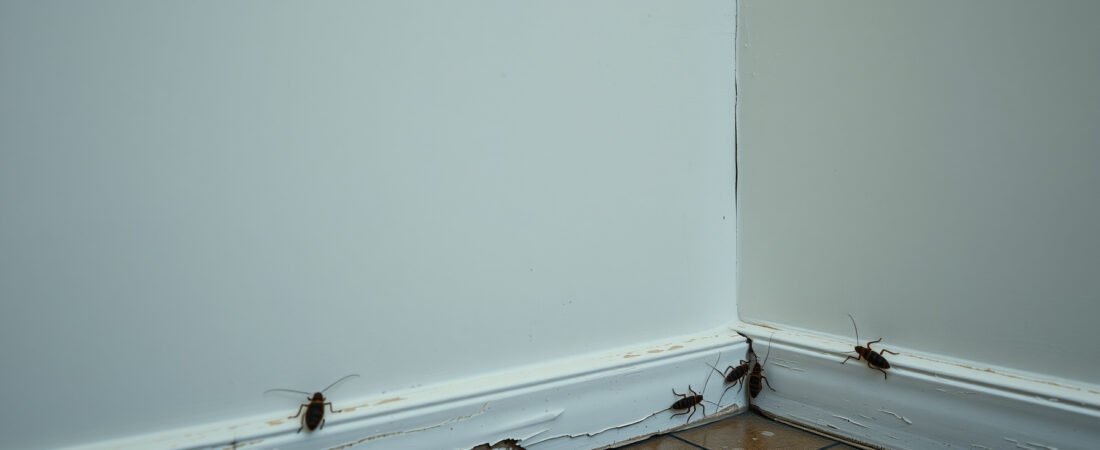
This close-up shows roach activity concentrated in the gap between a baseboard and drywall — exactly the kind of harborage a fresh coat of paint conceals without disturbing, making it nearly impossible for a tenant (or a judge) to assess the true scale of an infestation after the fact.
Why Landlords Do This — and Why It’s More Calculated Than You Think
The counterintuitive reality here is that painting over a pest problem isn’t always ignorance — it’s sometimes a deliberate delay strategy. Picture this: a tenant documents roaches and sends a written complaint. The landlord has a legal clock ticking, typically 14 to 30 days to remediate under most state habitability codes. Sending a painter costs $200 and creates a paper trail that says “corrective action was taken.” Hiring a licensed pest control company for a multi-unit German cockroach infestation can run $400 to $1,500 or more per treatment cycle, often requiring two to three visits.
The strategy works against tenants who don’t know what legitimate treatment looks like. If you accept the paint job as a response without pushing back in writing, you’ve potentially reset your complaint timeline in your landlord’s favor. Some property managers bank on tenants not following up — and statistically, many don’t. The ones who do follow up with documented, written demands are the ones who end up with actual remediation or a strong legal case when they don’t get it.
“Cosmetic remediation — painting, caulking over visible roach activity without baiting or treating harborage sites — doesn’t just fail to solve the problem. It can actually delay effective treatment by creating a false record of landlord responsiveness. Tenants who receive a paint job as a pest response should document it immediately and demand a written pest control service report from a licensed operator within the same notice window.”
Dr. Marcus Ellroy, Board-Certified Entomologist and Urban Pest Management Consultant, formerly with the University of Florida Extension Program
What Legitimate Cockroach Treatment Actually Looks Like
Knowing what real treatment involves is the fastest way to recognize when you’re not getting it. A licensed pest control professional treating a cockroach infestation will do several things a painter simply cannot. The approach varies by severity and building type, but the core elements are consistent.
- Inspection of harborage sites — A technician checks behind appliances, inside wall voids via outlet covers, under sinks, and along pipe chases. This takes 20 to 45 minutes in a single unit.
- Gel bait placement — Professional-grade gel baits like Advion or Maxforce are applied in small dots inside cabinets, along hinges, and near harborage areas — not in open spaces where tenants would see them. They work because roaches carry the bait back to the colony.
- Insect growth regulator (IGR) application — IGRs disrupt the roach reproductive cycle, preventing nymphs from reaching reproductive maturity. This is a critical second layer that gel bait alone doesn’t provide.
- Void treatments — Dust formulations (typically boric acid or diatomaceous earth) are injected into wall voids through electrical outlets and switch plates to reach roaches living inside the structure.
- Follow-up inspection at 2 to 3 weeks — Because egg capsules (oothecae) can survive an initial treatment and hatch afterward, a second visit is standard practice and required for lasting results.
- Written service report — A licensed pest control company is required in most states to provide a written report detailing chemicals used, application sites, and recommended follow-up. If your landlord can’t produce this document, treatment didn’t happen.
That written service report is the single most useful document you can demand. It’s not just useful for your own records — it’s admissible evidence in housing court and small claims proceedings. A paint invoice proves a painter came. It proves nothing about pest control.
What Are Your Legal Rights When a Landlord Substitutes Cosmetic Fixes for Pest Treatment?
Every U.S. state recognizes an implied warranty of habitability — the legal doctrine that a rental unit must meet basic livability standards. Cockroach infestations, particularly persistent ones that a tenant has reported in writing, consistently fall under habitability violations in housing court. The key word is “persistent”: a landlord who documents a single roach complaint and sends a painter has a much stronger defense than one who has received three written complaints over 90 days and still hasn’t produced a pest control service report.
Your response options vary by state, and severity matters. Here’s a realistic breakdown of the remedies typically available to tenants:
- Repair and deduct — Available in most states. You hire a licensed pest control company yourself and deduct the cost from rent, provided you’ve given written notice and a reasonable cure period (usually 14 to 30 days).
- Rent withholding — Allowed in some states when conditions are severe enough to constitute a substantial habitability breach. Typically requires placing withheld rent in escrow, not simply stopping payment.
- Rent reduction (rent abatement) — In some jurisdictions, you can petition for reduced rent reflecting the diminished value of a unit with an unresolved pest infestation.
- Code enforcement complaint — Reporting to your local housing authority triggers an official inspection. A citation against the landlord creates a third-party record that strengthens any subsequent legal action.
- Constructive eviction — In extreme cases, when conditions are severe enough that the unit is genuinely uninhabitable, some tenants successfully argue constructive eviction and terminate their lease without penalty.
One thing renters frequently get wrong: they assume the landlord’s response — any response — satisfies the legal obligation. It doesn’t. The obligation is to remediate the condition, not just to do something visible. A paint job that doesn’t address the infestation leaves the habitability violation legally open, even if the landlord argues otherwise.
Pro-Tip: Before withholding rent or using repair-and-deduct, send your landlord a written notice via certified mail (or email with read receipt) that explicitly states: “The painting completed on [date] did not constitute pest control treatment. I am requesting documented pest control services from a licensed operator within [your state’s required notice period]. I am retaining the right to pursue available remedies if this is not completed.” This language matters in court. Vague complaints carry less weight than specific, documented demands tied to your state’s habitability code.
How to Document the Situation in a Way That Actually Holds Up
Documentation is the part tenants consistently underdo — and it’s the part that determines whether a housing complaint becomes a legal win or a frustrating dead end. The good news is that documenting a cockroach infestation after a cosmetic-only response is entirely within reach, even for people with no legal background. The goal is to create a clear timeline that a third party — a housing inspector, a judge, a mediator — can follow without relying solely on your word.
| Document | What It Proves | How to Get It |
|---|---|---|
| Dated photos/video of roach activity | Infestation existed and was visible after the landlord’s response | Your phone — timestamp matters, email them to yourself immediately |
| Written complaint to landlord (certified mail or email) | Landlord had notice of the problem and your specific request | Write it yourself, send via email or certified USPS mail |
| Landlord’s written response (or paint invoice) | What remediation landlord claims to have performed | Request in writing; keep all replies |
| Licensed pest control service report | Whether actual professional treatment occurred | Demand from landlord in writing; hire your own company if needed for an inspection report |
One underrated move: hire a licensed pest control company to do an inspection — not treatment — and get their written assessment. A one-page report from a licensed operator stating that the unit shows active cockroach infestation with no evidence of professional treatment is one of the most useful documents you can have. It typically costs $75 to $150 and carries far more evidentiary weight than photos alone. Some pest control companies offer free inspections, which is worth asking about.
There’s also a less obvious reason to document aggressively early: if you eventually move out and seek to recover your security deposit, or if you’re ever accused of causing the infestation yourself, a clear timeline showing you reported the problem before the landlord’s cosmetic response is the difference between a strong claim and a “he said, she said” situation. Don’t wait until things escalate to start building that record.
It’s worth noting that some landlords genuinely don’t understand that painting isn’t pest control — particularly smaller independent landlords managing a property or two without professional property management support. That doesn’t excuse the failure to remediate, but it does mean a firm, specific written demand (citing “licensed pest control” and “written service documentation”) sometimes produces actual treatment faster than immediately escalating to housing court. Read the situation. If the landlord is unresponsive or retaliatory, escalate. If they’re just uninformed, a pointed written request sometimes resolves it in days. Just as pest control approaches vary — the way heat treatment works differently than chemical treatment for bed bugs is a useful parallel — what works depends on the specific conditions you’re dealing with.
And a quick word on gadgets: if you’ve seen ads for ultrasonic devices that promise to drive roaches away, you should know those don’t work for cockroach infestations either — the science on ultrasonic pest repellers is pretty clear on this. No landlord substitution for real treatment, whether it’s paint or plug-in devices, changes the underlying biology of a cockroach colony.
The underlying reality of a cockroach infestation is that it’s a building problem, not a unit problem. German cockroaches travel through shared plumbing chases and wall voids between apartments. A single unit treatment — even a legitimate one — often fails if adjacent units aren’t treated simultaneously. This is something your landlord should be coordinating, and if they’re not, it’s worth raising explicitly in your written complaint. Effective remediation in a multi-unit building usually requires inspecting and treating all connected units, not just applying gel bait to the unit where someone complained loudest.
Ultimately, the moment you recognize that paint was the response to a pest problem, your best move is to act quickly and in writing. The legal window matters. Most state habitability remedies require that you’ve given proper notice before taking action — and that notice clock starts from when the landlord received your complaint, not from when you decided to do something about it. Don’t let the paint dry on your timeline.
Frequently Asked Questions
can a landlord paint over roaches instead of exterminating them?
Technically a landlord can apply paint over a roach-infested area, but it doesn’t kill the infestation — it just temporarily traps some roaches in the wall void or crack. Most states require landlords to maintain habitable conditions under the implied warranty of habitability, which means treating active pest infestations, not concealing them. Painting over roaches without proper extermination could actually be considered a deceptive practice in some jurisdictions.
do roaches survive being painted over?
Yes, most roaches survive being painted over because paint doesn’t penetrate deep enough into wall voids, cracks, or gaps where colonies actually live. A single female German cockroach can produce up to 300 offspring in her lifetime, so even if a few roaches get trapped, the rest of the colony keeps breeding. You might not see them immediately after painting, but they’ll resurface within days or weeks.
what are my rights if my landlord hides a roach infestation?
If your landlord concealed a roach infestation rather than treating it, you may have grounds to withhold rent, break your lease without penalty, or sue for damages depending on your state’s tenant protection laws. Document everything — take photos and videos with timestamps, send complaints in writing via email or certified mail, and report the issue to your local housing code enforcement office. Some states allow tenants to pursue rent escrow or repair-and-deduct remedies when landlords fail to address pest infestations.
how can you tell if roaches were painted over in an apartment?
Look for uneven, bumpy, or discolored patches on baseboards, walls, and inside cabinet corners — these are common signs that something was painted over rather than properly repaired or treated. You might also notice a faint musty or oily odor, which is the pheromone scent cockroaches leave behind even through paint. Check behind appliances, under sinks, and along plumbing pipes, since roaches rarely stay confined to one painted spot.
will painting walls get rid of roaches?
No, painting walls won’t get rid of roaches — it’s not a pest control method and has zero effect on an active infestation. Roaches live inside walls, under floors, and behind appliances, so surface paint doesn’t reach them. Effective roach treatment typically requires a combination of gel bait, insect growth regulators, and professional extermination, especially for German cockroaches which are the most common apartment species.
Disclaimer: This article is for general informational purposes only and does not constitute legal advice. Landlord-tenant laws and pest-related disclosure or habitability requirements vary significantly by state and even by city, and they change over time. Before withholding rent, breaking a lease, or taking other legal action over a pest infestation, consult a licensed attorney or your local tenant rights organization familiar with the laws in your area.