
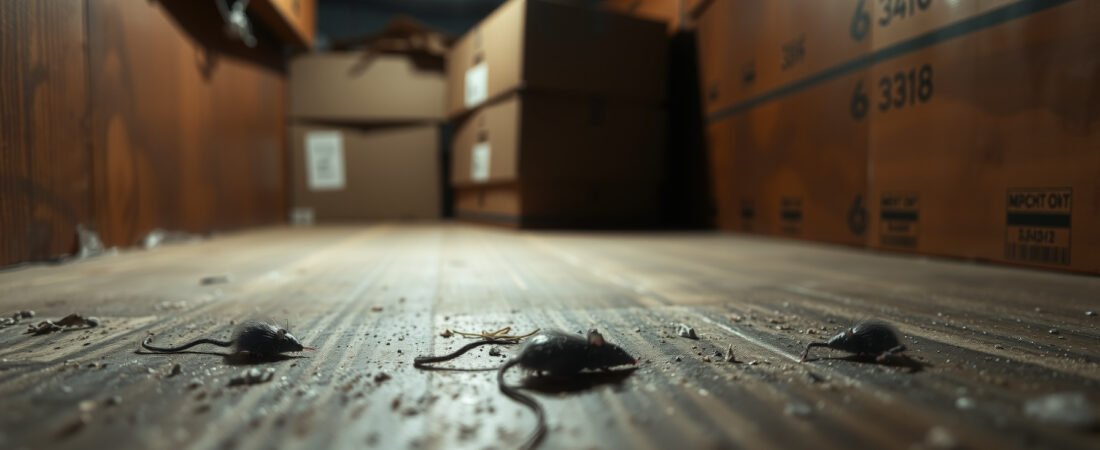
The size difference between mouse and rat droppings is only about a quarter of an inch — and getting that wrong could cost you weeks of chasing the wrong animal with the wrong traps. That’s the part most articles gloss over. They give you the measurements, maybe a photo, and call it done. But the real problem isn’t identifying the droppings in isolation. It’s that homeowners routinely misread age, quantity, and location of droppings — and those three things tell you far more about what you’re dealing with than shape alone ever will.
Mouse Droppings vs Rat Droppings: The Key Visual Differences
Mouse droppings are small — roughly 1/8 to 1/4 inch long — with pointed ends, and they look a bit like dark grains of rice. Rat droppings are noticeably larger, typically 1/2 to 3/4 inch, with blunt or rounded ends depending on the species. Norway rat droppings are capsule-shaped with blunt tips, while roof rat droppings are more elongated and slightly curved, almost banana-shaped in miniature.
Color can shift from nearly black when fresh to a dull gray-brown as they age and dry out — which matters a lot when you’re trying to figure out whether you have an active infestation or just remnants of one. Both mouse and rat droppings share that same darkening-to-gray progression, so color alone doesn’t help you tell them apart. Rely on size and shape first, every time.

This close-up comparison shows the size and shape difference between mouse and rat droppings side by side — a reference that’s hard to fully appreciate until you see both next to a common object like a penny or a grain of rice.
Why Fresh vs Old Droppings Matter More Than Most People Realize
Here’s the thing almost no pest control article explains clearly: finding droppings doesn’t confirm you have an active infestation right now. Rodent droppings can persist for months in undisturbed areas — behind appliances, inside wall voids, under insulation — long after the animal is gone. Treating old evidence as proof of a current problem leads people to set traps in the wrong spots and then wonder why they’re not catching anything.
Fresh droppings are soft and dark, almost moist-looking, and will smear if you press them with something (don’t use your bare hand — always use gloves). Droppings that are more than 48 to 72 hours old become hard, dry, and crumble when disturbed. If you’re unsure how old the droppings are, do this: put on gloves, clear the area completely, and come back in 24 hours. New droppings in the same spot confirm active rodent movement. No new droppings after 24–48 hours? You may be dealing with an old intrusion rather than a live one.
Pro-Tip: Before setting any traps, do a 24-hour “clearing test” — remove or mark all visible droppings in the suspected area and photograph it. Check back the next day. New droppings tell you exactly where the rodent is actively traveling, which is exactly where your trap should go.
How to Tell Mouse Droppings From Rat Droppings at a Glance
A quick comparison table goes a long way here, because the differences are specific enough that you can rule one out fairly confidently once you know what to measure.
| Feature | Mouse Droppings | Rat Droppings (Norway) | Rat Droppings (Roof Rat) |
|---|---|---|---|
| Length | 1/8 – 1/4 inch | 1/2 – 3/4 inch | 1/2 – 5/8 inch |
| Shape | Thin, pointed both ends | Blunt, capsule-shaped | Slightly curved, tapered |
| Color (fresh) | Dark brown to black | Dark brown to black | Dark brown to black |
| Color (old) | Gray, chalky | Gray, crumbly | Gray, crumbly |
The overlap in color is worth repeating: fresh droppings from both species look nearly identical in hue. Size is your most reliable field indicator. If you’re finding droppings and they’re under 1/4 inch with pointed tips, you’re almost certainly dealing with mice. Anything over 1/2 inch with rounded ends points strongly toward rats — and that distinction changes your entire control strategy, from trap type to bait station sizing.
What the Location of Droppings Tells You About the Species
Picture this: you pull your stove away from the wall and find a scatter of small dark pellets across the floor behind it, plus a dense cluster near the back corner where the wall meets the baseboard. That pattern — scattered movement droppings with a concentrated cluster at a resting spot — is classic mouse behavior. Mice are curious and exploratory by nature, moving constantly along walls and checking new objects obsessively. A single mouse produces between 50 and 75 droppings per day, so even one animal can make an infestation look far more severe than it is.
Rats behave differently. Norway rats tend to burrow and stay lower — under concrete slabs, along foundation walls, in crawl spaces — so their droppings show up near ground level, along travel paths close to walls and behind heavy appliances. Roof rats, as the name suggests, travel high: attic spaces, rafters, along the tops of pipes. Finding droppings up in the attic or near the ceiling line of a garage strongly points to roof rats rather than mice, even if the size seems ambiguous. Location context is often what resolves the ID when size alone doesn’t quite clinch it.
“One of the most common mistakes I see is homeowners assuming volume of droppings equals number of rodents. A single mouse can produce droppings that fill a drawer liner overnight. The better question isn’t ‘how many droppings’ — it’s ‘where exactly are they concentrated, and are they fresh?’ That tells you far more about what you’re dealing with and where to act.”
Dr. Marcus Ellery, Board-Certified Entomologist and Urban Pest Management Specialist, NPMA member
What Else Looks Like Rodent Droppings (And How to Rule It Out)
Not everything that looks like a mouse dropping is one — and misidentifying the source can send you down a completely unproductive path. Cockroach droppings from larger species like American cockroaches can look remarkably similar to mouse droppings, though they tend to have ridges running lengthwise and blunt ends. Bat droppings (guano) are often found in attic spaces and resemble mouse droppings in size, but they crumble easily into a glittery powder because bats eat insects — the wing fragments are visible under magnification. Squirrel droppings are a bit larger than mouse droppings and barrel-shaped, often found in attics and garages.
Here’s a quick checklist to help rule out the wrong pest before you buy traps:
- Ridges or segmentation on the sides → likely cockroach, not rodent
- Crumbles to glittery powder when touched → almost certainly bat guano
- Barrel-shaped and larger than 1/4 inch → consider squirrel, especially in attics
- Concentrated in a line along a wall edge with no scatter → rodent travel path (mouse or rat depending on size)
- Found only in high areas — rafters, top of walls, upper shelving → roof rat or bat, rarely mice
- Soft, dark, and found near food prep surfaces → rodent droppings should be treated as a health hazard regardless of species
The health angle here isn’t a scare tactic — it’s practical. Both mouse and rat droppings can carry hantavirus, salmonella, and leptospirosis. Never sweep or vacuum droppings dry, which aerosolizes particles. Always spray the area with a disinfectant solution first, let it soak for five minutes, then wipe with paper towels and dispose of everything in a sealed bag. That’s the CDC-recommended approach, and it applies equally whether you’re dealing with a mouse or a rat.
What to Do After You’ve Correctly Identified the Droppings
Once you’ve confirmed the species — mouse vs. rat — your next steps branch pretty sharply. For mice, snap traps placed perpendicular to the wall (trigger end touching the wall) within 2 feet of active dropping sites are your most effective starting point. Mice rarely travel more than 10–30 feet from their nesting area, so if you’re finding droppings in the kitchen, the nest is almost certainly within that radius. Set a minimum of 6 traps for a single mouse, more if you’re seeing widespread evidence, because mice are neophilic — attracted to new objects in their environment — which actually works in your favor with traps.
Rats are more cautious. Norway rats in particular are neophobic — genuinely afraid of new objects placed in their territory — and won’t approach a freshly set trap for several days. Experienced pest professionals often place unset traps for 3–5 days first, letting rats get comfortable with the object before setting the trigger. That’s a detail almost no homeowner knows, and it explains why many DIY rat control attempts seem to fail despite good trap placement. If your infestation is significant, or you’re a renter and your landlord isn’t responding to the problem, knowing what to do if your landlord ignores a pest problem can make a real difference in getting it addressed properly.
Here’s a step-by-step approach for after you’ve confirmed active droppings:
- Identify the species first using size, shape, and location of droppings — don’t skip this step even if you’re in a hurry to set traps.
- Map the activity zone by clearing all droppings and checking for fresh ones after 24 hours to pinpoint active travel paths.
- Find and seal entry points before or simultaneously with trapping — mice can squeeze through a gap as small as 1/4 inch, rats through a hole the size of a quarter. If you don’t close the door, you’re just trapping an endless supply.
- Place traps correctly for the species — perpendicular to walls for mice, set-and-wait unset for rats initially.
- Check traps every 24 hours — a dead rodent left in a trap quickly becomes a deterrent to other rodents, and decomposition creates a secondary pest problem.
- Consider a professional inspection if you can’t locate the entry point or the dropping activity doesn’t decrease within two weeks. A pest inspection can identify harborage areas and entry points that aren’t visible without professional tools and training.
One honest nuance worth naming: the difficulty of DIY rodent control varies significantly by building type and construction era. A newer home with tight construction and few utility penetrations is genuinely manageable with good trapping and sealing. An older home — pre-1970s construction, stone foundations, aging pipe chases — can have dozens of potential entry points that no amount of trapping will solve on its own. If you’re in the latter situation, setting traps without addressing the structure is like bailing a leaking boat with a cup. The biology of the rodent matters, but so does the building it’s living in.
Getting the ID right from the start — mouse or rat, fresh or old, active or remnant — is what separates a pest problem you solve in two weeks from one that drags on for months. The droppings aren’t just evidence of a problem. Read them correctly, and they’re essentially a map to fixing it.
Frequently Asked Questions
What do mouse droppings look like vs rat droppings?
Mouse droppings are small, dark, and pointed at both ends — about 1/8 to 1/4 inch long, roughly the size of a grain of rice. Rat droppings are noticeably larger, around 1/2 to 3/4 inch long, and tend to have blunt or rounded ends depending on the species. If you’re finding droppings smaller than a pencil eraser, you’re almost certainly dealing with mice.
how many droppings do mice leave per day?
A single mouse can leave between 50 and 75 droppings per day, which is why an infestation can look much worse than the actual number of mice involved. Rats produce fewer droppings — roughly 40 to 50 per day — but they’re much larger and harder to miss. Finding a heavy concentration of small droppings in one spot usually means a nesting area is nearby.
are mouse droppings dangerous to touch?
Yes — you should never touch mouse or rat droppings with bare hands. Rodent droppings can carry hantavirus, salmonella, and leptospirosis, all of which can make you seriously sick. Always wear disposable gloves and a dust mask when cleaning them up, and never vacuum fresh droppings since that can send particles into the air.
how do I know if droppings are old or fresh?
Fresh droppings are dark brown or black and have a shiny, moist appearance. After 48 to 72 hours they start to dry out, turning gray and crumbly. If you’re not sure whether you have an active infestation, clean the area completely and check back in 24 hours — new droppings confirm rodents are still present.
what do rat droppings look like compared to cockroach droppings?
Rat droppings are much larger than cockroach droppings — rat feces typically measure 1/2 inch or more, while cockroach droppings from large species look like small dark cylinders about 1/8 inch long with ridged sides. Small cockroach droppings look more like black pepper or coffee grounds. Shape and size together are usually enough to tell them apart without any guesswork.