
Carpet beetle larvae are not worms. That single misidentification is responsible for thousands of homeowners treating the wrong pest, buying the wrong products, and watching the damage spread while they wonder why nothing is working. They’re small, hairy, slow-moving, and they live in places most people never think to check — which is exactly why they’re so destructive before anyone notices them.
What Do Carpet Beetle Larvae Actually Look Like Up Close?
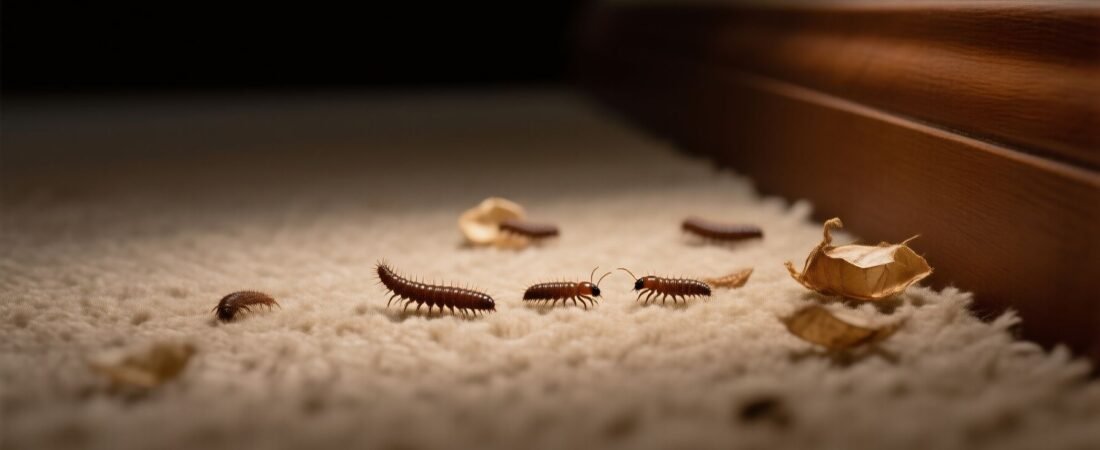
Carpet beetle larvae are oval to elongated in shape, typically between 1/8 and 1/4 inch long, with a distinctly banded pattern of alternating light and dark brown stripes running across their body. The most identifying feature is the dense covering of bristly hairs — called setae — that stick out from their body, often forming a tuft at the tail end that’s longer and more prominent than the rest. These hairs aren’t decorative; they’re a defense mechanism, and in sensitive individuals, they can cause skin irritation or a rash that gets mistaken for a flea bite or allergic reaction.
The color varies slightly by species — varied carpet beetle larvae tend to be more mottled brown and tan, while black carpet beetle larvae are darker overall, sometimes appearing nearly chestnut brown with a shiny sheen at the head. All species share that carrot-like or teardrop body shape: wider at the tail, narrower at the head. They move slowly and deliberately, which is why you’re more likely to spot them on a surface than in motion — they tend to hold still when disturbed rather than scatter.
This image shows the distinctive banded patterning and protruding setae (bristle hairs) of a carpet beetle larva on a textile surface — the hairs are the single most reliable visual feature to confirm you’re not looking at something else entirely.
Why Are Carpet Beetle Larvae So Often Mistaken for Something Else?
Here’s the misidentification that causes the most damage: homeowners see a tiny hairy larva and immediately think “moth larva,” then go treat their closet for clothes moths. Clothes moth larvae are smooth, pale white, and caterpillar-like — no hairs, no banding, completely different animal. Treating for the wrong pest means the carpet beetles continue feeding undisturbed, sometimes for a full season before anyone figures it out. By then, damage to wool rugs, taxidermy, stored clothing, or upholstered furniture can be extensive.
Carpet beetle larvae are also regularly confused with bed bug nymphs (which are translucent and smooth), flea larvae (which are microscopic and white), and occasionally with psocids or booklice. The hairs are the giveaway — if what you’re looking at has visible bristles or a hairy tuft at the rear, you’re almost certainly looking at carpet beetle larvae, not any of those other pests. Picture this: you’re pulling a wool sweater from a storage box and you notice what looks like a tiny grain of rice with fuzz on it sitting in the fold. That’s not a moth larva. That’s a carpet beetle larva that’s been feeding on your sweater for weeks.
Where Do Carpet Beetle Larvae Hide — and Why Those Spots Make Sense?
Carpet beetle larvae don’t live where adults are found. Adult carpet beetles are small, round, patterned beetles that feed on pollen and are typically found near windows, on flowers, or on windowsills in spring. The larvae, by contrast, go dark — they actively avoid light and seek out undisturbed areas where natural fibers accumulate. Understanding this split behavior is the key to finding an infestation before it gets bad.
The most commonly missed hiding spots aren’t the obvious ones. Everyone checks the carpet edges and wool rugs, but carpet beetle larvae are equally at home in air duct openings where pet hair and lint collect, underneath rarely moved furniture, inside piano felt, in the stuffing of mounted animal specimens, and in stored collections of dried flowers or herbs. They’ve even been found living in insulation where dead insects had accumulated — feeding not on fibers at all, but on the dead bug material itself. That’s the counterintuitive fact most sources skip: carpet beetle larvae are scavengers of animal-based material broadly, not fiber specialists narrowly, which is why they turn up in places that seem to have nothing to do with carpet.
Pro-Tip: Check underneath the rubber seal on the bottom edge of baseboards and around heat registers — carpet beetle larvae are drawn to the warmth and the accumulated lint and pet hair that builds up in those dead zones. A flashlight and a credit card to peel back the seal can reveal an infestation you’d never find otherwise.
How Do You Tell Carpet Beetle Larvae Apart by Species?
There are four carpet beetle species that commonly infest US homes, and their larvae look similar enough to cause confusion but different enough that species ID matters — especially for understanding what materials are at risk. Getting the species right also helps explain why some rooms are hit harder than others.
| Species | Larva Color/Pattern | Distinctive Feature | Primary Food Source |
|---|---|---|---|
| Varied Carpet Beetle (Anthrenus verbasci) | Brown, tan, white banding | Alternating light/dark bands, rounded rear hair tuft | Wool, silk, feathers, dried plant material |
| Black Carpet Beetle (Attagenus unicolor) | Dark brown to reddish-brown | Elongated body, longer tail hairs, shinier head | Animal fibers, grain, dried food products |
| Furniture Carpet Beetle (Anthrenus flavipes) | Light/dark banding, similar to varied | Hairs equal length around body (no dominant tuft) | Upholstery padding, feathers, fur |
| Common Carpet Beetle (Anthrenus scrophulariae) | Dark brown, banded | Slightly more robust body shape than varied | Wool carpet, natural fiber rugs, taxidermy |
The black carpet beetle is worth singling out because its larvae are significantly more elongated — almost worm-like — compared to the stockier, more oval larvae of the Anthrenus species. This is why “tiny hairy worm” descriptions online can refer to very different-looking things depending on which species is in your home. Black carpet beetle larvae can reach nearly 1/2 inch long at maturity, which is nearly double the size of a mature varied carpet beetle larva.
What Signs Confirm Carpet Beetle Larvae — Even If You Haven’t Seen One?
One of the more frustrating things about carpet beetle larvae is that the damage they leave behind often gets blamed on something else entirely. Irregular patches of thinning fiber in a wool rug, small holes in a cashmere sweater that appear without explanation, or a gradual flattening of a natural bristle brush — these are all classic carpet beetle larval damage patterns. Unlike clothes moths, which leave silky webbing and frass behind, carpet beetle larvae leave almost nothing visible except the damage itself and shed skins.
Here’s what to look for when you suspect carpet beetle larvae but haven’t confirmed a sighting:
- Cast skins (exuviae): Larvae molt multiple times — up to 7 times over a development period of 9 months to 3 years depending on conditions. These hollow, brownish husks are often the first physical evidence found, usually tucked in dark corners or along baseboards.
- Irregular fiber damage: Larvae chew from the base of fibers, creating bald patches that look like wear but don’t follow foot traffic patterns. A worn spot in the center of a rug is probably traffic; a worn patch under a couch leg is probably larvae.
- Fecal pellets: Tiny, sand-like dark specks near damaged areas — easier to see on light-colored fabrics.
- Skin irritation in a specific area of the house: The bristle hairs from shed skins can cause itchy red welts that look remarkably like flea bites or a rash, often noticed in rooms where larvae are actively molting.
- Adult beetles near windows in spring: Finding small, round, patterned beetles (roughly 1/8 inch, with scales on their back) near a window in April or May means larvae are almost certainly already active indoors.
That last point is one that takes people by surprise. If you’re seeing adult carpet beetles on a windowsill, the damage is already being done somewhere in your home — adults don’t eat fabric, their larvae do, and those larvae have been feeding since the previous season. Just as a flea infestation in a house without pets can feel impossible to explain, finding carpet beetle larvae without any obvious source material is more common than most people expect, because the larvae can feed on accumulated lint, pet hair, and dead insects just as readily as on wool.
How Long Do Carpet Beetle Larvae Live — and Why That Changes Everything?
This is the part of the carpet beetle life cycle that genuinely shocks people: carpet beetle larvae can remain in the larval stage for anywhere from 9 months to 3 full years depending on temperature, humidity, and food availability. Most pest insects have larvae that mature in weeks. Carpet beetle larvae can be in your home, feeding slowly and incrementally, for longer than you’ve probably lived in your current apartment. That’s not hyperbole — a single larva at cold indoor temperatures with limited food can stretch its development cycle to nearly 36 months.
The number of times they molt during that period — anywhere from 5 to 11 instars — means there are multiple opportunities to find shed skins even when you can’t find a live larva. It also means that a “solved” infestation can resurface if even a few eggs or early-stage larvae were missed during treatment, because those survivors have years of development ahead of them. Honestly, carpet beetles are one of the few household pests where a single incomplete treatment genuinely does more harm than good, because it kills the visible larvae while the hidden ones continue undisturbed. The same way that ants in a clean kitchen aren’t a sign of a dirty home but of an overlooked entry point, carpet beetles in a well-maintained house aren’t a hygiene failure — they’re an identification and response problem.
- Egg stage (1–4 weeks): A female carpet beetle lays between 25 and 100 eggs near a food source. Eggs are white, tiny (under 0.5mm), and virtually impossible to spot without magnification.
- Early larval instars (months 1–6): Larvae are at their smallest and hardest to detect. Damage is minimal but they’re actively establishing in a food source.
- Middle larval instars (months 6–18): Most visible damage occurs here. Larvae are larger, molting frequently, and leaving behind detectable cast skins.
- Late larval instars (up to 36 months in cool conditions): Larvae seek out dark, undisturbed areas to continue development. Less mobile, harder to locate.
- Pupal stage (1–3 weeks): Pupa forms inside the final larval skin. No feeding occurs, but the pupa is still vulnerable to treatment.
- Adult emergence (spring): Adults live only 2–6 weeks, during which they mate and lay eggs — beginning the cycle again inside your home.
“Carpet beetle larvae are arguably the most underestimated fabric pest in the country, partly because the damage accumulates so slowly that people assume it’s wear and tear until something irreplaceable is already destroyed. The key to controlling them is recognizing that by the time you see one larva, you’re probably dealing with multiple overlapping generations — not a single isolated individual.”
Dr. Sandra Okafor, Board-Certified Entomologist and Textile Pest Specialist, University Extension Program
One honest nuance worth acknowledging: carpet beetle larval development timelines vary significantly depending on your region and home environment. A home in Arizona with consistent warmth will cycle through generations faster than a home in Minnesota where seasonal temperature drops slow larval metabolism considerably. This matters for timing your response — in warmer climates, you’re potentially dealing with new egg batches year-round rather than one annual cycle, which changes how aggressively you need to treat and monitor.
Knowing exactly what carpet beetle larvae look like — and understanding that they’re patient, slow, and often hiding somewhere you haven’t thought to look — is the difference between catching an infestation early and discovering it the hard way when you unfold a heirloom quilt or pull back a rug edge. Start with the shed skins, work backward to where the larvae are feeding, and don’t stop at the first one you find. There are almost certainly more.
Frequently Asked Questions
What do carpet beetle larvae look like?
Carpet beetle larvae are small, carrot-shaped worms that range from 1/8 to 1/4 inch long. They’re covered in bristly hairs or tufts and are usually tan, brown, or banded with light and dark stripes. Some species have longer hair tufts at the tail end that fan out like a tiny brush.
How do I tell carpet beetle larvae apart from bed bug larvae?
Carpet beetle larvae have visible body hairs and a worm-like shape, while bed bug nymphs are smooth, oval, and look like tiny versions of adult bed bugs. Bed bug nymphs are also nearly translucent when unfed and turn reddish after a blood meal — carpet beetle larvae never change color that way. If you’re seeing hairy, bristly worms near fabric or rugs, it’s almost certainly carpet beetle larvae.
Where are carpet beetle larvae usually found in a house?
You’ll most often find them in dark, undisturbed spots like under furniture, inside closets, along baseboards, or deep in carpet fibers. They also show up in stored wool, silk, or leather items, and sometimes in pantries where they feed on dried grains or spices. Check any area that doesn’t get regular foot traffic or vacuuming.
Are carpet beetle larvae harmful to humans?
Carpet beetle larvae don’t bite, but their bristly hairs can cause a skin rash or irritation that’s sometimes mistaken for bed bug bites. Some people are more sensitive than others — if you’re waking up with itchy red bumps near your neck or arms, check your pillowcase and mattress seams for shed larval skins. They’re not dangerous, but an infestation left untreated can destroy clothing, rugs, and upholstered furniture.
How do I get rid of carpet beetle larvae in my carpet?
Start by vacuuming thoroughly every 2 to 3 days, including along edges, under furniture, and inside closets. Wash any infested fabric items in hot water — at least 120°F — and dry on high heat for at least 30 minutes. For a heavier infestation, a boric acid powder applied along baseboards or a deltamethrin-based spray labeled for carpet beetles can knock down the population fast.