

There are four species of carpet beetles living in most American homes right now — and the one doing the most damage probably isn’t the one you’d recognize. That’s the part most identification guides skip entirely. They show you a single bug, label it “carpet beetle,” and move on. But the adults aren’t even the ones destroying your belongings. By the time you spot a grown carpet beetle crawling toward your window, the larvae have already been feeding on your wool rug, silk blouse, or taxidermy mount for weeks. Knowing what the adult looks like is step one. Knowing what the larva looks like — and where it hides — is what actually stops the damage.
What Do Adult Carpet Beetles Actually Look Like?
Adult carpet beetles are small — roughly 1/16 to 1/8 of an inch long, depending on species — and they’re frequently mistaken for ladybugs or tiny roly-poly beetles because of their rounded, compact shape. The four species you’re most likely to encounter in the U.S. are the varied carpet beetle, the black carpet beetle, the furniture carpet beetle, and the common carpet beetle. Each looks meaningfully different from the others, which is why generic descriptions fail homeowners trying to make a positive ID.
The varied carpet beetle (Anthrenus verbasci) has an irregular patchwork of white, brown, and yellowish scales across its back — almost like a tiny mosaic tile. The black carpet beetle (Attagenus unicolor) is exactly what it sounds like: shiny black or dark brown with brownish legs, no pattern, and a slightly more elongated body than the others. The furniture carpet beetle (Anthrenus flavipes) has a similar mottled pattern to the varied species but with more distinct orange or reddish markings mixed in. The common carpet beetle (Anthrenus scrophulariae) looks similar but has a bolder reddish-orange stripe running down its center. None of them look alarming. That’s a problem.
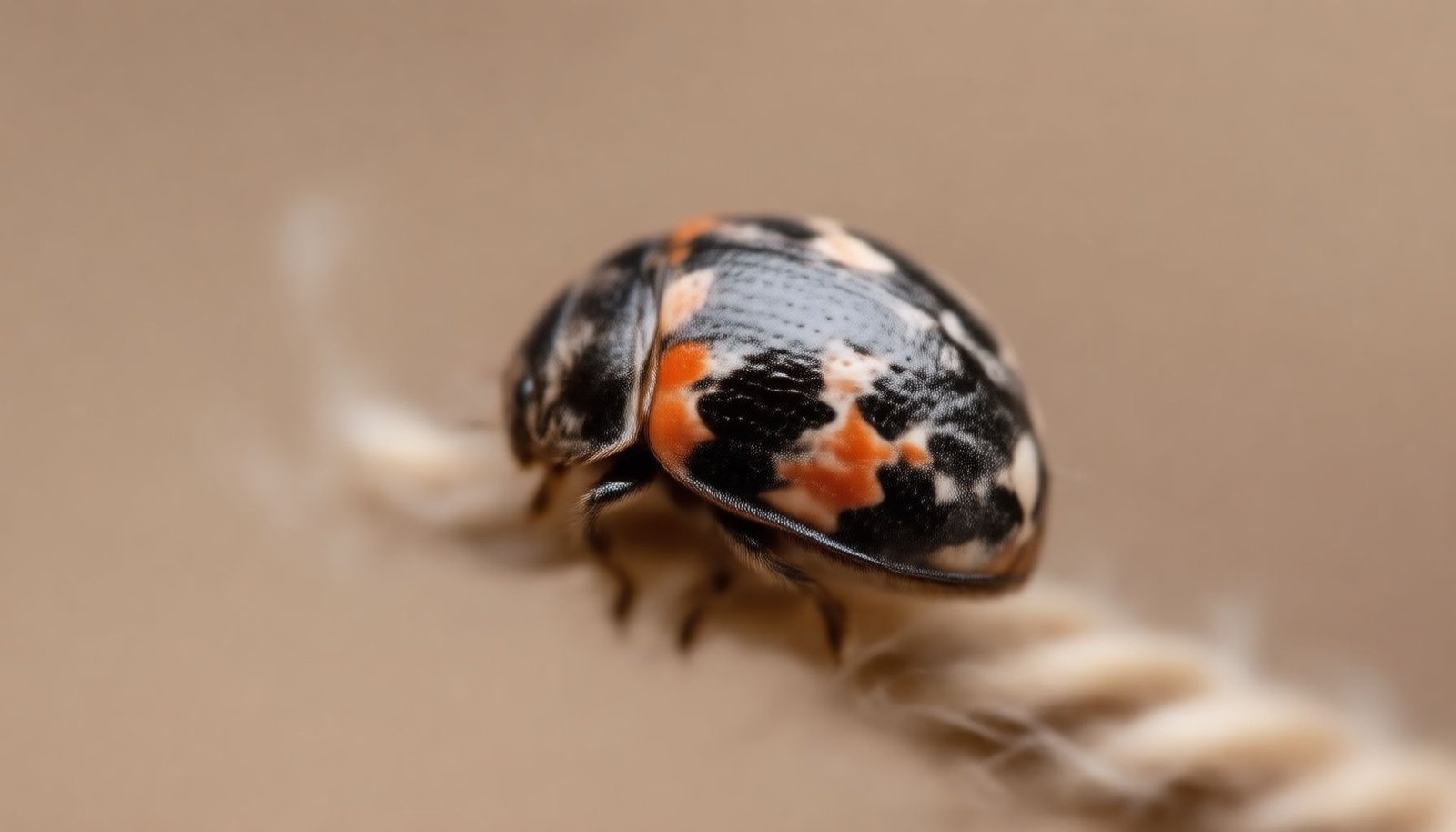
This close-up comparison shows the scale pattern differences between varied and furniture carpet beetles — two species that are often confused, but whose slightly different markings can tell you a lot about where in your home the infestation likely started.
What Do Carpet Beetle Larvae Look Like (And Why They’re the Real Problem)?
Here’s the thing that most homeowners get completely backwards: the adult carpet beetle doesn’t eat your stuff. Adults feed on pollen and nectar outdoors. They’re essentially just the delivery system — they fly inside through open windows or hitchhike in on cut flowers, and then they lay eggs in dark, undisturbed spots near protein-rich materials. The larvae are the destructive stage, and they look nothing like the adults.
Carpet beetle larvae are carrot-shaped, banded in alternating light and dark brown, and covered in stiff bristle-like hairs called setae. They range from about 1/8 to 1/4 inch long as they grow through multiple instars (molting stages), and they leave behind shed skins that look like tiny hollow husks — one of the most reliable signs of an active infestation. A larva from the black carpet beetle species tends to be longer and more tapered, with a distinctive tuft of hair at the tail end. Larvae from the Anthrenus species (varied, furniture, common) are more rounded and bristlier overall. Spotting cast skins in a corner of your closet is often the first real evidence you’ll find.
“Most people bring me a dead adult they found on a windowsill and assume that’s the infestation. I always tell them — that adult is the flag, not the problem. You need to find where the larvae are feeding, which is almost always somewhere dark, undisturbed, and full of natural fibers or dried organic material. The damage is already happening there.”
Dr. Sandra Kline, Urban Entomologist and University Extension Specialist, Pacific Northwest Research Station
Where Do Carpet Beetles Hide Inside Your Home?
Picture this: you’re doing a deep clean and you pull your grandmother’s wool area rug away from the wall for the first time in two years. Along the edge that sat against the baseboard — the part that never saw light or foot traffic — there’s a ragged patch of damage and a scattering of tiny brown husks. That’s a textbook carpet beetle scene, and it plays out in tens of thousands of homes every year. These insects are masterful at exploiting the spaces we forget exist.
The hiding spots that consistently get overlooked aren’t the obvious ones like closets and carpets. Larvae will infest air ducts and wall voids where dead insects, animal dander, and debris accumulate — they’re one reason a thorough pest inspection should always include checking duct returns. They’ll establish themselves inside upholstered furniture seams, inside old taxidermy, in piano felts, inside dried floral arrangements, in stored pet food, and even inside wall voids where a bird or rodent nest exists. Speaking of which, if you’ve ever dealt with rodents in your insulation, you should know that the debris rodents leave behind — fur, dander, droppings, nesting material — is prime carpet beetle food. There’s a documented overlap between rodent activity and carpet beetle infestations that most homeowners never connect. How to get rid of mice nesting in insulation is worth reading if you’ve had both problems in the same area of your home.
Pro-Tip: Run a flashlight along the edge where your carpet meets the baseboard — particularly in low-traffic rooms and under heavy furniture. Carpet beetle larvae prefer the perimeter of rugs over the center because it’s darker, less disturbed, and often accumulates shed skin, pet hair, and lint that they feed on. If you see ragged, irregular damage (not uniform holes like moth larvae make), that pattern strongly suggests carpet beetles over moths.
How Do You Tell Carpet Beetle Damage Apart from Moth Damage?
Carpet beetles and clothes moths get blamed for each other’s damage constantly, and the mix-up leads to the wrong treatment approach. The damage patterns are genuinely different once you know what to look for. Moth larvae tend to cut irregular holes through the middle of fabric and sometimes leave silk webbing or small silken tubes attached to the material. Carpet beetle larvae, on the other hand, tend to graze the surface of fabric in a more scattered, spreading pattern — they often chew along the base of fibers rather than cutting straight through, which can leave fabric looking threadbare or thinned in patches before actual holes appear.
The other major tell is cast skins. Moth larvae don’t molt the same way carpet beetle larvae do, so if you’re finding tiny brown husk-like shells near the damage, you’re almost certainly looking at carpet beetles, not moths. If you’ve been managing a wardrobe pest problem and aren’t sure which insect is responsible, the guide on how to get rid of moths in a closet full of wool sweaters covers clothes moth identification in detail — reading both helps you make a confident call. Misidentifying the pest is the number one reason people spend money on the wrong treatment and see the damage continue.
| Feature | Carpet Beetle Larvae | Clothes Moth Larvae |
|---|---|---|
| Appearance | Bristly, banded brown, carrot-shaped | Creamy white, smooth, worm-like |
| Damage pattern | Surface grazing, scattered, at fabric edges | Holes through fabric, often centered |
| Evidence left behind | Cast skins (hollow husks), fecal pellets | Silk webbing, silken tubes or cases |
| Preferred locations | Dark perimeters, ducts, taxidermy, stored goods | Dark closets, stored woolens, undisturbed drawers |
How Do Carpet Beetles Get Inside and What Attracts Them?
Adults enter homes in a handful of predictable ways, and understanding the mechanism helps you cut off future infestations at the source. A female carpet beetle can lay between 50 and 100 eggs in a single reproductive cycle, and those eggs hatch in 10 to 20 days under warm conditions. The larvae then feed for anywhere from 60 days to over a year before pupating — the timeline stretches or compresses depending on temperature, humidity, and food availability. That’s a long window of damage before you even know they’re there.
Here’s the entry and attraction breakdown that most guides compress into a single vague sentence about “open windows”:
- Cut flowers brought inside: Adult carpet beetles feed on pollen and regularly rest on flowering plants. Bringing a bouquet in from the garden — especially from composite flowers like zinnias or daisies — can introduce adults or eggs directly into your home.
- Bird and rodent nests in walls or attics: Nests are rich in feathers, fur, dried insects, and debris — exactly what larvae need to develop. Once the nest is abandoned, carpet beetles frequently migrate from the nest into living spaces through gaps and wall penetrations.
- Used or thrifted furniture and clothing: Eggs and larvae can survive in fabric for extended periods. Secondhand upholstered furniture is one of the most underappreciated entry routes, particularly for furniture carpet beetles specifically.
- Museum-quality or heirloom items in storage: Taxidermy, mounted insect collections, antique wool textiles, and dried plant arrangements create long-term feeding grounds. Items stored in garages or attics with inconsistent temperature and humidity are especially vulnerable.
- HVAC systems and ductwork: Carpet beetles can travel through duct systems, and debris inside ducts — particularly near returns — provides a food source. Homes with forced-air systems that haven’t been cleaned in years sometimes have persistent reinfestation cycles traced back to the ductwork.
How to Do a Proper Carpet Beetle Inspection Room by Room
The counterintuitive part of a carpet beetle inspection is that you should start with the rooms you use least, not the rooms you use most. Larvae thrive in low-traffic areas precisely because those spots go undisturbed for months. A spare bedroom, a finished basement with area rugs, a home office with an antique wool rug under the desk — these are the places you’ll find an active infestation long before it makes its way into a high-traffic living room.
Work through the inspection systematically so you don’t miss the less obvious locations:
- Carpet edges and rug undersides: Flip back the corners of every area rug and inspect the underside and the floor beneath it. Check the full perimeter where the carpet meets the baseboard, using a flashlight and looking for cast skins, fecal pellets (tiny dark specks), or actual larvae.
- Closet floors and stored clothing: Pull items off the floor of closets entirely. Larvae often feed on natural fiber clothing that sits folded on the floor or in boxes. Pay close attention to wool, cashmere, silk, leather, and fur — synthetic-only garments are rarely damaged.
- Upholstered furniture seams and underneath: Use a flashlight to inspect the underside of sofas and chairs, inside seams, and in any tufted areas. Flip cushions and check underneath them along the frame.
- Air vent covers and duct returns: Remove vent covers and shine a light inside. Look for accumulated debris, dead insects, animal dander, and — in bad cases — live larvae or shed skins visible near the opening.
- Stored natural items in attic or basement: Old taxidermy, mounted animal heads, dried flower arrangements, feather pillows, down comforters in storage bags, and antique books with leather or animal-glue bindings are all high-risk items. Inspect each one individually.
- Window sills and nearby walls: Adults are phototropic — they move toward light as they prepare to exit the home and breed outdoors. Finding adults clustered on windowsills indoors during spring is a reliable indicator that larvae are active somewhere in that room or the room adjacent to it.
One honest nuance worth naming: the severity of a carpet beetle infestation and how deeply it’s penetrated your home depends significantly on building type, how long the infestation has gone undetected, and whether there’s an ongoing food source like a hidden bird nest or persistent rodent activity. A ground-floor apartment with old wool carpeting and a ventilation system that hasn’t been serviced is going to be a much harder situation to resolve than a newer home where someone spotted an adult early and traced it quickly. The inspection approach is the same, but your expectations for how much is involved should adjust to the specifics of your situation.
Knowing exactly what you’re dealing with before you act changes everything. An adult carpet beetle on a windowsill in April is almost always a signal that larvae have been feeding in your home since fall or winter — the adults are the end of one cycle and the beginning of the next. Find the larvae, find the food source, and you’ve found the infestation. That’s the only sequence that actually stops the damage.
Frequently Asked Questions
What do carpet beetles look like to the human eye?
Adult carpet beetles are tiny, usually between 1/16 and 1/8 inch long, and look like small, rounded bugs with a mottled pattern of white, brown, yellow, or orange scales depending on the species. The varied carpet beetle is the most common type in US homes and has an irregular patchwork of those colors on its back. Without a magnifying glass, they’re easy to mistake for a small fleck of dirt or a ladybug.
What do carpet beetle larvae look like?
Carpet beetle larvae are the ones doing the actual damage in your home — they’re small, carrot-shaped, and covered in stiff brown or tan hairs or bristles. They range from about 1/8 to 1/4 inch long and move slowly across surfaces. Most people spot them before they ever see an adult beetle, often finding shed skins that look like tiny hollow husks near baseboards or under furniture.
Where do carpet beetles hide in your house?
Carpet beetles hide in dark, undisturbed spots where they can feed on natural fibers, pet hair, and dead insects. Common hiding spots include under rugs and carpets, inside closets, in upholstered furniture, inside air ducts, and along baseboards. They’re also known to infest stored items like wool sweaters, taxidermy, and even dried pantry goods like flour or spices.
How do I know if I have carpet beetles or bed bugs?
The easiest way to tell them apart is size, shape, and behavior — carpet beetles are rounder and don’t bite people, while bed bugs are flat, oval, and leave itchy bite marks on skin. You’re more likely to find carpet beetle damage as irregular holes in fabric or shed larval skins near rugs and closets, not in or around your mattress. If you’re waking up with bites, that points toward bed bugs rather than carpet beetles.
Can carpet beetles infest the whole house?
Yes, they can spread throughout a home if the infestation goes unnoticed for several months. Because adults fly and are attracted to light, they can move between rooms and lay eggs in multiple locations. An unchecked infestation can damage clothing, rugs, furniture, and even pantry items across several rooms before most homeowners realize there’s a problem.