

There are probably grain beetles in your cereal box right now, and you won’t see them until the population has already exploded. That’s the part most people get wrong — they assume an infestation starts with visible bugs. It doesn’t. It starts with a single female beetle laying 300 or more eggs directly inside packaged grain products, and by the time you spot the first adult crawling across your shelf, you’re already dealing with multiple generations living inside your food.
The bigger mistake? Most people think they’re looking for something obvious — a large, dark insect scurrying away from light. Grain beetles are roughly 1/10 of an inch long, reddish-brown, and flattened enough to slip between the cardboard layers of a sealed cereal box. They don’t look alarming. They look like a sesame seed that moved.
What Do Grain Beetles Actually Look Like Up Close?
The two species you’re most likely to encounter in your kitchen are the sawtoothed grain beetle (Oryzaephilus surinamensis) and the merchant grain beetle (Oryzaephilus mercator). Both are roughly 2.5 mm long — about the size of a typed hyphen — with flat, elongated bodies and a reddish-brown to dark brown color that blends almost perfectly with whole wheat flour, rolled oats, and bran cereal. The defining feature of both species is the row of six saw-like projections along each side of the thorax. Those serrated edges aren’t just a curiosity — they’re actually what helps these beetles force themselves into packaging seams that look sealed from the outside.
Under magnification, you’ll also notice the antennae are clubbed at the tip and the head is distinctly narrower than the thorax, giving the beetle a pinched, segmented look. The merchant grain beetle has slightly larger eyes and can fly, which matters a lot for how fast an infestation spreads through your kitchen. The sawtoothed grain beetle cannot fly. If you’re seeing grain beetles on shelves far from where you store food, there’s a good chance you’re dealing with the merchant species.
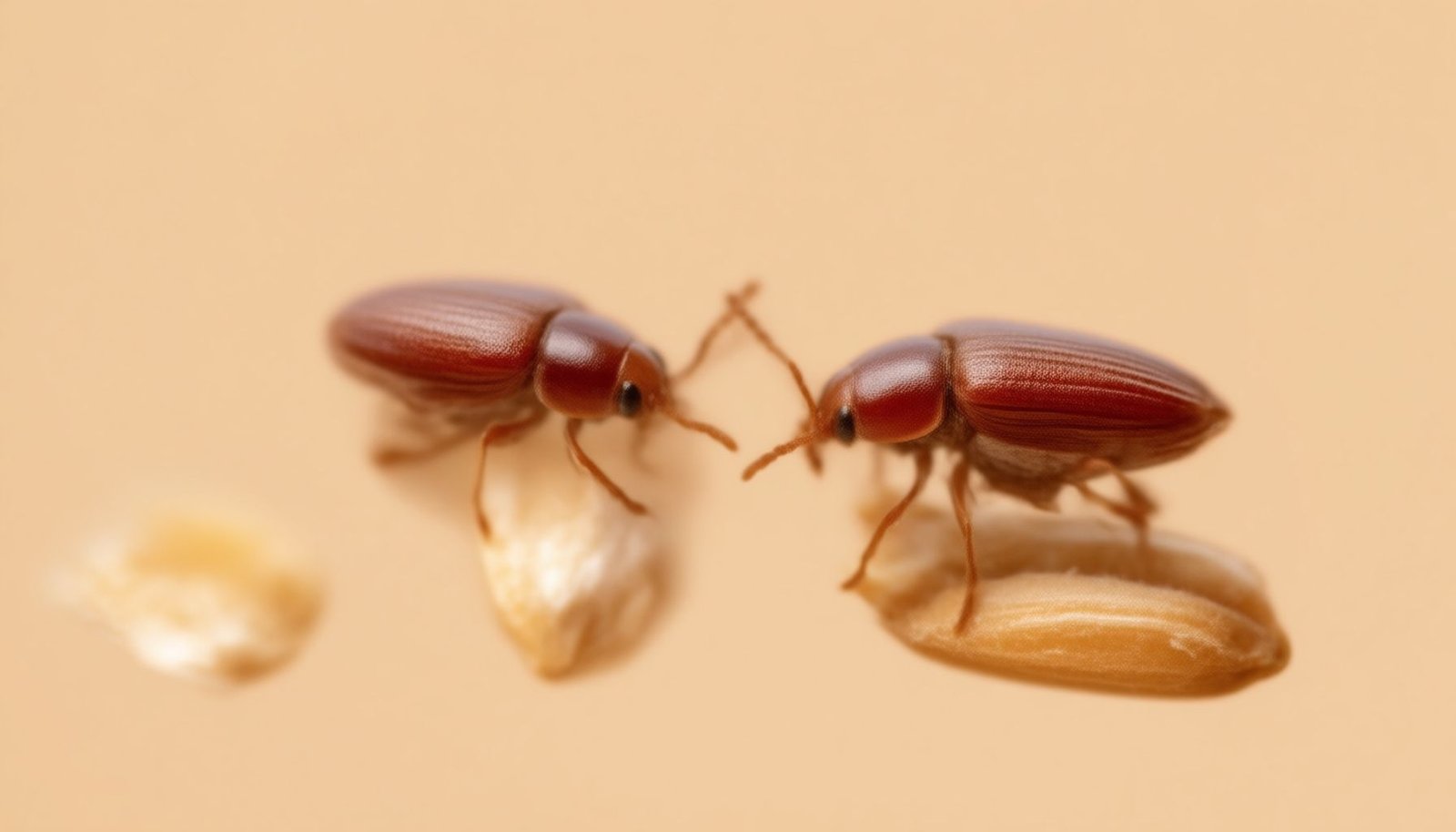
This close-up shows the sawtoothed projections along the thorax that give grain beetles their name — those tiny serrated edges are exactly what you should look for when examining a suspicious bug found in cereal or flour, since no other common pantry pest shares this feature.
How Do You Tell Grain Beetles Apart From Other Pantry Bugs?
This is where most people lose the thread. Pantry infestations rarely involve just one species, and grain beetles are routinely misidentified as flour beetles, drugstore beetles, or even weevils. Getting the ID right matters because the control strategy is slightly different for each. Weevils, for example, have a distinctive long snout — grain beetles don’t. Flour beetles (Tribolium species) are similarly small and reddish-brown, but their antennae end in a distinct three-segmented club and their bodies are more oval-shaped rather than flat and elongated.
The flatness of grain beetles is genuinely diagnostic. Hold a suspect beetle on its side — if it looks almost paper-thin compared to its length, you’re almost certainly looking at a grain beetle. Flour beetles are notably more rounded in cross-section. Drugstore beetles are rounder still, almost bullet-shaped, and covered in fine hairs. If you’re unsure, your county cooperative extension office can often ID a specimen for free, and that identification is worth the effort before you start throwing out food.
| Pest | Size | Body Shape | Distinctive Feature |
|---|---|---|---|
| Sawtoothed Grain Beetle | ~2.5 mm | Flat, elongated | 6 saw-like teeth on thorax sides |
| Red Flour Beetle | ~3–4 mm | Oval, slightly rounded | 3-segmented antennal club |
| Granary Weevil | ~3–5 mm | Cylindrical | Long, prominent snout |
| Drugstore Beetle | ~2–3.5 mm | Rounded, hairy | Bullet-shaped, parallel-sided |
What Does a Grain Beetle Infestation Look Like Inside a Cereal Box?
Picture this: you open a box of bran flakes that’s been sitting at the back of the pantry for three weeks. Everything looks normal at first glance. Then you notice a faint musty smell — not moldy exactly, but stale in a way that’s slightly off. You pour some cereal into a bowl and there’s a powdery residue at the bottom of the bag you didn’t notice before. That dust isn’t from the cereal. It’s frass — the combined waste product of beetles, larvae, cast skins, and eggs — and it’s one of the clearest signs of an active infestation before you even spot a live adult.
Grain beetle larvae are even harder to spot than the adults. They’re off-white to yellowish, roughly 3 mm long when fully grown, and they burrow directly into grain kernels or clump together in the compressed layers of cereal flakes and oats. You might see larvae as tiny pale worms moving sluggishly through flour or as faint dark streaks inside a grain kernel where one has burrowed through. The larvae go through three to four instars before pupating, and the entire life cycle from egg to adult can complete in as few as 24 days under warm conditions — which is why a pantry left undisturbed through summer can go from zero to hundreds of beetles faster than most people expect.
Pro-Tip: Shine a flashlight along the bottom seam of your cereal bags and flour sacks before you assume they’re clean. Grain beetle frass settles to the lowest point of the packaging, and even a light dusting visible under direct light is enough to confirm an infestation that isn’t visible yet from above.
Which Foods Are Grain Beetles Most Likely to Infest?
Grain beetles are not picky, but they do have clear preferences, and knowing those preferences helps you audit your pantry more effectively. They prefer foods with higher oil content and moderate moisture — which is why they show up in certain products far more frequently than others. Cereals with added nuts, seeds, or dried fruit are particularly attractive because those inclusions provide the fat content grain beetles need to reproduce efficiently.
Here’s what’s most commonly infested, ranked roughly by how often grain beetles are found in each:
- Ready-to-eat breakfast cereals, especially granola, muesli, and bran-based varieties
- Rolled oats and oat-based products (oatmeal packets, oat flour)
- Brown rice, wild rice, and rice blends (more so than white rice, due to higher oil content in the bran layer)
- Dried pasta, especially whole wheat varieties
- Birdseed, pet food, and dried herbs stored near pantry staples
- Chocolate and cocoa powder — a less obvious target that grain beetles exploit heavily when present
That last one surprises most people. Chocolate isn’t a grain, but its fat and sugar content makes it an ideal food source for grain beetles, and products like hot cocoa mix, chocolate chips, and baking chocolate are frequently infested without homeowners making the connection. If you’ve found beetles in your cereal but can’t trace the source, check any chocolate products stored nearby — they may be the actual origin point of the colony.
“The biggest mistake I see homeowners make during a grain beetle infestation is treating it like a spot problem. They throw out the obviously infested box and stop there. But by the time you’re seeing adult beetles walking on your shelves, the infestation has almost certainly spread to two or three other products — often ones that look completely sealed. A thorough audit of everything in that pantry, not just the obvious culprit, is the only way to actually break the cycle.”
Dr. Patricia Kelso, Ph.D. Entomology, University Extension Stored Products Specialist
How Did Grain Beetles Get Into Your Sealed Pantry in the First Place?
This is the question that genuinely stumps people, and the answer is uncomfortable: they almost certainly came in with the groceries. Grain beetle infestations in homes typically start at the processing facility, the distribution warehouse, or the grocery store shelf — not at your house. A female grain beetle can lay up to 300 eggs over her lifespan and deposits them directly inside grain products. Those eggs and newly hatched larvae are invisible to the naked eye, and they ride home with you inside a box or bag that shows no outward sign of a problem. The packaging isn’t truly a barrier for a beetle that’s flat enough to slip through folded cardboard and heat-sealed bag seams.
Once inside your pantry, temperature drives everything. Grain beetles breed most aggressively between 68°F and 95°F, with 85°F being close to the optimal range for maximum reproduction. A cool pantry (below 60°F) will slow development to a near standstill, and temperatures below 50°F kill larvae within about a week. This is why the same box of cereal sitting undisturbed through a cold winter might show no infestation, then explode with beetles by midsummer when the kitchen warms up. The infestation was always there — the temperature just finally gave it permission to run. That said, in climates or homes where temperatures stay consistently warm year-round, there’s effectively no seasonal brake on the life cycle at all.
It’s also worth knowing that grain beetles don’t need a gap to get in — they don’t come in from outside the way moisture-seeking bugs like those found in bathroom grout do. They’re almost always introduced through infested purchased products. That means your cleanest, tightest pantry is still vulnerable if any single product coming off a store shelf was already compromised before you bought it.
How Do You Confirm It’s Grain Beetles and Not Something Else Damaging Your Pantry?
Confirmation takes a few specific steps, and the order matters. Start by removing everything from the pantry — not just the suspicious items — and placing each product on a white surface under bright light. Look for adults (small, flat, reddish-brown), larvae (tiny pale worms or yellowish grubs), frass (fine powdery residue or gritty clusters), cast skins, and webbing. Webbing is not a grain beetle sign — if you’re seeing silk threads or webbing in your food, that points to Indian meal moths instead, which is a completely different pest with a different control approach.
Once you’ve confirmed grain beetles visually, do a methodical sweep in this order:
- Remove every item from the pantry, including things stored on the top and bottom shelves you rarely touch.
- Inspect every product — including sealed cans and jars around the edges where dust collects — for beetles that may be using the exterior surface as a hiding spot.
- Discard anything showing signs of infestation in a sealed bag taken outside immediately, not into your kitchen trash.
- Vacuum the shelves thoroughly, paying attention to shelf brackets, corners, and any cracks in shelf material where pupae or eggs can be tucked — grain beetles don’t just live in the food, they pupate in the debris around it.
- Wipe down all surfaces with hot water and a mild cleaning solution, then allow to dry completely before restocking.
- Transfer surviving dry goods into sealed, hard-sided containers — glass or thick polypropylene — before returning them to the pantry.
One honest nuance here: how thorough this process needs to be depends on how advanced the infestation is. A single infested box found early, before you’ve seen beetles walking freely on shelves, might genuinely be contained to that one product. But if you’re seeing adults moving on the shelf surface, or finding them in multiple different products, the infestation has already spread beyond one source and you need to treat the entire pantry as compromised. Don’t let wishful thinking shrink the scope of your response — that’s what turns a one-week fix into a three-month problem.
It’s also worth noting that grain beetle damage to food looks fundamentally different from structural pest damage. If you’re worried about similar identification challenges in other parts of your home, the visual diagnostic process used for termite damage in hardwood floors follows a similar logic — you’re looking for the evidence the pest leaves behind, not the pest itself, because adults are often the last thing you’ll see.
The counterintuitive fact most pest control guides skip entirely: grain beetles don’t actually need to eat your food to survive long enough to spread. Adults can live for weeks on trace amounts of grain dust — the kind that accumulates in a pantry shelf crack or along a baseboard where a cereal box once sat. This is why vacuuming and wiping the shelf is not optional cleanup. It’s the step that actually breaks the infestation cycle once the food sources are removed.
Once your pantry is clean and restocked in proper containers, the real prevention is in what you buy and how fast you use it. Buying in bulk feels economical, but a 10-pound bag of oats that sits in a paper sack for four months is an incubator, not a bargain. Smaller quantities, faster rotation, and hard-sided storage containers eliminate the conditions grain beetles need to establish a colony in your home — and that’s a system that keeps working whether you’ve had an infestation before or not.
Frequently Asked Questions
What do grain beetles look like in cereal?
Grain beetles in cereal are tiny, flat, reddish-brown insects that are usually only about 1/10 of an inch long — roughly the size of a sesame seed. They have six legs, two antennae, and a distinctly narrow, elongated body that lets them squeeze into sealed packages. You’ll often spot them moving slowly through dry cereal, flour, or oats, sometimes in clusters near clumps of food debris.
How do I know if I have grain beetles or just dirt in my pantry food?
Grain beetles actually move, so if you see tiny brown specks in your cereal or flour that crawl or shift position, that’s your answer. You might also notice a musty or unpleasant smell in infested packages, along with webbing or fine powder that wasn’t there when you opened the box. Dirt and debris don’t have legs, so a quick look with a magnifying glass will clear things up fast.
Are grain beetles in cereal dangerous to eat?
Grain beetles aren’t known to bite, sting, or transmit disease, so accidentally eating a few won’t send you to the emergency room. That said, heavily infested food can carry mold, bacteria, and waste products from the beetles that may cause stomach upset in some people. It’s best to throw out any package where you can see live or dead beetles, eggs, or shed skins — don’t try to salvage it.
What is the difference between a sawtoothed grain beetle and a merchant grain beetle?
Both are small, flat, reddish-brown beetles about 1/10 of an inch long, and they’re easy to mix up. The key difference is that the merchant grain beetle can fly, while the sawtoothed grain beetle can’t — both have six saw-like teeth on each side of their thorax, but only the merchant grain beetle has functional wings. For most homeowners this distinction doesn’t change how you get rid of them, but it does explain how an infestation can spread quickly to other rooms.
Where do grain beetles in cereal come from?
Most infestations start at the grocery store or food processing facility, where beetles or their eggs get into packaging before you even bring the product home. They can also enter your pantry through tiny cracks in cardboard boxes or thin plastic bags, since their flat bodies let them slip through gaps less than 1mm wide. Once inside your pantry, a single infested box can spread beetles to neighboring packages within a few weeks if it’s not caught early.