
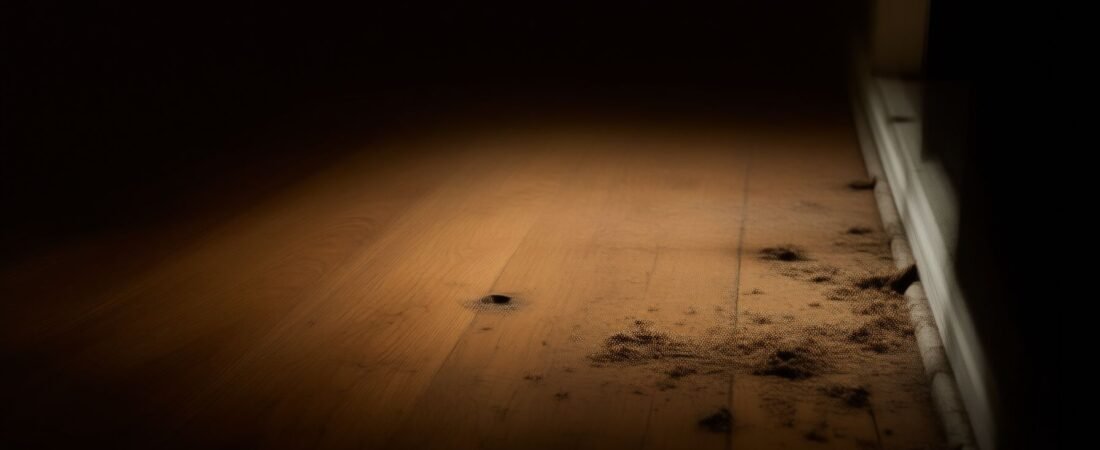
Hardwood floors don’t rot from the top down — they collapse from the inside out. That’s the part most people miss entirely. By the time termite damage in hardwood floors looks like anything obvious on the surface, the structural wood beneath it has often been hollowed out for months, sometimes longer. The signs are there earlier, but they don’t look like what you’d expect.
Here’s the bottom line: the most reliable early indicators of termite damage in hardwood floors have nothing to do with seeing the termites themselves. They’re tactile, acoustic, and geometric — things you feel underfoot, hear when you tap the floor, and notice in the shape of your boards. Learning to read those signals before the floor starts to visibly fail is the difference between a targeted treatment and a full floor replacement.
Why Hardwood Floors Hide Termite Damage Better Than Any Other Surface
Subterranean termites — the species responsible for the vast majority of structural wood damage in the US — eat wood from the inside while leaving an outer shell intact. That shell, even just a millimeter or two thick, is enough to look perfectly normal under finish and stain. A colony of 500,000 to over 1 million individuals can be actively consuming the wood beneath your feet without producing a single visible clue on the surface for six to eighteen months after they’ve established a gallery network.
Hardwood specifically presents a problem because its density and finish create a barrier that conceals early damage far better than softwood subfloors or drywall. Homeowners who check walls and window sills for mud tubes can completely overlook the floor — which is often the termites’ primary highway between the soil and the structural framing above. The finish coat buys the colony time it wouldn’t otherwise have on an unfinished surface.
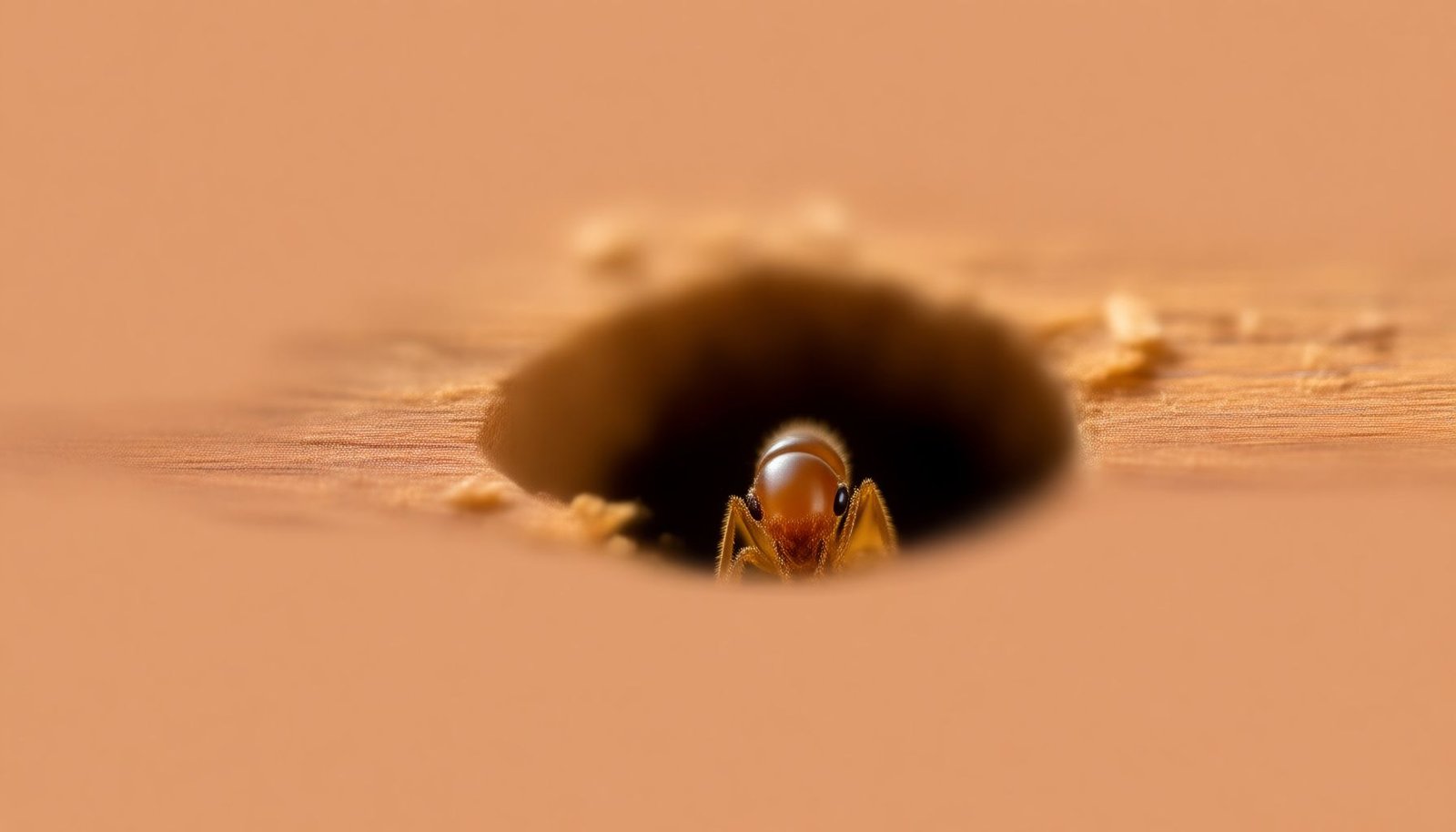
This close-up shows the characteristic hollowed gallery pattern just beneath the surface of a hardwood plank — the kind of damage that’s completely invisible until the board is physically lifted or breaks underfoot, which is exactly why waiting for visible signs is already waiting too long.
What Does Termite Damage in Hardwood Floors Actually Feel and Sound Like?
Picture this: you walk across the same stretch of hallway floor every morning and one day notice a faint give — not a creak, not a bounce, but a subtle spongy compression under your foot that wasn’t there before. That sensation, especially when it’s localized to a specific board or small section and surrounded by floors that feel completely solid, is one of the most reliable early physical indicators of termite activity. It means the internal structure of that board has been compromised enough that the remaining shell deflects slightly under body weight.
The tap test is the other tool you have. Knock on a healthy hardwood floor with your knuckle and you’ll get a solid, dense thud. Knock on a termite-damaged board and you’ll hear a hollow, papery resonance — sometimes described as the sound of tapping on a cardboard box. Work your way across the floor in a grid pattern, every six inches or so, and the acoustic difference between damaged and undamaged areas becomes unmistakable once you’ve trained your ear. This isn’t a professional technique; it’s something any homeowner can do in twenty minutes.
Pro-Tip: Do the tap test in the morning before anyone has walked through the room. Floors that have been repeatedly walked on compress slightly and can mask the hollow sound. Cold, still conditions give you the clearest acoustic reading — tap firmly with one knuckle, not your palm, and move in a consistent grid so you can map which boards respond differently.
Which Visual Clues on the Floor Surface Are Actually Caused by Termites?
Surface-level visual signs of termite damage in hardwood floors are easy to misread — and two of the most common ones get blamed on the wrong culprits constantly. Buckling or warping boards are frequently attributed to moisture or seasonal expansion, and while those causes are real, termite galleries also disrupt the wood’s internal moisture equilibrium. When termites consume the cellulose structure inside a plank, the board loses its ability to manage moisture evenly, causing it to cup or bow in ways that look identical to water damage. The key distinction: moisture warping typically affects multiple boards in a contiguous area, while termite-driven warping can appear in isolated boards surrounded by flat ones.
The other visual flag people miss is surface blistering — small raised areas or bubbles in the finish that look like the finish itself is failing. What’s actually happening is that termites eating just beneath the surface have removed the material that the finish was anchored to, causing it to lift. You’ll sometimes see very fine cracks in the finish running parallel to the wood grain at these blistered spots. Mud tubes are the definitive visual confirmation, but they’re usually found at the edges — along baseboards, at expansion gaps, or where the floor meets a threshold — not in the middle of a plank.
“Most people associate termite damage with structural beams and wall framing, but hardwood floors are one of the most underdiagnosed sites precisely because homeowners and even some inspectors don’t think to test them systematically. By the time a floor board physically fails, we’re often looking at damage that’s been progressing for a year or more. The tap test and a flashlight inspection at the expansion gaps along baseboards should be standard practice in any home with a crawl space or slab foundation in a termite-active region.”
Dr. Marcus Ellroy, Board-Certified Entomologist and Structural Pest Control Consultant, University Extension Program, Southeast Region
How to Tell the Difference Between Termite Damage and Other Floor Problems
This is where diagnosis gets genuinely tricky, and anyone who tells you there’s one foolproof visual test is oversimplifying. Termite damage in hardwood floors shares symptoms with subfloor moisture problems, wood rot, and powderpost beetle activity — and the treatment path is completely different for each one. Getting this wrong means either tearing up sound floors unnecessarily or missing an active infestation while treating a symptom.
Here’s a comparison of the overlapping signs and how to tell them apart:
| Symptom | Termite Damage | Moisture / Rot | Powderpost Beetles |
|---|---|---|---|
| Hollow sound when tapped | Yes — papery, resonant | Sometimes — denser thud | Rarely — localized to exit holes |
| Surface blistering or finish lift | Yes — along grain lines | Yes — bubbled, discolored | No |
| Fine powder or frass visible | Mud/soil-colored frass in galleries | No powder | Fine cream/tan powder at exit holes |
| Mud tubes at baseboards or gaps | Yes — definitive confirmation | No | No |
The frass distinction is worth pausing on. Drywood termites — which are more common in coastal and southern states — leave behind small, hexagonal pellet-shaped frass that accumulates in small piles near kick-out holes. Subterranean termites don’t leave frass piles; they incorporate waste into their mud galleries. If you’re finding fine sawdust-like powder and you’re in the Midwest or Northeast, powderpost beetles are a more likely culprit than termites. If you’re in Florida, Texas, or California and finding tiny pellet piles, drywood termites move up the list considerably.
Where on the Floor Should You Actually Be Checking for Termite Activity?
Not all areas of a hardwood floor are equally vulnerable, and knowing where to focus your inspection saves time and catches problems earlier. Termites follow moisture gradients and structural pathways — they don’t just appear randomly in the center of a room. Understanding their access routes tells you exactly where to look first.
These are the highest-priority inspection zones, in order of risk:
- Perimeter boards along exterior walls — Subterranean termites enter from the soil through the foundation. The boards closest to exterior walls are almost always the first to be colonized, since they’re nearest the entry points.
- Areas around plumbing penetrations — Anywhere a pipe passes through the subfloor creates both a gap and a moisture source. Termites exploit both. Check the floor around toilets, under sinks where pipes enter, and near dishwasher and refrigerator water lines.
- Boards adjacent to exterior door thresholds — Door frames are common entry points. The floor directly inside exterior doors — especially sliding glass doors on a slab — should be tapped and inspected closely for mud at the expansion gap.
- Areas over crawl spaces — If any portion of your home has a crawl space beneath it, the flooring directly above is at dramatically higher risk than slab sections. Crawl space humidity accelerates termite activity and conceals mud tubes until they’re extensive.
- Floors abutting interior walls that share a crawl space or basement — Interior wall bases that sit on the sill plate are another common termite highway. The floor on both sides of these walls warrants attention even if it’s not on an exterior edge.
One thing worth knowing: just because a section of floor passed inspection last year doesn’t mean it’s protected now. Active subterranean termite colonies expand their foraging territory continuously, often adding new gallery networks at a rate that makes annual inspection genuinely necessary rather than optional marketing language from a pest control company. Identifying flying ants inside the house during spring or fall can also serve as an indirect early warning — termite swarmers and ant swarmers often emerge around the same time and from similar interior wall or floor locations, and distinguishing between them quickly matters for your next step.
Beyond the floor itself, the signs you notice at other heights in the room can redirect your inspection back to the floor. For example, unexplained mud streaking on baseboards or a faint earthy smell near the floor level in a specific room — especially one over a crawl space — often points to termite activity that hasn’t yet produced obvious floor symptoms. Termite damage in hardwood floors rarely exists in isolation; it’s part of a larger infestation pattern that usually has clues at multiple points if you know where to look. Just as other pest infestations reveal themselves through indirect evidence (the way you’d track tick exposure risks by habitat rather than waiting for a bite), termite damage is best caught by reading the environment rather than waiting for the floor to fail.
What to Do When You Find These Signs — and What Not to Do First
The worst move at this point — and it’s a common one — is to immediately pull up the damaged boards to get a better look. It seems logical, but breaching the gallery network can scatter termites deeper into the structure before you’ve established the full extent of the damage or brought in someone who can treat it strategically. The colony doesn’t die when its tunnels are exposed; it retreats and relocates, which can spread the infestation into areas that weren’t yet affected.
What you should do instead:
- Document what you’ve found before touching anything — Take photos of hollow-sounding board locations (mark them with painter’s tape), mud tubes, blistered finish, and any frass. This documentation helps a pest control professional assess scope faster and gives you a record if you’re renting or in the middle of a home sale.
- Check the crawl space or basement if accessible — Look for active mud tubes on the foundation walls, floor joists, and sill plates. Active tubes are tan-brown and moist-looking; abandoned tubes are dry and crumble when touched. Seeing active tubes confirms the infestation is ongoing.
- Get a licensed termite inspector, not a general pest inspector — A WDO (Wood-Destroying Organism) inspection is a specific certification. Ask for a licensed WDO inspector rather than a general pest control technician if you want someone trained to map structural damage and distinguish termite damage from other causes.
- Don’t apply over-the-counter termiticides to the floor or baseboards as a first response — Spot treatments on a surface infestation that’s actually subterranean push colonies away from treated areas without eliminating them. This creates a false sense of resolution while the colony continues working elsewhere.
- Ask specifically about liquid soil treatment vs. baiting systems — For subterranean termites causing floor damage, the treatment approach depends heavily on whether you’re on slab or over crawl space, and how extensive the gallery network is. There’s no single right answer regardless of what a salesperson tells you.
One honest nuance here: how urgently you need to act depends on several factors — your geographic region, the species involved, how extensive the hollow zones are, and whether you’re seeing active mud tubes or old dried ones. In warm, humid climates like the Gulf Coast or Southeast, an active subterranean termite infestation causing hollow floor sections warrants a call within days. In cooler northern states, termite activity typically slows significantly in winter, which gives you slightly more time — but doesn’t eliminate the urgency, since damage continues at any temperature above about 50°F and colonies can remain partially active through mild winters.
The counterintuitive fact that most pest control content skips over: termite damage in hardwood floors is not necessarily a sign of a new infestation. Some of the hollow boards you find today may represent damage that happened years ago from a colony that has since moved on or been treated — and distinguishing active from historic damage changes both the urgency and the approach entirely. Dry, crumbling galleries with no soil moisture and no live insects found in the crawl space mud tubes suggest historical damage. Fresh soil in galleries, moisture at the tube walls, and live workers visible when a baseboard is carefully removed — those signal active feeding that needs immediate professional attention.
If you’ve found real damage and you’re deciding next steps, the floor itself can be repaired — individual boards can be replaced once treatment is complete and the infestation is confirmed eliminated. But the repair conversation comes after the infestation is addressed, not before. Getting the sequence right is what separates a contained, fixable situation from one that expands significantly while you’re focused on cosmetics.
Frequently Asked Questions
What does termite damage in hardwood floors look like?
Termite damage in hardwood floors usually shows up as blistering, buckling, or sagging sections that look like water damage but aren’t near any moisture source. You might also notice small pinholes in the wood surface, hollow-sounding planks when you tap on them, or thin tunnels just beneath the finish. In serious infestations, the floor can actually give slightly underfoot in spots where it used to feel solid.
How do I know if my hardwood floors are hollow from termites?
Knock on the floorboards with your knuckles across several sections — a solid plank makes a dull thud, while a termite-damaged one sounds noticeably hollow or papery. Subterranean termites eat wood from the inside out, so the surface can look almost normal while the interior is mostly gone. If you’re getting hollow sounds across an area larger than 12 inches, it’s worth pulling up a board to inspect underneath.
Can termites damage hardwood floors from underneath?
Yes, and that’s actually the most common way it happens — subterranean termites travel up through the soil, build mud tubes along your foundation or joists, and attack hardwood floors from below before you’d ever notice anything from the top. By the time you see visible surface damage, they’ve often been feeding for months. Checking your crawl space or basement for mud tubes on the joists directly under your floors is one of the fastest ways to confirm an active infestation.
Is termite damage in hardwood floors covered by homeowners insurance?
In almost every case, no — standard homeowners insurance policies in the US exclude termite damage because it’s considered a preventable maintenance issue, not a sudden accident. The National Association of Insurance Commissioners confirms that pest damage is a standard exclusion across most policies. Your best financial protection is a termite warranty through a licensed pest control company, which typically runs between $200 and $500 per year depending on your region and home size.
How much does it cost to repair hardwood floors damaged by termites?
Repairing termite damage in hardwood floors typically costs between $500 and $3,000 depending on how many boards need replacing and whether the subfloor or joists are also compromised. If the damage is isolated to a few planks, a flooring contractor can often do a board replacement for under $1,000. However, if the structural subfloor is weakened, you could be looking at $5,000 or more once you factor in both pest treatment and full floor restoration.