
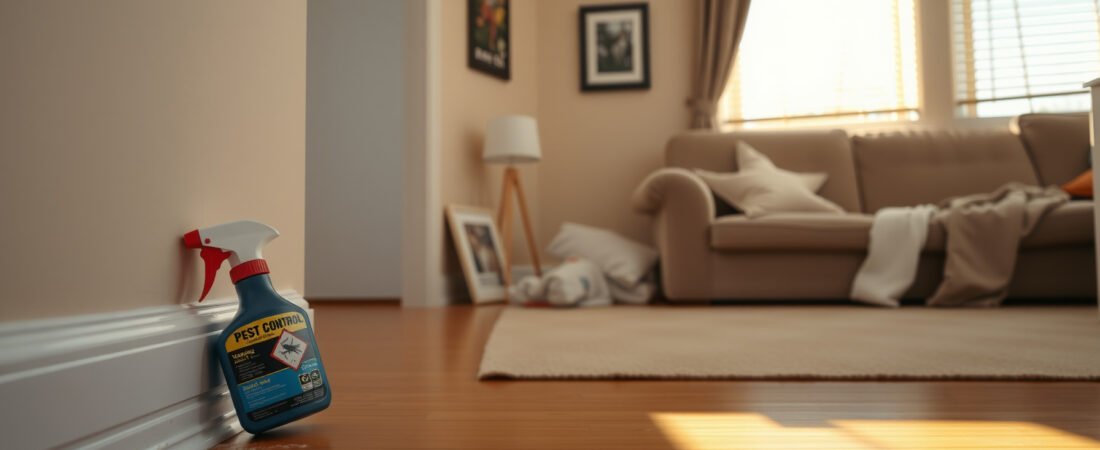
Two hours is the number most pest control companies will give you over the phone — and for certain treatments, two hours is genuinely fine. But for others, walking back in at the two-hour mark is exactly how you end up re-exposing yourself to wet chemical residue, inhaling volatile organics that haven’t fully off-gassed, or — most frustratingly — undermining a treatment that needed 24 to 72 hours of undisturbed contact time to actually work. The real answer isn’t one number. It’s a set of variables that the technician’s post-service sheet almost never explains clearly, and that’s the problem most homeowners run into.
The Re-Entry Time You Were Given Is Probably for the Wrong Treatment
Here’s what catches people off guard: pest control isn’t one thing. A general perimeter spray, a termite fumigation, a bed bug heat treatment, a cockroach gel bait application, and a flea fog are five completely different chemical and physical processes — and they have re-entry intervals that range from 30 minutes to 72 hours or more. Quoting a blanket “two to four hours” figure, as many services do, only applies to standard liquid residual sprays applied to exterior surfaces in low-traffic areas. Apply that same window to a full fumigation and you’re putting your family at serious risk.
The other variable nobody mentions is ventilation. A well-sealed modern home holds airborne chemical concentrations significantly longer than an older drafty house with gaps around windows and doors. Picture this: two neighbors on the same street get identical flea treatments on the same day. One lives in a 1960s ranch with leaky single-pane windows — she’s back home safely in three hours. The other is in a tight, energy-efficient build from the last decade — the same chemicals are still off-gassing at hour four. Same product, same technician, genuinely different safe re-entry times based on nothing more than construction vintage.
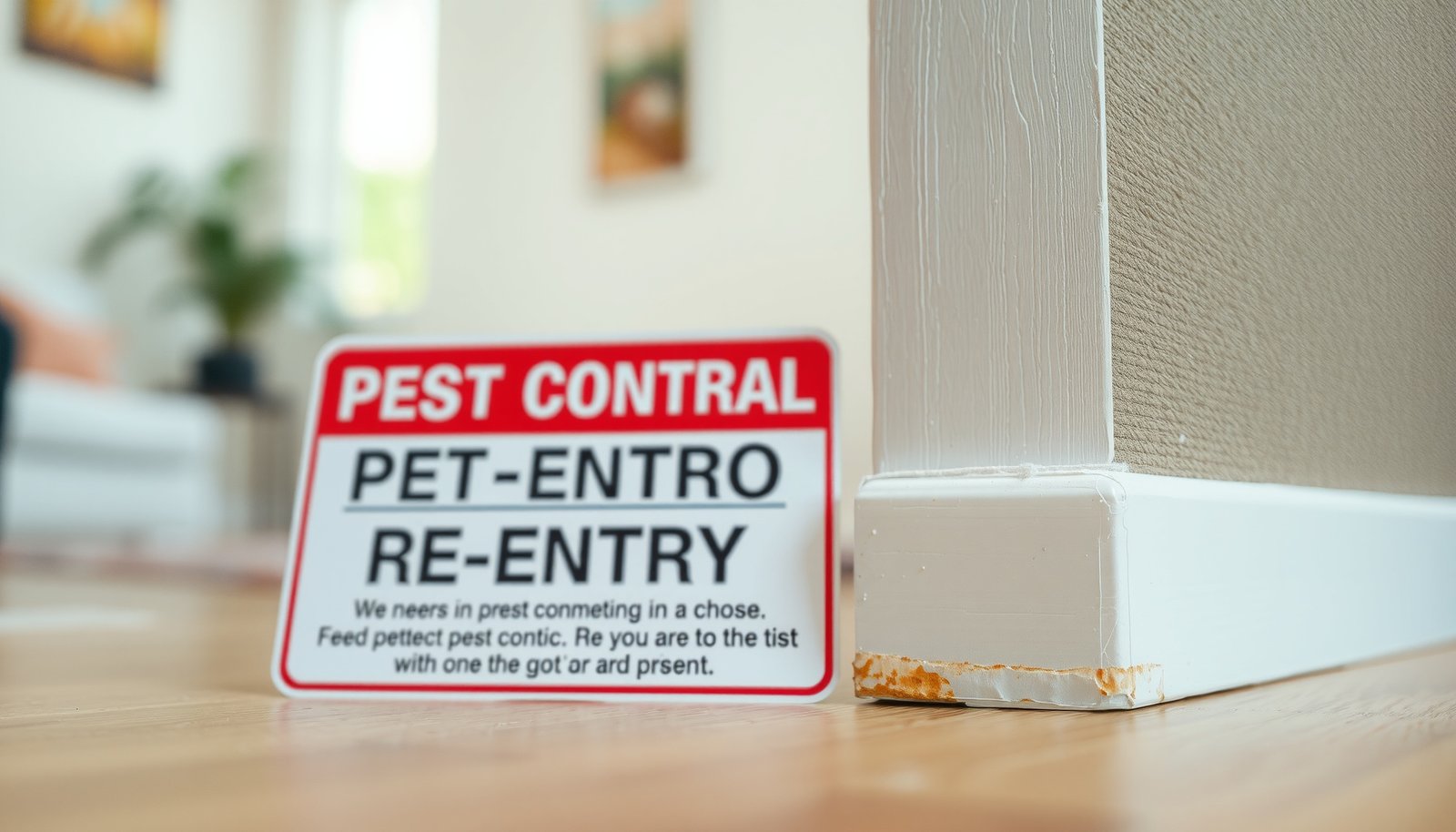
This close-up shows residual spray drying on a baseboard surface — the visual difference between wet and dry product matters because re-entry is only safe once residue has fully cured, not just when it looks dry to a quick glance.
What Are the Actual Re-Entry Times by Treatment Type?
Re-entry intervals (REIs) are federally regulated for agricultural pesticides, but for residential pest control they’re largely left to product label instructions and state licensing boards. That said, there are well-established windows that licensed technicians follow in practice. Knowing which category your treatment falls into is the single most useful thing you can do before you schedule service.
| Treatment Type | Typical Re-Entry Window | Key Condition |
|---|---|---|
| General liquid residual spray (exterior/interior perimeter) | 30 minutes – 2 hours | Surfaces must be visibly dry |
| Flea fogger / total-release aerosol | 2 – 4 hours minimum | Open all windows before re-entry, run fans for 30 min |
| Cockroach or ant gel bait | 0 – 30 minutes | No airborne chemical; bait stations are sealed |
| Bed bug heat treatment | 1 – 2 hours after technician confirms cool-down | Room must drop below 90°F before safe occupancy |
| Tent fumigation (Vikane / sulfuryl fluoride) | 24 – 72 hours; clearance test required | Certified air clearance test mandatory before re-entry |
Gel bait treatments — commonly used for German cockroaches, which produce 30 to 40 eggs per capsule and can infest a kitchen in weeks — require almost no re-entry wait at all, because the active ingredient is contained inside small dots of bait matrix, not aerosolized. This is one of the cleaner, lower-disruption treatment options if you have kids or pets and want to return home the same day. The tradeoff is that gel bait works more slowly than a broad spray application.
Why Does Walking Back In Too Soon Actually Matter?
The concern isn’t just theoretical. Pyrethroids — the most common class of insecticide used in residential pest control — are respiratory and neurological irritants at exposure levels above safe thresholds. Wet pyrethroid spray on a hard floor surface, walked on by a toddler who then puts their hands in their mouth, delivers a direct oral exposure route that wouldn’t exist if the product had been given two hours to dry and bind to the surface. This is the actual mechanism people should understand, not just a vague warning to “be careful.”
Organophosphate-based products — less common now but still used for certain applications — carry even stricter handling concerns, with some label REIs of 12 to 24 hours for indoor application. One honest nuance worth acknowledging: the risk level scales with who’s in the household. A healthy adult with no respiratory conditions who re-enters at the 90-minute mark after a standard spray probably won’t feel a thing. Infants, toddlers, pregnant people, elderly residents, and anyone with asthma or chemical sensitivities are in a genuinely different risk category and should hold to the full label interval — not the tech’s verbal estimate.
“The label is the law in pest control — that’s not a figure of speech, it’s federal statute under FIFRA. When a product label says re-entry after surfaces dry, that means fully dry, not damp-to-the-touch dry. I always tell clients: if you’re unsure, add an extra hour. The inconvenience of waiting is nothing compared to re-exposing a child or a pet to residue that hasn’t fully cured.”
Dr. Marcus Ellroy, Board-Certified Entomologist and NPMA-Certified Pest Management Professional
Does Re-Entry Time Change If You Have Pets or Children?
Yes — and this is the variable that pest control companies most consistently underemphasize on post-service paperwork. Pets, especially cats, are at elevated risk from pyrethroid exposure because they metabolize these compounds far less efficiently than dogs or humans. Cats also spend time on treated floor surfaces and groom their paws, which creates an ingestion exposure route that persists well past the point when a surface looks dry. For cats specifically, most veterinary toxicologists recommend waiting a full four to six hours after any pyrethroid application, even when the product label says two.
Children under six present a similar concern for different reasons — they spend more time at floor level, they touch surfaces and then touch their faces, and their body weight relative to exposure concentration means the same residue contact dose is proportionally higher than for an adult. The counterintuitive fact that most pest control guides skip: the square footage of your home affects safe re-entry time for pets and kids almost as much as the product type does. A 900-square-foot apartment treated with the same product as a 2,800-square-foot house will have a higher indoor air concentration per cubic foot, especially in the first hour after treatment.
Pro-Tip: Before you leave the house on treatment day, open interior cabinet doors under sinks and in bathrooms — technicians often spray these areas and they’re among the slowest spots to ventilate. Leaving them open while you’re out and during re-entry ventilation dramatically reduces the time residue stays concentrated in those enclosed spaces.
What Should You Actually Do Before and After Re-Entry?
Most post-service sheets hand you a list of what not to do — don’t mop, don’t wipe down baseboards, don’t let the dog in for two hours. Fewer give you an actionable re-entry protocol that actually protects your household and preserves the treatment’s effectiveness. These two goals work together, not against each other: a treatment that gets washed off counters within the first 24 hours because someone wiped them down is a treatment that failed, regardless of how careful you were about the re-entry time.
Here’s what a proper re-entry sequence looks like, ordered by priority:
- Confirm the re-entry window with the technician before they leave — get the specific product name if possible, not just a time estimate, so you can cross-reference the label if needed.
- Ventilate before full occupancy — open windows and run exhaust fans for at least 15 to 30 minutes before bringing children or pets back in, regardless of treatment type.
- Keep children and pets off treated floor surfaces for the full dry time — “dry to the touch” isn’t the same as fully cured; give hard floors an extra hour beyond when they look dry.
- Do not mop, vacuum, or wipe treated surfaces for at least 24 to 48 hours — residual products are designed to stay on surfaces; cleaning them off immediately defeats the entire purpose of a residual treatment.
- Wash any exposed food prep surfaces before cooking — countertops and stovetop areas should be wiped down with a damp cloth before food contact, even if the technician says they avoided these areas.
- Store your re-entry time documentation — if a follow-up treatment is needed, the technician will want to know what was applied and when, and your records protect you if any health concern arises afterward.
One area that gets overlooked in this whole conversation is pest control in bathrooms — particularly when treatments are applied for moisture-loving insects like silverfish, which are common in humid, dark spaces and often survive in spots that are awkward to treat thoroughly. If you’ve had a treatment done and you’re managing a recurring silverfish issue in those same areas, it’s worth reading up on Best Silverfish Traps and Sprays: Tested for Bathrooms to understand which follow-up products work well without requiring another full professional application.
When Is It Safe to Clean — and What Cleaning Actually Ruins the Treatment?
This is the part of re-entry guidance that most homeowners get genuinely wrong, and it costs them the effectiveness of a treatment they paid good money for. Residual insecticide sprays work by leaving an active layer on surfaces — baseboards, wall voids, under appliances — that insects walk through and pick up on their legs and body. That contact exposure is the whole mechanism. Mopping a treated tile floor with a strong cleaner within 12 hours of application removes that residual layer almost entirely, leaving you with a clean floor and zero pest control protection.
The rule that actually holds up: don’t wet-mop treated hard floors for at least 48 to 72 hours. Dry sweeping is fine. Spot-cleaning obvious spills is fine. But full wet mopping — especially with anything alkaline like a standard floor cleaner — breaks down pyrethroid residue fast. The same goes for bathrooms: if a technician treated along your tub surround or under your vanity for silverfish or other moisture pests, running a hot shower repeatedly in the first 24 hours accelerates the breakdown of whatever was applied. For anyone dealing with recurring issues in those humid zones, pairing professional treatment with targeted DIY products is often more realistic — something covered in detail in our guide on How to Get Rid of Silverfish in Bathroom and Bedroom.
There’s also a cleaning step most people skip before treatment that directly affects how long it stays effective: a cluttered home with dense furniture, stacked boxes, and accumulated debris gives insects far more harborage to avoid treated surfaces entirely. Mice, for example, can squeeze through a gap as small as 1/4 inch and navigate behind wall cavities that no spray ever reaches. Pest control is more effective — and re-entry safer — when the home has been cleaned and decluttered before the technician arrives, not after.
Here’s a quick breakdown of what preserves versus destroys treatment residue after you return home:
- Safe after re-entry: dry sweeping, light dusting of non-treated surfaces, running HVAC as normal, gentle wiping of food prep counters only
- Wait 48–72 hours: wet mopping of hard floors, steam cleaning, shampooing carpets, cleaning baseboards with liquid sprays
- Avoid entirely for the treatment cycle: applying your own spray products on top of professional treatment (product interactions can reduce effectiveness and increase exposure risk)
- Check with your technician first: running a whole-house dehumidifier or air purifier — some HEPA units can pull airborne active ingredients out of the air faster than intended, which sounds good but may reduce efficacy for fogger-type treatments
The bottom line on re-entry is really about understanding what type of treatment happened in your home, because that single variable changes everything — the wait time, the ventilation protocol, who needs to stay out longest, and what cleaning you can safely do. Two hours is a reasonable ballpark for a basic spray service in a well-ventilated space with no vulnerable occupants. It’s not a universal answer, and treating it like one is exactly where things go wrong. Ask for the product name, ask for the specific label REI, and add time if you have cats, toddlers, or a tightly-sealed home. The treatment you paid for only works if you give it the conditions it needs — and the safest re-entry is always the one you’ve actually confirmed, not assumed.
Frequently Asked Questions
How long after pest control treatment can you return home?
For most standard indoor pesticide sprays, you’ll need to stay out for 2 to 4 hours after treatment. If the exterminator used fumigation with tent enclosure, that wait time jumps to 24 to 72 hours depending on the chemicals used. Always ask your pest control company for the specific re-entry interval listed on the product label — that number is legally required and non-negotiable.
Is it safe to sleep in your house after pest control?
It depends on what was sprayed and where. If treatment was limited to baseboards, cracks, or the garage, sleeping at home the same night is usually fine as long as you waited the recommended 2 to 4 hours and the rooms are well-ventilated. If your bedroom was directly treated or the whole house was fumigated, you shouldn’t sleep there until the exterminator gives you a written clearance.
Do you have to wash everything after pest control treatment?
You don’t need to wash everything, but you should wipe down any countertops, tables, or surfaces where food is prepared or eaten before using them again. Bedding and kids’ toys that were directly exposed to spray should be washed. Cabinets that were left open during treatment are worth wiping down too, just as a precaution.
How long after pest control can kids and pets go back inside?
Children and pets are more vulnerable to pesticide residues than adults, so it’s smart to wait at least 4 to 6 hours even when the standard re-entry time is shorter. Keep pets off treated floors until the spray has fully dried, which usually takes 1 to 2 hours. For babies or toddlers who crawl on the floor, waiting closer to 6 hours gives the residue more time to settle and dry completely.
What happens if you go back in your house too soon after pest control?
Going back in too early can expose you to pesticide vapors or wet residue that hasn’t finished drying, which can cause symptoms like headaches, dizziness, nausea, or skin irritation. Most reactions from short-term exposure are mild, but people with asthma, allergies, or chemical sensitivities can have stronger responses. If you accidentally re-entered too soon and feel unwell, get fresh air immediately and call Poison Control at 1-800-222-1222 if symptoms don’t clear up.
Disclaimer: This article is for informational purposes only. Pest control costs, timelines, and outcomes vary widely depending on the pest, the severity of the infestation, your location, and the company you hire. Always get multiple quotes and ask for a written inspection report before agreeing to a treatment plan.