
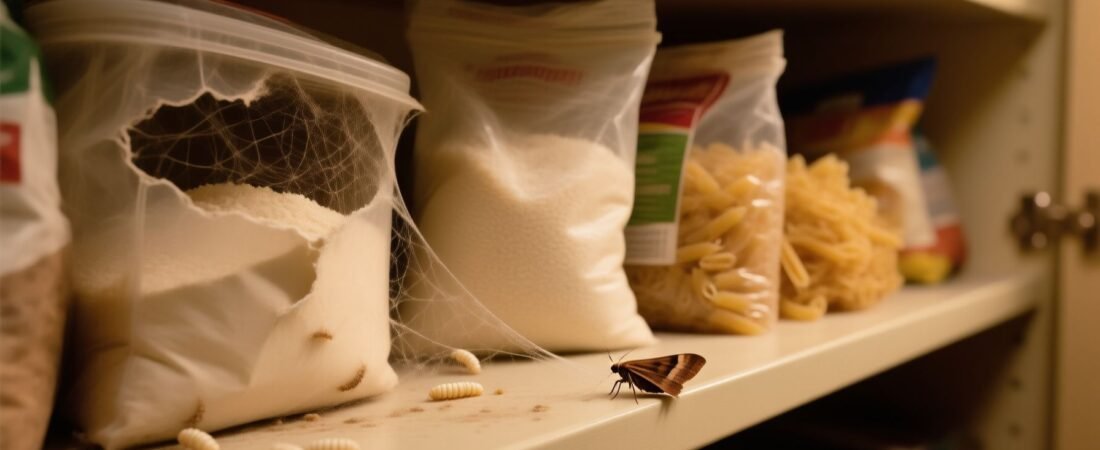
Pantry moths are already gone by the time most people realize they have them. That’s the part nobody tells you. You spot a single fluttering moth near your cereal shelf, assume it flew in from outside, and move on — while a full breeding cycle is silently churning through your dry goods. The real signs of a pantry moth infestation almost never start with the moth itself. They start with things that look like something else: clumped flour, a faint silky thread across a bag of rice, or tiny cream-colored worms you might mistake for weevil larvae or even mold strands. Recognizing the actual evidence — in the right order, in the right places — is what separates catching this early from throwing out half your pantry shelf by shelf.
Why Do Pantry Moths Look Like a Different Problem at First?
The Indian meal moth (Plodia interpunctella) is responsible for the vast majority of pantry moth infestations in US homes. Its life cycle has four distinct stages — egg, larva, pupa, and adult — and only one of those stages is the moth you can actually see flying around. The other three happen deep inside your food packaging, which is exactly why the visible moth is almost always a lagging indicator, not a leading one. By the time adults are zipping around your kitchen light at night, the larvae that hatched weeks earlier have already contaminated multiple containers.
A female Indian meal moth lays between 100 and 300 eggs directly on or inside food sources — usually within the packaging itself, not on the outside surface. Those eggs hatch in as little as 2 to 14 days depending on temperature, and the larvae immediately begin feeding and spinning silk. That silk — fine, whitish webbing matted into the food itself — is typically the earliest visible clue, and most people either don’t notice it or assume the product is just clumped from humidity. That assumption costs weeks of catch-up time.
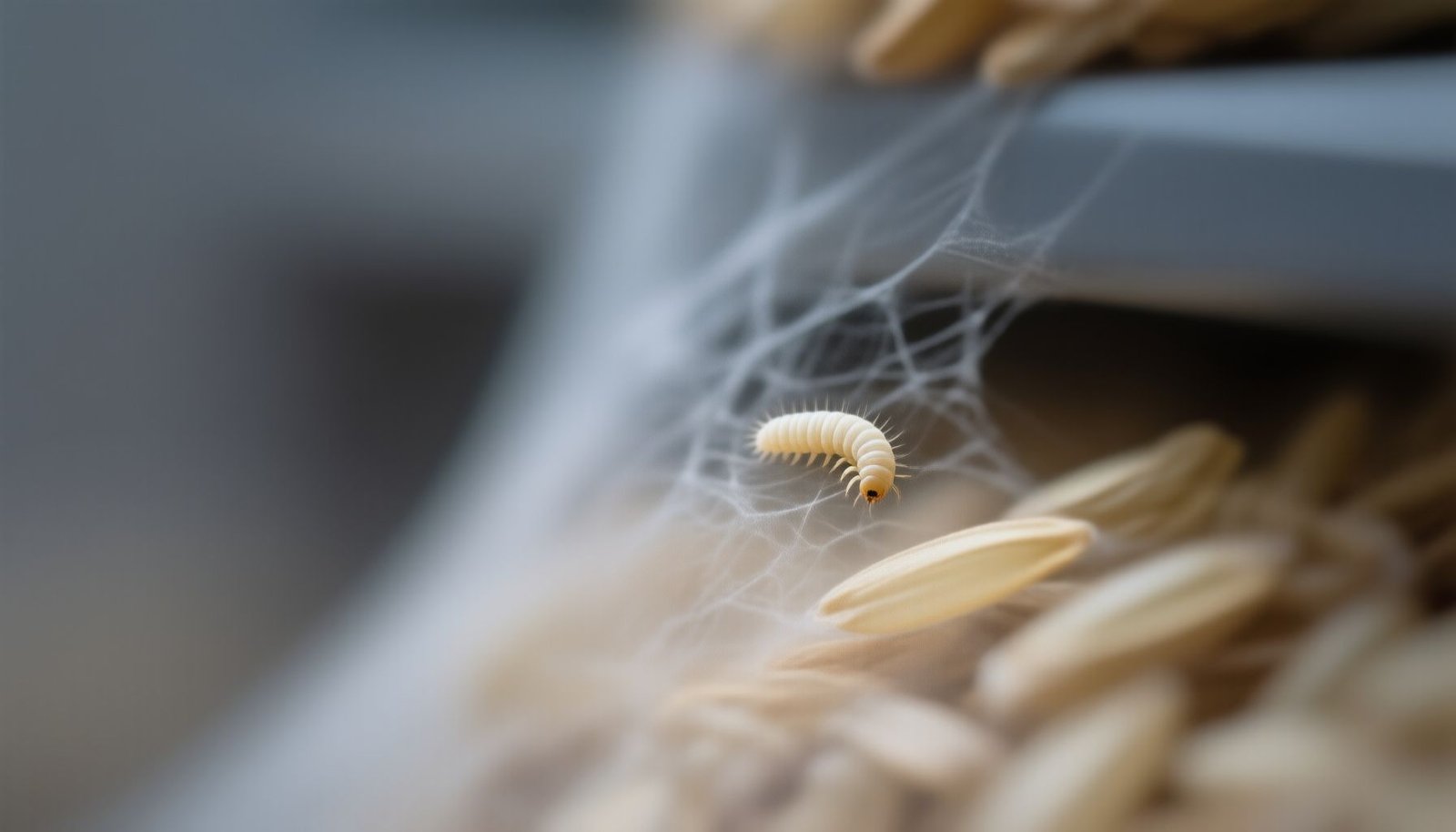
This close-up shows the silky webbing and frass that pantry moth larvae leave behind inside dry food packages — the kind of detail that’s easy to dismiss as product clumping until you know exactly what you’re looking at.
What Does Pantry Moth Webbing Actually Look Like Inside Food?
The webbing left by pantry moth larvae is different from spider webbing in one key way: it’s woven through the food, not stretched across a surface. Grab a bag of cornmeal, flour, or oats that’s been sitting for a few months and look closely at the interior walls and the food near the top. If you see a fine, matted, grayish-white film — almost like a thin layer of lint pressed into the grain — that’s larval silk. It’ll often clump the product into irregular, slightly sticky masses. It is not the same texture as moisture-clumped food, and once you’ve seen it once, you won’t confuse it again.
Webbing also shows up in the crevices of shelves, along the underside of shelf edges, and tucked into the folds of packaging. Larvae migrate to spin their cocoons in these spots before pupating, so you’ll often find the silk trails leading away from the food source itself. Check the joint where your shelf meets the wall, the underside of shelf liner paper, and even inside decorative cracks in wood shelving. Picture this: you’ve just cleaned your pantry, restocked everything, and two weeks later the moths are back — that’s almost always because one cocoon tucked into a shelf crevice survived the cleanup and completed its cycle undisturbed.
How Do You Identify Pantry Moth Larvae vs. Other Pantry Pests?
This is where a lot of people get it wrong, and it genuinely matters for treatment. Pantry moth larvae are small — typically 1/2 inch long at maturity — and creamy white or pinkish-white with a darker head capsule. They move with a distinctive inchworm-like motion and leave a trail of silky webbing behind them. They’re not the same as grain beetles, flour mites, or weevil larvae, which have their own identifying features. If you’re seeing tiny, hard-shelled, moving bugs in your flour rather than soft-bodied wriggling worms, you may be dealing with a weevil problem instead — for more on how to tell those apart, What Do Weevils Look Like in Flour and Pantry Foods? breaks down the key differences.
Here’s a comparison of the most common pantry moth signs across the four life stages, which matters because the stage you’re finding tells you how far along the infestation actually is:
| Life Stage | What You’ll See | Where to Look |
|---|---|---|
| Egg | Tiny (0.3–0.5 mm), white, barely visible to naked eye — usually in clusters on food surface | Inside packaging, on grain surfaces, near food seals |
| Larva | Cream/pinkish worm up to 1/2 inch, silk webbing trail, dark head capsule | Inside food, shelf crevices, corners of shelving |
| Pupa (cocoon) | Small silken cocoon, tan or brownish, often in a corner or crevice away from food | Shelf joints, wall corners, packaging folds, ceiling corners |
| Adult moth | Wingspan about 3/4 inch, distinctive two-toned wings (outer half reddish-brown, inner half gray) | Flying near light sources at night, resting on walls near pantry |
Which Foods Get Infested First — and Why That Matters for Finding the Source
Pantry moths don’t hit every food equally, and knowing their preferences helps you find the source fast instead of inspecting everything one by one. They’re drawn primarily to products with higher fat and protein content, not just carbohydrates. Nuts, birdseed, and dried pet food are common hidden sources that people miss entirely because they’re not thinking of them as “pantry” items the same way they think of pasta or flour. Spices — especially paprika, red pepper, and dried herbs — are another frequently overlooked reservoir. The larvae can chew through thin plastic bags and cardboard with ease, so sealed-looking packaging is not a reliable barrier.
Search these specific food categories in this order when you’re trying to locate the original infestation source:
- Birdseed and dried pet food — These are the single most common uninspected source in homes with pantry moth problems. They’re often stored in bags that have been open for weeks or months.
- Whole grains, cornmeal, and oats — Anything coarser than white flour gives larvae more surface area to move through and web across. Check these before white flour, which is actually a less favorable substrate.
- Nuts, seeds, and trail mix — The fat content makes these highly attractive. Even vacuum-sealed bags can be compromised if eggs were present before sealing at the facility.
- Dried fruit and chocolate — Raisins, dried cranberries, and even chocolate chips can harbor larvae. The high sugar and fat content is ideal for larval development.
- Dried herbs and spices — Especially bulk spices stored in loosely closed containers. Red pepper flakes and paprika are particularly vulnerable due to their organic content and typical storage conditions.
- Decorative dried items — Dried flower arrangements, wreaths, potpourri, and even ornamental dried corn can be overlooked infestation points that keep reseeding the problem.
Pro-Tip: Don’t start by inspecting opened packages — start with the oldest, longest-sitting items in the back of your shelves. Indian meal moth infestations almost always originate in food that’s been sitting untouched for 2 to 6 months, not in recently purchased items.
What Are the Signs That a Pantry Moth Infestation Has Spread Beyond the Pantry?
Adult pantry moths can travel surprising distances from the original food source. They’re drawn to light and will fly toward windows, ceiling corners, and light fixtures in rooms nowhere near the kitchen. Finding a single adult moth resting on your bedroom ceiling or bathroom wall doesn’t necessarily mean you have an infestation in that room — but it does mean larvae are active and adults are emerging somewhere in your home. The mistake is treating only where you see the moths instead of backtracking to where the larvae are feeding.
Spread beyond the pantry is confirmed by finding pupae or webbing in non-food areas. Larvae that are ready to pupate actively crawl away from their food source — sometimes traveling 10 to 30 feet — looking for a sheltered spot to spin their cocoon. You might find cocoons tucked into drawer hinges, behind outlet plates, in the grooves of wood trim near the kitchen, or even in the folds of paper bags stored near the pantry. This migration behavior is why treating the pantry alone rarely resolves a well-established infestation. It’s also a useful distinction from other pest contamination situations — unlike, say, cockroach droppings, which cause respiratory problems through chronic airborne exposure, pantry moth evidence doesn’t pose the same ongoing health risk during an active infestation. The risk here is food waste and recontamination, not direct health harm from the infestation itself spreading through your air.
“Most homeowners assume they’ve solved the problem once they throw out the infested food, but the cocoons are what resets the clock. A single pupa surviving in a shelf crevice or behind a baseboard can produce an adult that lays over 200 eggs within days of emerging. The source elimination and the structural search have to happen at the same time, or you’ll be back to square one within three to four weeks.”
Dr. Sandra Kowalski, Board-Certified Entomologist and Urban Pest Management Specialist, Purdue University Extension
How Do You Know If What You’re Seeing Is an Active Infestation or Old Evidence?
This question matters more than most pest guides acknowledge, because the answer changes what you actually need to do next. Old webbing is dry, brittle, and breaks apart easily when disturbed — it’ll crumble rather than stretch. Active webbing has a slight elasticity and is often still attached at both ends. Old larval frass (the tiny dark pellets larvae leave behind) will be loose and dusty; fresh frass is darker and slightly waxy-looking. If you find only brittle silk and no live larvae, no fresh-looking cocoons, and no adult moths over a period of 5 to 7 days, the infestation may have burned itself out — particularly if the infested food was fully consumed or discarded.
Active infestations have these confirmed indicators, which distinguish them from old or resolved problems:
- Live larvae with intact coloring — Cream or pinkish-white, moving, with no desiccation or darkening that would indicate a dead specimen
- Fresh webbing with elasticity — Silk that stretches slightly rather than crumbling when touched with a toothpick or cotton swab
- Recently formed cocoons — These are firmer, slightly larger, and often have a smooth outer layer rather than the crumbling, flattened appearance of an old empty cocoon
- Adult moths observed flying at dusk or drawn to light — Adult Indian meal moths are most active in low light conditions and live only 1 to 2 weeks, so consistent sightings suggest ongoing emergence from new pupae
- Continued food clumping in sealed containers — If products that were moved to airtight storage are still showing webbing or larval activity, eggs or early instar larvae were present before the transfer
One honest nuance worth naming here: the severity of what you’ll find varies significantly based on climate and home type. In warmer regions or homes with consistently warm indoor temperatures (above 70°F), pantry moth larvae develop much faster — completing the full egg-to-adult cycle in as little as 4 to 6 weeks versus 8 to 10 weeks in cooler northern climates. That means the same overlooked bag of birdseed becomes a much bigger problem much faster in a Texas kitchen than in a Minnesota one, and the window for catching it at the early webbing stage is shorter than most generic guides suggest.
If you’ve confirmed an active infestation, the next step isn’t just throwing things out — it’s a systematic inspection that includes every shelf surface, every corner, the ceiling of your pantry cabinet, and every stored item, food or non-food, that’s been sitting for more than a month. The moths don’t care about your cleaning schedule. They care about warmth, organic material, and undisturbed corners. Give those three things less of your pantry, and you give the infestation nowhere left to hide.
Frequently Asked Questions
What are the first signs of a pantry moth infestation?
The earliest signs are usually small webbing clusters inside food packages or along the corners of your shelves, plus tiny cream-colored larvae crawling near your dry goods. You might also notice a musty or sour smell coming from infested food before you ever spot an actual moth. Check your flour, cornmeal, and dried fruit first — those are the most common starting points.
What do pantry moth larvae look like?
Pantry moth larvae are small, about 1/2 inch long when fully grown, and cream or off-white with a brown head. They leave behind silky webbing as they crawl through food, which is often how people first spot them. Don’t confuse them with mealworms — pantry moth larvae are much thinner and you’ll usually find them near clumped or webbed-together food particles.
How do I know if moths in my kitchen are pantry moths or just regular moths?
Pantry moths, also called Indian meal moths, are small — about 5/8 inch wingspan — with a distinctive two-toned wing pattern that’s tan near the body and reddish-brown or copper toward the tips. Regular house moths tend to be plain gray or brown all over and are usually larger. If you’re finding these small two-toned moths flying near your pantry or food cabinets, it’s almost certainly a pantry moth infestation.
Can pantry moths infest sealed packages?
Yes, and that’s what makes them so frustrating. Pantry moth larvae can chew through thin plastic bags, cardboard boxes, and even foil-lined packaging to get inside. Just because a package looks sealed doesn’t mean it’s safe — always check for tiny entry holes, webbing inside the package, or clumped food as signs of infestation.
How do I tell if my pantry moth infestation is bad enough to call an exterminator?
If you’re finding larvae, webbing, or adult moths in multiple cabinets or across different food types, that’s a sign the infestation is well-established and spreading. Most pantry moth infestations can be handled without a professional by throwing out all infested food, deep cleaning shelves, and using pheromone traps. Call an exterminator if you’ve done a full cleanout and you’re still seeing moths or larvae after 2 to 3 weeks — that usually means eggs or larvae are hidden in wall cracks or cabinet gaps you can’t easily reach.