

That scratching sound at 2am isn’t your house settling. It’s a mouse, and it’s probably about six inches from your ear, running the same path it ran the night before. Here’s what most articles won’t tell you: the sounds mice make in walls at night aren’t random noise — they follow a predictable pattern that tells you exactly how bad your problem is, where the mice are living, and how long they’ve been there. Most homeowners waste weeks trying to figure out if they’re imagining things when the sounds themselves are the clearest diagnostic tool they have.
Why Mice Are Louder in Walls at Night Than You’d Expect
Mice are nocturnal, which means they ramp up activity roughly an hour after your house goes quiet. The wall cavity acts like a speaker box — hollow spaces between drywall and exterior sheathing amplify every scratch, squeak, and scurry. A single mouse can sound like three when it’s moving through a wall void.
What surprises most people is that the volume has very little to do with how many mice you have. A single pregnant female setting up a nest near a heat source — a furnace flue, a hot water pipe, or even a bathroom exhaust run — will make far more noise than a mouse just passing through. The nest-building phase is when you’ll hear the most sustained, repetitive scraping, because she’s actively shredding insulation, paper, or fabric into nesting material for up to 20 minutes at a stretch.
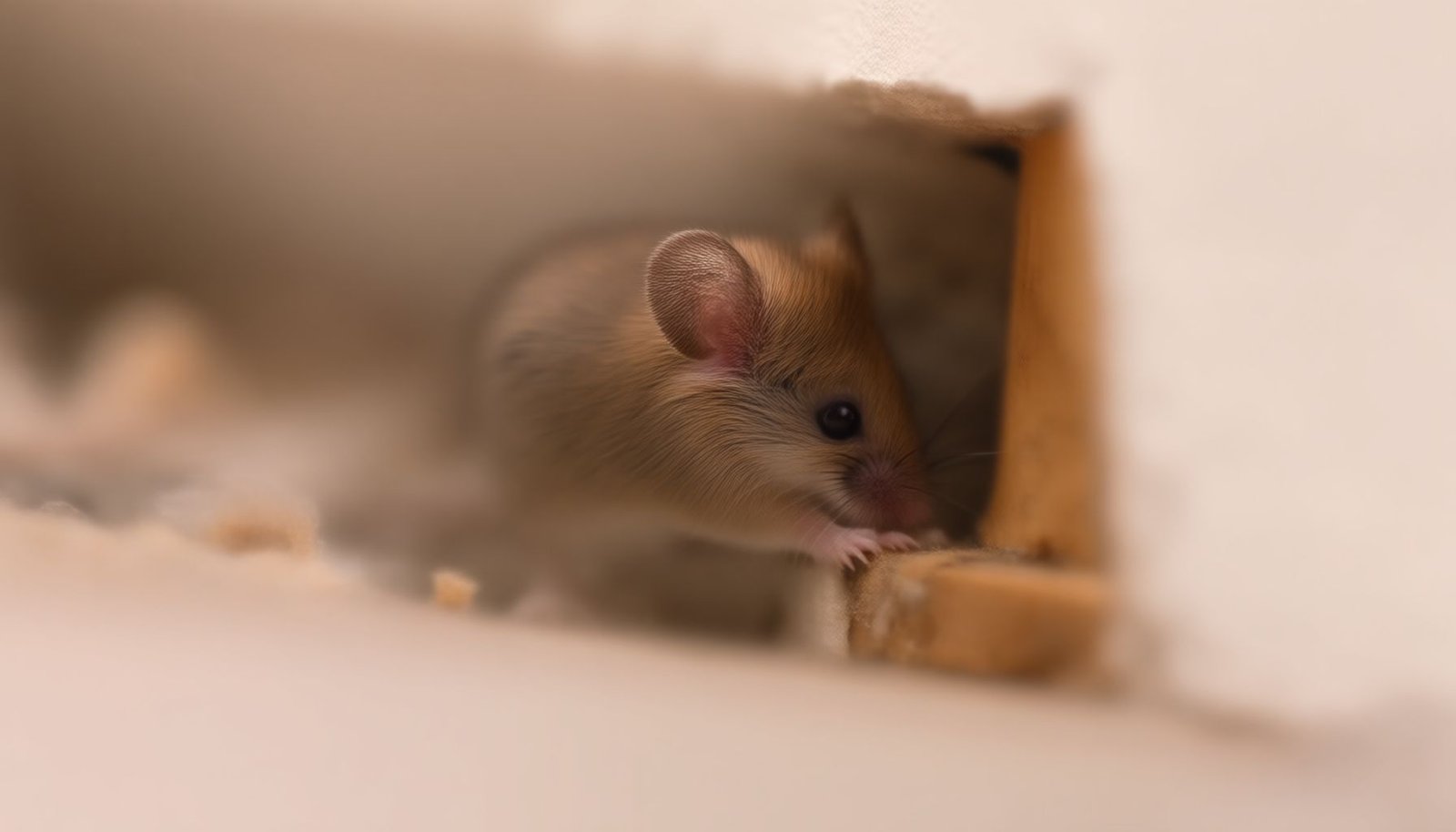
This cross-section view of a wall void shows exactly how close a mouse nest can be to your living space — often less than half an inch of drywall separates you from the activity, which explains why the sounds feel so immediate and loud at night.
What Do the Different Mouse Sounds in Walls Actually Mean?
Not all wall sounds are the same, and treating them as interchangeable is one of the biggest mistakes you can make during an infestation. Each type of sound maps to a specific behavior — and knowing the difference tells you whether you’re dealing with one mouse or a colony in progress. Mice can reproduce fast enough that a pair entering your home can become a population of 20 or more within 60 to 90 days, so reading those early sounds correctly matters.
Here’s how to decode what you’re hearing:
- Rapid scratching or scurrying: This is a mouse in transit — moving along a established run inside the wall. It’s typically brief (5–10 seconds), happens repeatedly at similar times each night, and usually means the mouse has a fixed route between its nest and a food source.
- Slow, sustained scraping: This is nest-building. It’s the most ominous sound because it means a mouse has decided your wall is home. You’ll hear it in longer bursts, often concentrated in one area of the wall, and it may include the sound of soft material being torn or compressed.
- High-pitched squeaking: This is communication — typically between a mother and her pups, or between two mice competing for space or food. If you’re hearing squeaking, you almost certainly have more than one mouse.
- Gnawing or chewing sounds: A harder, more rhythmic sound. Mice have incisors that grow continuously — about 0.3mm per day — so they must chew to wear them down. Hearing gnawing in walls means they’re working on wood framing, pipes, or wiring. This is the sound that warrants the fastest response.
- Thumping or falling sounds: Less common, but it can indicate a mouse dropping from a joist or losing footing inside a wall cavity. It sometimes sounds like a small object being knocked over. It’s easy to dismiss this one as a fluke — don’t.
Which Walls Are Mice Most Likely to Be In?
Mice don’t pick walls at random. They follow heat gradients, food smells, and established scent trails left by previous mice. Exterior walls, especially on the north or east face of a house, are almost never where mice nest — they’re too cold. The sounds you hear in those walls are usually just transit paths.
Interior walls adjacent to the kitchen, walls that share a run with plumbing, and walls near the furnace or utility room are where you’ll find nests. These spots stay warm, they’re close to food odors, and they’re quieter during the day. Mice are remarkably consistent creatures — they’ll use the same 10- to 30-foot radius for most of their lives once they’ve established a territory. So if you hear scratching in a specific corner of your bedroom wall every night at around 11pm, it’s not a coincidence. That’s a fixed route.
Pro-Tip: Press your ear against the drywall in different spots during the first hour after the house goes quiet. The spot where the sound is loudest and most concentrated is likely either directly above or below the nest. Mark it with a small piece of painter’s tape — this tells your exterminator exactly where to focus, and it can shorten the job significantly.
How Do Mouse Sounds Compare to Other Animals in Walls?
This is where a lot of people go wrong — they hear something in the wall, assume it’s mice, buy snap traps, catch nothing, and conclude the problem is gone. But rats, squirrels, and even birds can make sounds that are easy to confuse with mice, and they require completely different responses. Misidentifying the animal costs time and money, and in the case of squirrels or rats, the problem keeps getting worse while you’re setting the wrong traps.
| Animal | Sound Characteristics | Time of Activity | Key Difference |
|---|---|---|---|
| House Mouse | Light scratching, soft squeaking, rapid scurrying | Mostly 11pm–3am | Sounds small and fast; repeats in short bursts |
| Norway Rat | Heavier thumping, louder gnawing, low-pitched squealing | Dusk and pre-dawn | Noticeably heavier footfall; slower, more deliberate movement |
| Squirrel | Rapid running back and forth, rolling sounds (nuts), chattering | Daytime, especially dawn | Almost entirely daytime activity; distinctive rolling sound |
| Bird | Fluttering, pecking, occasional chirping | Early morning only | No scratching; wing flutter sound is unmistakable |
The weight difference between a house mouse and a Norway rat is dramatic — a mouse weighs about 0.5 to 1 ounce, while a rat can hit 12 ounces or more. You feel that difference in the sound even through drywall. Mice sound like a nervous energy; rats sound like something with business to attend to. Just like identifying other hidden threats in your home requires knowing exactly what you’re dealing with — the way you’d approach What Do Grain Beetles Look Like in Cereal and Stored Food? before treating a pantry problem — getting the animal right before setting traps saves a lot of wasted effort.
Can Sound Alone Tell You How Many Mice Are in Your Walls?
Not exactly — but it gives you a reasonable range. A single mouse makes intermittent, irregular sounds with no overlap. Two mice will occasionally produce simultaneous sounds from different locations, and you’ll start hearing the squeaking of interaction. Once you’re at five or more mice, the sounds become more continuous during peak activity hours, often layered — scratching in one wall while gnawing is happening in another.
The honest nuance here is that sound alone is unreliable in older homes with complex wall structures, or in homes with blown-in insulation, which muffles sound significantly. A house with fiberglass batt insulation in the walls will transmit mouse activity loudly and clearly. The same infestation in a house with dense-pack cellulose insulation might be nearly silent. So if you’ve got an older craftsman or a heavily insulated modern build and you’re hearing even faint sounds, the actual activity level may be higher than the noise suggests.
“Homeowners consistently underestimate infestations based on sound. The absence of loud noise doesn’t mean the absence of mice — it often just means the walls are insulated. By the time most people call us, the evidence on the floor of the wall cavity tells a very different story than what they heard from bed. We find droppings, nesting material, and food caches that represent weeks of activity. Sound is a signal, not a census.”
Dr. Marcus Fielding, Urban Rodentologist and NPMA-Certified Pest Management Professional, Midwest Pest Research Institute
What Should You Do the Night You First Hear Mice in the Walls?
The temptation is to do nothing and wait to see if it happens again. That’s the wrong call. Mice don’t pass through — if you’re hearing them in your walls at night, they’ve already scouted the route, found a reason to be there, and are establishing a pattern. A female house mouse can begin producing a litter of 6–8 pups within 19–21 days of becoming pregnant, and she’ll be ready to breed again within 24 hours of giving birth. Waiting a week to “see if it gets worse” is giving a lot of ground, fast.
That first night, do these things before you go back to bed:
- Note the exact location of the sound and the time — this tells you where the run or nest is and when activity peaks
- Check the kitchen for droppings (under the stove, behind the fridge, inside lower cabinet corners) — fresh droppings are dark and moist, and they confirm the mouse is accessing your living space, not just the wall void
- Inspect the exterior foundation for gaps — mice can squeeze through any opening larger than ¼ inch, roughly the diameter of a pencil, and they almost always enter at or below the foundation level
- Place a snap trap baited with peanut butter directly against the baseboard in the room closest to the sound — perpendicular to the wall, with the trigger facing the baseboard, not parallel to it
- Do not use poison bait inside walls — a poisoned mouse will often die in the wall void and create a decomposition odor that’s extremely difficult to locate and remove
One thing worth knowing: the counterintuitive fact that most pest guides skip over is that snap traps placed the first night — before the mice become “trap shy” — have a dramatically higher catch rate than traps placed after several days of infestation. Mice that have had time to associate your intervention with danger become significantly harder to trap. That first 24–48 hours is a real window.
It’s also worth remembering that some pest situations demand professional evaluation even when they don’t seem life-threatening at first glance — just as a seemingly minor problem like a Are Scorpion Stings Dangerous to Adults, Kids and Pets? question often turns out to have more nuance than people expect. The same is true here: what sounds like one mouse occasionally scratching can be the edge of a colony that’s been in place for weeks. If you catch a mouse within the first two nights, don’t stop — keep traps set for at least another week, because mice almost never travel alone for long.
The sounds in your walls at night are telling you something specific. Listen to them like information, not background noise — because the difference between a one-mouse problem and a full nest situation is often just a matter of how quickly you act on what you heard.
Frequently Asked Questions
What sounds do mice make in walls at night?
Mice in walls typically make scratching, gnawing, and scurrying sounds — kind of like someone crumpling paper or dragging small objects. You might also hear faint squeaking, especially if there’s a nest with young mice nearby. These sounds are most active between dusk and about 2 AM, when mice are out foraging.
How do I know if it’s mice or rats in my walls?
Mice produce lighter, faster scurrying sounds and high-pitched squeaks, while rats make heavier thumping and dragging noises that are noticeably louder. Rats also tend to move slower and more deliberately, so if the sounds feel heavy or rhythmic, there’s a good chance it’s rats. The location matters too — mice are more likely in upper wall cavities, while rats often stick to lower walls and floor-level spaces.
Why do I only hear mice in my walls at night?
Mice are nocturnal, so they’re most active after dark when the house is quiet and they feel safer moving around. The silence of nighttime also makes the sounds easier to pick up — what you’re hearing at 1 AM was likely happening at lower levels during the day too. If you start hearing them during daylight hours, it usually means the infestation has grown large enough that competition for food is pushing some mice out earlier.
Can mice in walls cause damage to my house?
Yes — mice constantly gnaw to keep their teeth trimmed, and that includes electrical wiring, insulation, wood studs, and PVC pipes inside your walls. Chewed wiring is one of the leading causes of house fires linked to rodents. Even a small infestation of 5 to 10 mice can cause significant structural and electrical damage within just a few weeks if left unchecked.
What should I do if I hear scratching in my walls at night?
Start by checking for entry points around your home’s exterior — mice can squeeze through gaps as small as a quarter inch, so look around utility lines, vents, and foundation gaps. Set snap traps inside the wall cavity by placing them near any access holes, using peanut butter as bait. If you’re hearing sounds in multiple rooms or the activity doesn’t stop within a week or two of trapping, it’s worth calling a pest control professional to assess the full extent of the infestation.