
Citronella candles do almost nothing to protect your yard from mosquitoes. That’s not an opinion — it’s the conclusion of a University of Guelph study that found citronella candles reduced mosquito landings by less than 42% even when testers were sitting directly beside them, and the effect drops to near zero beyond a two-foot radius. Yet citronella candles are still the first thing most homeowners reach for every summer, while the products that actually work sit on store shelves collecting dust. This guide cuts through the noise on mosquito repellents for yard and patio — specifically the ones that treat your outdoor space, not just your skin — and explains why the most popular options often fail while some underrated ones quietly work.
Why Most Yard Mosquito Repellents Fail Before You Even Open the Box
The single biggest mistake homeowners make is choosing a repellent based on what it smells like instead of how it actually works. Mosquitoes locate you through a combination of carbon dioxide from your breath, body heat, and specific chemical compounds like lactic acid from your skin — and most scent-based repellents only mask one of those signals weakly. A mosquito flying 30 feet away isn’t deterred by your citronella torch. She’s already locked onto your CO2 plume from across the yard.
There’s also a coverage problem that most product labels quietly ignore. Your patio might be 400 square feet, but wind, air currents, and the open-air nature of outdoor spaces mean that any airborne repellent disperses fast. Products designed for indoor use — diffusers, candles, even some plug-in units — lose effectiveness almost immediately outdoors. The only outdoor products that reliably work are those designed to either treat the surfaces mosquitoes land on, create a genuine barrier, or draw and kill mosquitoes before they reach you.
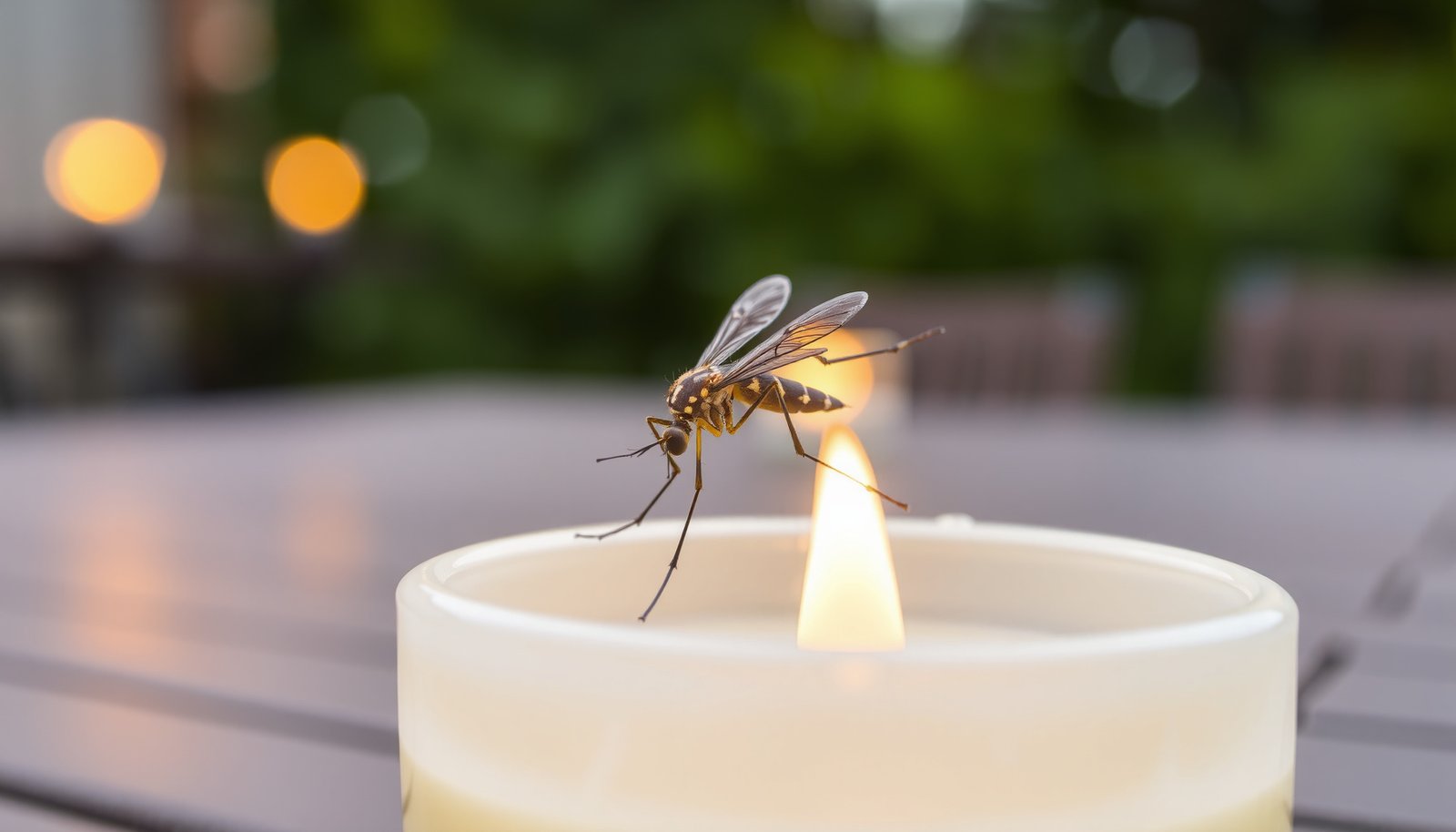
This close-up shows the difference in spray coverage between a broadcast yard treatment and a candle-type repellent — understanding surface area versus air dispersion is exactly why product choice matters so much for outdoor protection.
What Types of Mosquito Repellents Actually Work for Yards and Patios?
There are four categories worth your money for outdoor mosquito control. Each one works through a different mechanism, and the best setups typically combine at least two of them. Here’s how to think about each category before you buy anything:
- Residual yard sprays (permethrin-based): These are applied to grass, shrubs, and landscaping — not to people or pets. Permethrin binds to plant surfaces and kills or repels mosquitoes on contact for up to 3–4 weeks per application. Brands like Spectracide Triazicide and Bifen I/T (bifenthrin) use similar mechanisms. These are the workhorses of serious outdoor mosquito control.
- Propane-powered mosquito traps: Devices like the Mosquito Magnet series emit CO2, heat, and octenol (a chemical that mimics human breath) to draw mosquitoes in and trap them. They work best in yards larger than 1/4 acre and need 2–3 weeks to reduce local mosquito populations noticeably — they’re not a same-day fix.
- Oscillating fans with DEET-based spatial repellents: A surprisingly effective low-tech option — mosquitoes are weak fliers and struggle against airflow above 1 mph. Combining a large oscillating fan with a nearby spatial repellent device (like Thermacell) disrupts their approach vector on a small patio better than most dedicated gadgets.
- Thermacell devices (allethrin-based): These use a small heat source to vaporize synthetic pyrethroid into the air in a localized zone — roughly 15 square feet per device for the standard unit, 20 feet for the EX90. They don’t kill mosquitoes; they repel them from the treated airspace. Genuinely effective for sitting areas, not for walking around the yard.
- Bacillus thuringiensis israelensis (Bti) dunks: These aren’t repellents — they’re larvicides. But skipping them while buying repellents is like mopping water while the faucet’s still running. Mosquitoes breed in as little as a teaspoon of standing water, and Bti kills larvae before they become biting adults. Every birdbath, planter saucer, and clogged gutter on your property is a breeding site.
The counterintuitive insight here: the most effective yard mosquito strategy isn’t about repelling the mosquitoes that are already there — it’s about reducing the number that hatch in your yard in the first place. Treat standing water with Bti monthly (each dunk treats 100 square feet of water surface), apply a residual spray to your landscaping every 3–4 weeks, and use a Thermacell when you’re actually sitting outside. That layered approach outperforms any single product by a significant margin.
Which Yard Spray Is Best: Permethrin, Bifenthrin, or Natural Alternatives?
Picture this: you spray your backyard on a Saturday morning, have a perfect mosquito-free barbecue that afternoon, and then two days later you’re getting eaten alive again. That’s not the product failing — that’s the difference between permethrin, bifenthrin, and what’s actually happening in your yard. Here’s how the main chemical classes compare:
| Active Ingredient | Residual Duration | Best Use | Pet/Child Safety Note |
|---|---|---|---|
| Permethrin (0.5%) | 2–4 weeks | Lawn, ornamental plants, shrubs | Toxic to cats until dry; safe when dry |
| Bifenthrin (0.3%) | 4–6 weeks | Lawn, perimeter, mulch beds | Low mammalian toxicity; avoid fish ponds |
| Lambda-cyhalothrin | 3–4 weeks | Spot treatments, perimeter | Similar to bifenthrin profile |
| Rosemary/Cedar oil (natural) | 3–7 days | Low-pressure zones, garden areas | Generally safe; much shorter residual |
Bifenthrin (the active ingredient in Bifen I/T and Ortho Home Defense Outdoor) edges out standard permethrin for yard applications because it bonds more tightly to organic matter like soil and mulch, which is exactly where mosquitoes rest during the day. Female mosquitoes spend 90% of their time resting in cool, shaded, humid vegetation — not flying around your patio. Spraying the undersides of shrubs and low ground cover hits them where they actually live, not just where you’re afraid they might go.
Natural alternatives like cedar oil or geraniol-based sprays are legitimate options, especially if you have cats (permethrin is acutely toxic to cats), but be realistic about expectations. Their residual window is measured in days, not weeks, and you’ll need to reapply after any rain. They’re a reasonable choice for small patios or households with multiple outdoor pets — just know you’re committing to more frequent applications.
Are Mosquito Traps Worth the Investment for Backyard Use?
“I spent $400 on a Mosquito Magnet and still got eaten alive all summer” is a complaint you’ll find on every outdoor living forum — and it’s almost always caused by two things: placement errors and unrealistic timelines. Propane mosquito traps work by mimicking a large mammal. They emit CO2 at a rate of roughly 0.5–1 lb per day (similar to a resting adult), warmth, moisture, and octenol, which is a fermentation byproduct that specifically attracts Aedes and Culex mosquitoes. When it works, it genuinely reduces local mosquito populations — but it takes time.
Placement is everything with propane traps. The trap should be positioned upwind of your sitting area, at least 30–40 feet away, so it intercepts mosquitoes before they reach you — not next to the patio table. Most homeowners put the trap near where they sit, which makes it compete with them for mosquito attention instead of acting as a lure drawing mosquitoes away. Give any propane trap 3–4 weeks of continuous operation before judging its effectiveness; the goal is population reduction over a season, not instant relief.
Pro-Tip: Add octenol cartridges to your trap if you’re in the eastern US (where Aedes mosquitoes dominate), but switch to Lurex3 attractant if you’re in the Gulf Coast or southeastern states — it’s more effective against the Asian tiger mosquito (Aedes albopictus), which is now established in 40 US states and bites aggressively during the day, not just at dusk.
What About Misting Systems and Professional Yard Treatments — Are They Worth It?
Automated misting systems — the kind with nozzles mounted around your fence line that spray on a timer — are genuinely effective, but they come with honest tradeoffs that most promotional material glosses over. They typically use pyrethrins or permethrin diluted in water, misting for 30–60 seconds every few hours at dawn and dusk when mosquitoes are most active. A professionally installed system runs $1,500–$3,000 upfront plus refill costs. DIY drum systems from companies like MistAway run $600–$900 for equipment alone.
“The biggest gap in how homeowners approach yard mosquito control is treating it as a one-product problem. The yards with genuinely low mosquito pressure all have three things in common: they’ve eliminated standing water, they’re doing monthly residual treatments to the vegetation, and they’re using a localized repellent device when people are actually sitting outside. No single product does all three jobs well.”
Dr. Stacy Hollenbeck, Board-Certified Entomologist and Urban Pest Management Specialist, Texas A&M AgriLife Extension
The environmental concern with misting systems is real and worth acknowledging: broad-spectrum pyrethroids kill pollinators, beneficial insects, and aquatic invertebrates when they drift or run off. If you have a garden with active pollinators or a koi pond nearby, a misting system timed to spray during peak pollinator hours (mid-morning to mid-afternoon) is a bad fit. Some newer systems use essential oil blends during daytime cycles and reserve pyrethrin mists for dusk-only timing — a reasonable compromise that’s worth asking about if you’re getting quotes. On smaller lots under a quarter-acre, a professional spray service every 3 weeks often gives equivalent results at lower cost and environmental impact than an installed system.
What Should You Actually Buy? A Practical Setup by Yard Size
Honest answer: there’s no single “best” mosquito repellent for every yard. A 600-square-foot apartment patio in Florida has completely different needs than a half-acre wooded lot in Maryland. Here’s how to match products to your actual situation without overcomplicating it:
- Small patio or deck (under 200 sq ft): One Thermacell EX90 device plus a large oscillating fan positioned to push air across the seating area. Add Bti dunks to any nearby standing water. Total cost under $60. Reapply Thermacell mats every 4–6 hours of use.
- Medium yard (200–1,000 sq ft): Bifen I/T or Ortho Home Defense yard spray applied to all vegetation every 4 weeks, plus a Thermacell for sit-down use. Apply spray to the undersides of leaves and shrubs, not just the lawn surface.
- Large yard with lawn (1,000+ sq ft): Broadcast bifenthrin treatment via hose-end sprayer (Bifen I/T mixes at 0.33 oz per gallon), a propane mosquito trap positioned upwind of main seating areas, and monthly Bti dunk treatment of any water features or drainage areas.
- Wooded or heavily shaded yard: Shade means more resting mosquitoes in vegetation. Prioritize foliar residual sprays over lawn treatment — spray shrub undersides and dense ground cover first. Consider a professional service for the initial knockdown treatment before maintaining with DIY methods.
- Households with cats or fish ponds: Use cedar oil or rosemary oil-based yard sprays (EcoSmart Yard & Garden, Wondercide Outdoor Pest Control). Apply more frequently (every 5–7 days) and keep cats indoors for 2–3 hours after any spray application, even natural ones, until fully dry.
One thing worth saying plainly: if you’re dealing with a severe mosquito problem and also noticing other pest issues around your property — like termite mud tubes along your foundation or damage to stored items that could be confused with other pests — it may be worth a broader property inspection before spending heavily on any single treatment category. Pest pressure often comes from multiple sources, and solving one problem while missing another is an easy and expensive mistake. Similarly, if you’re finding unusual insect damage indoors while battling outdoor mosquitoes, it’s worth checking whether other insects are using your outdoor-to-indoor entry points — detailed guides like how to get rid of clothes moths can help rule out unrelated infestations that sometimes get misattributed to seasonal insect pressure.
The best setup is the one you’ll actually maintain consistently. A perfect mosquito control plan that requires you to reapply every 5 days will fail by mid-July when you get busy. Pick a routine that fits your schedule, automate what you can (timer-based misting, monthly Bti dunks on a calendar reminder), and prioritize eliminating breeding sites over buying more repellent gear — because a mosquito that never hatches in your yard is the only one you’ll never have to repel.
Frequently Asked Questions
What is the most effective mosquito repellent for a large yard?
For large yards, propane mosquito traps and yard sprays containing permethrin or bifenthrin tend to give the best coverage — some sprays protect up to half an acre per application. Mosquito misting systems are another strong option if you’re dealing with a serious infestation, since they can be timed to spray automatically at dusk and dawn when mosquitoes are most active.
How long does yard mosquito spray last after you apply it?
Most permethrin-based yard sprays last 4 to 6 weeks, though heavy rain can cut that down significantly — if you get more than an inch of rain shortly after spraying, you’ll likely need to reapply sooner. Some professional-grade sprays advertise up to 8 weeks of protection, but real-world results are usually closer to 3 to 4 weeks in humid climates.
do mosquito repellent plants actually work for patios?
Plants like citronella, lavender, and lemon balm do contain compounds that repel mosquitoes, but they don’t release enough of those compounds just by sitting there to make a noticeable difference on your patio. You’d need to crush or burn the leaves to get any real effect, so they’re better thought of as a nice bonus than a standalone solution.
are mosquito coils safe to use on a covered patio?
Mosquito coils aren’t great for enclosed or semi-enclosed spaces because they release smoke that contains particulate matter and compounds like carbon monoxide — not something you want building up where you’re sitting for hours. If your patio has decent airflow, occasional use is unlikely to cause harm, but they work better in open outdoor areas and shouldn’t be used around kids or people with asthma or respiratory issues.
what’s the difference between a mosquito trap and a mosquito repellent for the yard?
A mosquito repellent keeps mosquitoes away from a specific area, while a trap actually lures and kills them — propane traps like Mosquito Magnet attract mosquitoes using CO2 and then trap or kill them, which can reduce the local population over time. Repellents are better for immediate relief during outdoor activities, while traps work best as a long-term population control strategy when placed away from where you spend time.