
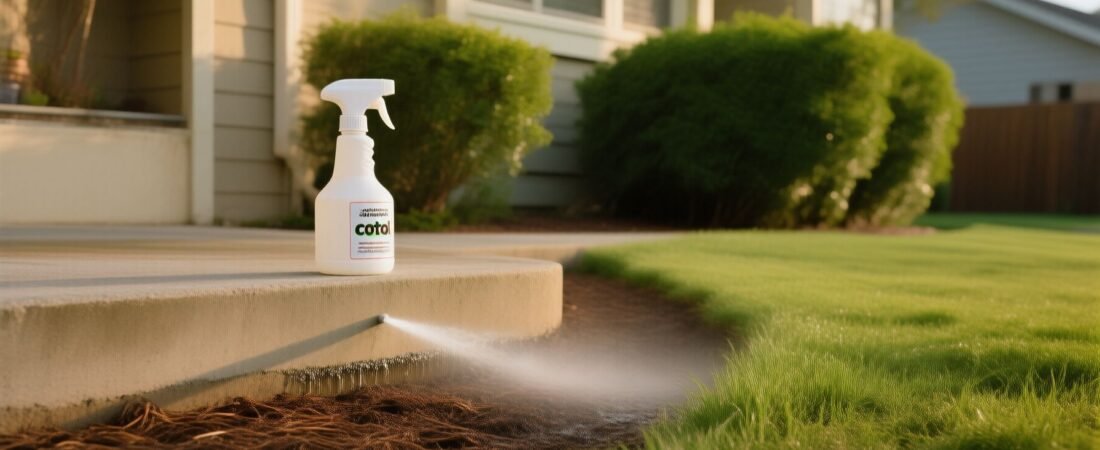
Perimeter spraying works — but only if you’re not making the mistake that quietly cancels out everything you just applied. Most homeowners spray around their foundation and figure they’re done. What they don’t realize is that the application pattern matters as much as the product itself, and a 6-inch spray band when you need 10 feet of coverage is basically decorative. The real reason perimeter sprays fail isn’t the formula — it’s that people treat them like a force field you spray once and forget, instead of a renewable barrier with a biological clock.
Why Most Perimeter Sprays Fail Before the Bugs Even Reach Your Door
Here’s the counterintuitive part: a lot of homeowners buy a perfectly good insecticide and still end up with ants in the kitchen two weeks later, and they blame the product. The real culprit is usually application width. A proper perimeter treatment needs to cover at least 3 feet up the foundation wall and 3–10 feet out across the ground — anything narrower and fast-moving insects like German cockroaches or odorous house ants simply walk around the treated zone before it even dries. Pyrethroid-based sprays don’t create a contact barrier the instant they’re applied; they need to be walked through or groomed off to work on most insects.
Rain is the other silent saboteur. Most residual sprays retain their killing power for 30–90 days under normal conditions, but a heavy rain within 24–48 hours of application can reduce effectiveness by more than half on porous concrete or bare soil. That’s not a failure of the product — it’s physics. Timing your spray for a dry weather window and reapplying after major rainfalls is the single most underused strategy in DIY perimeter control.
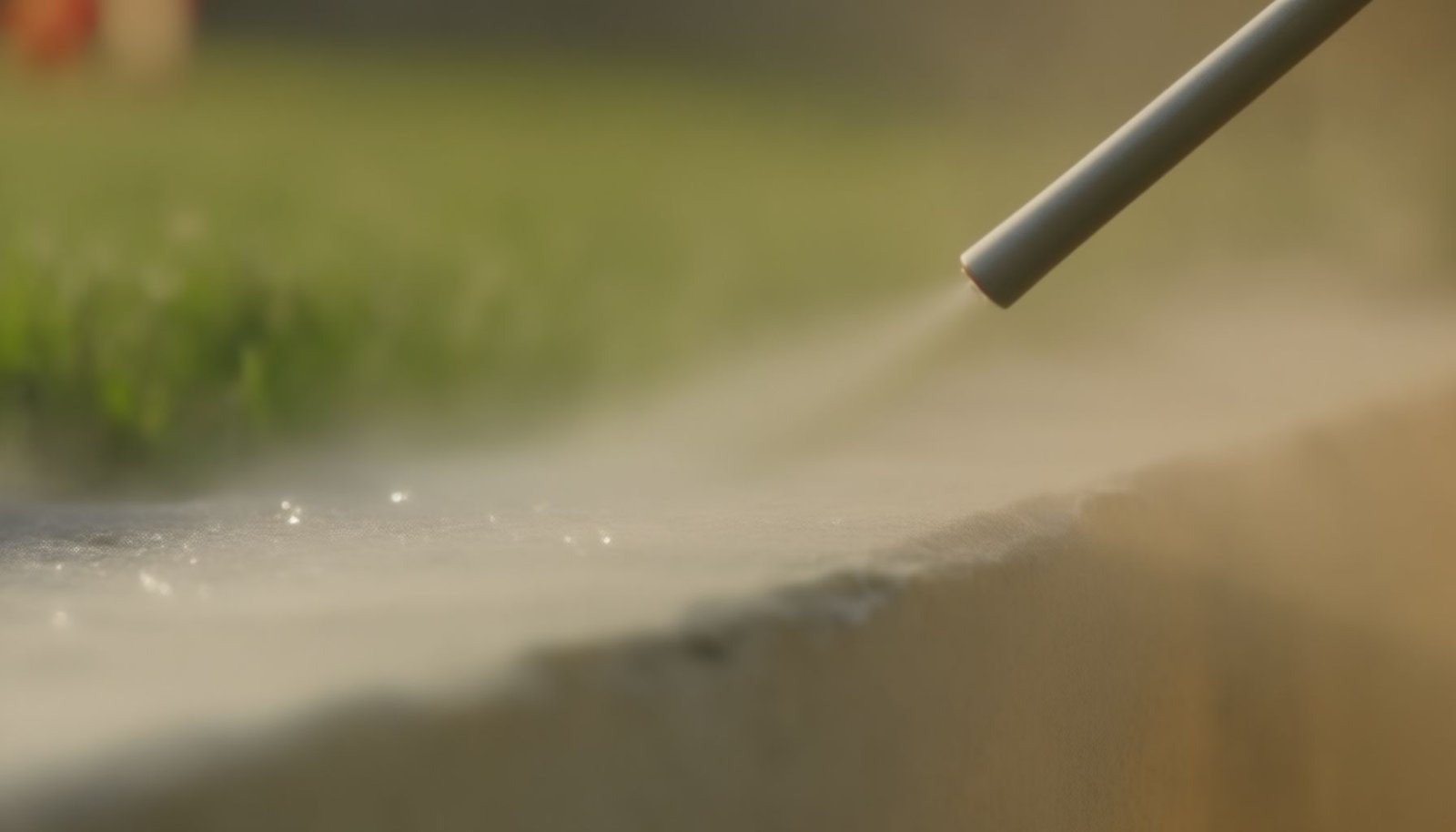
This close-up shows the difference between a uniform spray band along a foundation edge versus a thin, patchy application — a gap of even a few inches is enough for ants and roaches to find an untreated path into your home.
Which Active Ingredients Actually Hold Up Outdoors?
Not all insecticides are built for outdoor exposure. UV light, temperature swings, and moisture break down certain chemistries much faster than others — which is why the active ingredient on the label matters more than the brand name on the front. Pyrethroids like bifenthrin, permethrin, and lambda-cyhalothrin are the workhorses of perimeter control because they bind tightly to soil particles and degrade more slowly than pyrethrins (the natural version). Bifenthrin in particular has earned its reputation: at concentrations of 0.05%–0.1%, it delivers residual control for up to 90 days on non-porous surfaces like painted concrete.
Newer active ingredients like beta-cyfluthrin and zeta-cypermethrin offer similar residual profiles with slightly lower application rates, which matters if you’re worried about runoff near garden beds or water features. If you prefer a non-pyrethroid option, spinosad-based sprays are worth knowing about — they’re derived from soil bacteria, have a much better environmental profile, and work well against ants and certain beetles. That said, spinosad breaks down faster in sunlight, so you’ll need to reapply every 4–6 weeks instead of every 90 days.
| Active Ingredient | Typical Residual (Outdoors) | Best For |
|---|---|---|
| Bifenthrin | 60–90 days | Broad-spectrum perimeter, ants, roaches, spiders |
| Lambda-cyhalothrin | 30–60 days | Ants, beetles, crickets, earwigs |
| Spinosad | 4–6 weeks (UV-sensitive) | Ants, thrips, garden pests — lower environmental impact |
| Beta-cyfluthrin | 60–90 days | Heavy infestations, perimeter + lawn combo |
Which Outdoor Perimeter Pest Control Sprays Are Actually Worth Buying?
There are dozens of products on the market, and they’re not all created equal. The most reliable options for homeowners are concentrates you mix yourself — they’re significantly cheaper per gallon than ready-to-use sprays and give you control over concentration depending on pest pressure. Picture this: a homeowner in Georgia dealing with a bad carpenter ant season spending $15 on a bottle of Bifen IT concentrate that makes 25 gallons of spray versus $40 on a ready-to-use spray that covers maybe 500 square feet. The math isn’t close.
That said, ready-to-use sprays are genuinely useful for spot treatments and touch-ups between full perimeter applications — they’re just not cost-effective as your only tool. Here are the products that consistently deliver based on active ingredient efficacy, user results, and independent testing:
- Bifen IT (bifenthrin 7.9% concentrate) — One of the most-used professional-grade concentrates available to homeowners. Mix at 1 oz per gallon for general perimeter use, 2 oz for heavy infestations. Handles ants, roaches, crickets, earwigs, spiders, and more. Residual of up to 90 days on protected surfaces.
- Ortho Home Defense MAX Insect Killer (ready-to-use) — A solid bifenthrin-based RTU spray for homeowners who don’t want to mix concentrates. The built-in wand sprayer makes foundation application easier, though coverage per bottle limits it to maintenance use rather than initial treatment.
- Talstar P Professional (bifenthrin 7.9%) — Effectively the same active ingredient as Bifen IT but from a different manufacturer. Well-tolerated on landscaping when dry, and particularly effective against fire ants when watered in lightly after application.
- Suspend SC (deltamethrin 4.75%) — A good alternative for homeowners who’ve seen resistance to bifenthrin products. Deltamethrin has a slightly different mode of action and can break through where bifenthrin has lost some edge over time. Works well on spiders and larger beetles.
- Wondercide Outdoor Pest Control Spray (cedar oil-based) — The best natural option for families with young children or pets who want a lower-toxicity choice. It doesn’t have the 90-day residual of pyrethroids, but it kills on contact and is genuinely effective against mosquitoes, fleas, and ants when applied consistently every 2–3 weeks.
Pro-Tip: For maximum residual on a concrete or brick foundation, apply your perimeter spray on a warm, dry day when temps are above 50°F — most pyrethroid molecules bind more effectively to warm surfaces, and you want at least 24 hours of dry weather after application. Apply when the surface is dry but not hot enough to cause rapid volatilization (above 90°F can reduce how much active ingredient stays on the surface).
How to Apply Outdoor Perimeter Sprays So They Actually Work
Application technique is where most DIY perimeter treatments quietly fall apart. If you’ve ever wondered why your spray didn’t seem to do anything, there’s a good chance the issue wasn’t the product — it was the delivery. Perimeter insects aren’t crawling through the air; they’re moving along the ground, through mulch, and up foundation walls. Your spray needs to intercept those travel corridors completely, not just wet the surface.
Follow these steps in order for a proper perimeter application:
- Clear the perimeter first. Pull mulch back at least 6 inches from the foundation before spraying. Mulch acts as a sponge that absorbs and deactivates your spray before insects ever contact it, and it’s also a moisture source that attracts pests in the first place. Rake leaves and debris away from the spray zone.
- Treat the foundation wall from the bottom up. Start at ground level and spray up the wall at least 2–3 feet. Insects like silverfish, earwigs, and centipedes often enter through weep holes and cracks at ground level — they need to cross this band before reaching any entry point.
- Extend outward 3–10 feet from the wall. Three feet is the minimum; 10 feet is better for heavy pressure or areas with lots of vegetation. This is the “kill zone” where insects pick up a lethal dose before they even reach the house.
- Treat entry points specifically. Door frames, window frames, garage door thresholds, utility penetrations, and weep holes all need direct spray attention — not just a general sweep of the surrounding area. These are the 1/4-inch gaps that ants and small roaches exploit.
- Don’t forget harborage areas within 20 feet of the structure. Woodpiles, AC units, compost bins, and dense shrubs within 20 feet of the foundation are staging areas for pests before they move to the house. A quick treatment of these zones dramatically extends how long your perimeter holds.
- Reapply on schedule — not when you see bugs. Waiting until you have visible activity to reapply means the barrier has already broken down. Set a calendar reminder for every 60–90 days for pyrethroid-based sprays, every 4–6 weeks for natural options.
“The single biggest mistake I see homeowners make is treating the perimeter like a one-time event. A perimeter spray is a renewable system — the chemistry degrades, rain washes it away, and UV breaks it down. Homeowners who treat quarterly and maintain good exclusion practices around the foundation see dramatically better results than those who spray once and expect year-round coverage.”
Dr. Karen Vail, Extension Urban Entomologist, University of Tennessee Institute of Agriculture
What Perimeter Sprays Can’t Do — And What to Pair Them With
Outdoor perimeter sprays are excellent at intercepting insects that are actively foraging from the outside in. They’re much less useful against pests that are already established inside your walls, already living in your insulation, or breeding in a moisture source inside the home. A spray around your foundation won’t solve a German cockroach colony living in a warm cabinet near your kitchen sink — those require interior gel baits and IGR treatment, a completely different approach. Perimeter sprays are a prevention and interception tool, not a treatment for existing interior infestations.
The most effective pest control programs pair a perimeter spray with physical exclusion — sealing gaps, fixing door sweeps, caulking around pipes — and targeted interior products where needed. If ants keep showing up in your kitchen despite good perimeter coverage, the issue is probably that they’re already nesting inside a wall void or have found a gap in your exclusion. In that case, you’ll want to dig into how to get rid of ants on the kitchen counter for an interior strategy that works alongside your perimeter treatment. Similarly, if your pest pressure is bed bugs being tracked in from furniture or travel — those are interior problems entirely outside what a perimeter spray addresses, so pairing with the right interior protocol (like the approach outlined for getting rid of bed bugs in a couch) is where your energy needs to go.
One honest nuance worth calling out: in climates with mild winters, perimeter sprays need to run year-round because pest activity never fully stops. In northern states where ground freezes solid, you can scale back to 2–3 applications between spring thaw and first frost and still maintain effective coverage. Don’t let a company or product label push you into a quarterly subscription if your climate and pest pressure don’t warrant it — the right schedule depends on where you live, what pests you’re dealing with, and how well-sealed your home already is.
A perimeter spray is one of the highest-value tools a homeowner can have — not because it eliminates every pest problem, but because it reduces the constant immigration pressure that makes indoor infestations hard to control. Keep the barrier tight, keep it renewed, and treat the house itself as the thing worth protecting rather than the spray as the whole solution. When the chemistry, the timing, and the exclusion work together, you stop most of what’s trying to get in before it ever becomes a problem you’re trying to get rid of.
Frequently Asked Questions
How often should I apply outdoor perimeter pest control spray around my house?
Most outdoor perimeter pest control sprays need to be reapplied every 30 to 90 days depending on the product and how much rain you get. Concentrate formulas like Bifen IT or Suspend SC tend to last longer than ready-to-use sprays. After heavy rain or if you’re seeing bugs again sooner than expected, go ahead and reapply early.
How far out from my house should I spray for perimeter pest control?
You want to spray at least 3 feet up the foundation and 3 to 6 feet out along the ground to create an effective barrier. For heavier infestations or larger pests like roaches and spiders, extending that band out to 10 feet gives you better protection. Don’t forget to treat around door frames, window sills, and any cracks where pests can sneak in.
Are outdoor perimeter pest control sprays safe for pets after they dry?
Most pyrethroid-based sprays — like those containing bifenthrin or permethrin — are considered safe for pets once they’re fully dry, which typically takes 30 to 60 minutes. Keep dogs and cats off treated areas until the spray has completely dried and there’s no visible sheen on the surface. Always check the label, since some products have specific re-entry intervals listed.
What bugs does perimeter spray actually keep away?
A good outdoor perimeter pest control spray will handle ants, spiders, roaches, earwigs, silverfish, centipedes, and stink bugs — basically most common household invaders that enter through the foundation or ground level. Broad-spectrum concentrates with bifenthrin or lambda-cyhalothrin cover the widest range of pests. If you’re dealing with mosquitoes or fleas specifically, look for a product that lists those on the label since not all perimeter sprays cover them.
Can I use a garden hose sprayer to apply perimeter pest control concentrate?
You can, but a pump sprayer gives you a lot more control over where the product goes and how much you’re applying. Hose-end sprayers work for treating larger yard areas but they’re harder to dial in for a tight perimeter band around your foundation. For most homeowners, a 1- or 2-gallon pump sprayer is the better tool for accurate perimeter treatments.