
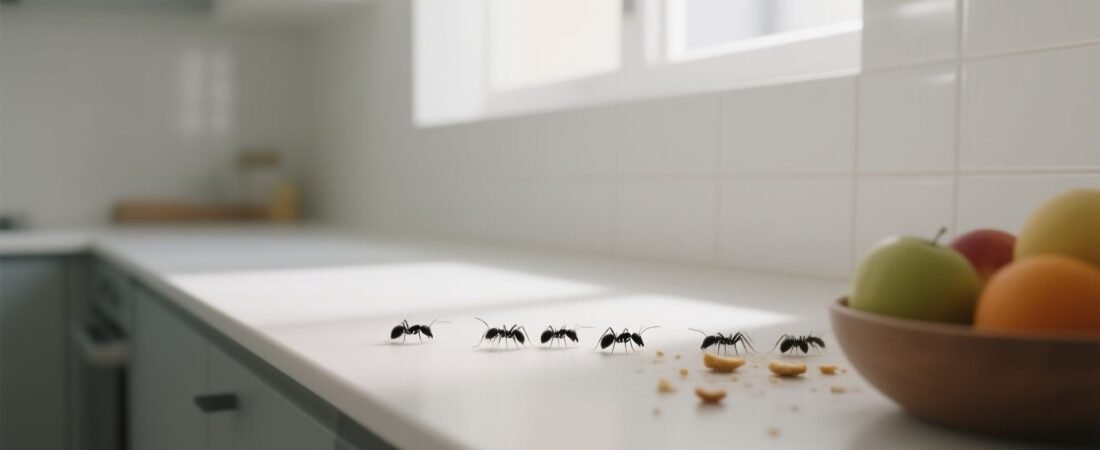
Wiping down your counters every night and still waking up to ants the next morning isn’t a cleanliness failure — it’s a targeting failure. Most people treating a kitchen counter ant problem are solving the wrong problem. They’re killing the ants they can see, which are just foragers — scouts sent out by a colony that may be 50,000 workers deep and sitting comfortably inside a wall void, under a cabinet toe-kick, or in a gap behind your dishwasher. Until you understand what those visible ants are actually doing on your counter, every spray you use is just rearranging the problem.
Why Killing the Ants on Your Counter Makes the Infestation Worse
Here’s the mechanism most people never get told: forager ants are expendable. A healthy ant colony — Argentine, odorous house, or pavement ants included — produces foragers specifically to die. When you spray a contact killer on visible ants, the colony senses a disruption in pheromone communication and responds by sending more foragers down different routes. In some species, particularly odorous house ants, stress from a direct spray triggers a behavior called budding, where a segment of the colony physically splits off and relocates, turning one infestation point into two or three.
Picture this: you’ve sprayed the same corner of your counter five times in two weeks, and the ants keep appearing two feet to the left of where they were before. That’s not coincidence — that’s budding. A queen can begin producing new workers within 72 hours of establishing a satellite colony, which means your spray bottle is actively accelerating your ant problem. The only effective counter-strike is something the foragers carry back to the queen themselves.
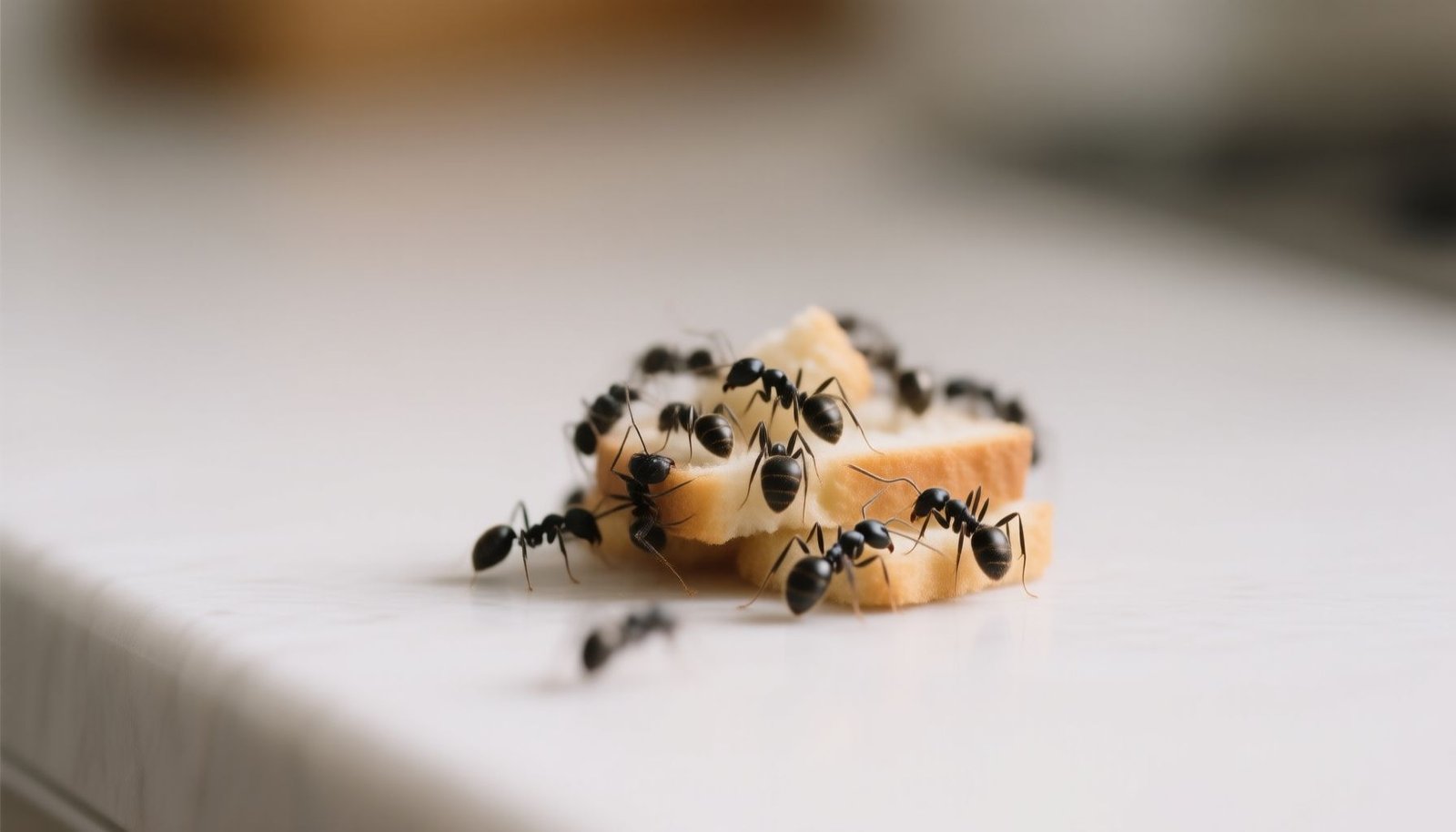
This close-up shows an active forager trail on a kitchen counter surface — notice the tight, purposeful line formation, which tells you the ants have already laid a stable pheromone trail and are running a consistent route back to the colony.
What Species of Ant Is on Your Counter — and Why It Changes Everything
Not all kitchen counter ants respond to the same treatment, and using the wrong bait for the wrong species is one of the most common reasons DIY attempts fail. Odorous house ants (the tiny dark ones that smell like rotten coconut when crushed) prefer sweet, sugar-based baits. Pavement ants and carpenter ants lean toward protein and fat-based attractants. Argentine ants — one of the most persistent kitchen invaders in warm-climate states — have massive interconnected supercolonies that can stretch across entire neighborhoods underground, meaning what you’re seeing on your counter is one thread of an enormous network.
Species identification takes less than five minutes and changes your whole strategy. Odorous house ants are 1/16 to 1/8 inch long, uniformly dark brown or black, and travel in erratic, broken lines. Pavement ants are slightly larger, have parallel grooves on their head and thorax, and move in very orderly columns. Carpenter ants are hard to miss — they’re 1/4 to 1/2 inch long and if you’re seeing them on your counter regularly, there may be a moisture-damaged wood void nearby that needs its own attention beyond just baiting. Knowing the species tells you whether to use a sugar bait, a protein bait, or both.
How to Use Bait Correctly So the Colony Actually Dies
Slow-acting bait is the entire game. The goal is for foragers to consume the bait, carry it back to the colony, share it through trophallaxis (mouth-to-mouth feeding), and ultimately deliver a lethal dose to the queen and her brood. Borax-based baits like TERRO work exactly this way — they kill slowly enough (within 24-72 hours of ingestion) that workers have time to share the toxicant before dying. Fast-acting contact sprays destroy the foragers before they can complete the return trip, which is why they feel satisfying and accomplish almost nothing.
Placement and patience are the two things most people get wrong with bait. Place bait stations directly on the active trail — not near it, on it. Don’t clean the area with any citrus or vinegar cleaner right before placement, because those compounds break down the pheromone trail the ants are following, and they’ll lose interest in the bait entirely. You’ll often see a surge in ant activity around the bait within the first 24-48 hours, which means it’s working. Resist every instinct to wipe them out — leave the bait alone for at least 5-7 days before assessing whether it needs to be refreshed or repositioned.
Pro-Tip: If your bait isn’t getting any attention after 48 hours, try switching from a sugar-based gel to a protein-based bait or vice versa — ant colonies shift their nutritional preferences seasonally, and a bait that worked in spring may be completely ignored in late summer when the colony is focused on fat and protein for reproductive growth.
“The biggest mistake I see homeowners make is treating the foragers like the problem. They’re not the problem — they’re the symptom. The colony is the problem, and the only way to reach the colony through a kitchen counter infestation is with a slow-acting bait the workers will actually transport. Spraying kills the messenger before the message gets delivered.”
Dr. Marlene Ortega, Board-Certified Entomologist and Urban Pest Management Specialist, Texas A&M AgriLife Extension
Where Are Ants Actually Entering Your Kitchen? (It’s Rarely Where You Think)
Following the trail backward is one of the most underrated steps in eliminating a kitchen ant problem. Most homeowners see ants on the counter and assume they’re coming through a window or the back door — and sometimes that’s true. But a significant portion of kitchen ant infestations originate from inside the wall cavity, entering through gaps around plumbing penetrations under the sink, spaces between the countertop and backsplash, or the gap behind a stove or refrigerator where utility lines pass through drywall. These aren’t gaps you’d notice during a normal clean, but ants can squeeze through a crack as small as 1/32 of an inch.
Spend five minutes watching the trail without disturbing it. Follow the column backward past your counter and trace it to where it disappears — into a wall, under an appliance, or through a gap in the caulking. Once you’ve identified entry points, you have two jobs: bait the trail now, and seal those entry points after the colony is eliminated (not before, or you risk trapping ants inside and forcing them to find a new exit, often deeper into your living space). Sealing entry points is part of the long-term fix, not the first step. The same careful gap-sealing logic applies across pest types — if you’ve dealt with rodent entry points, you already know this principle well, and resources like the best products to seal gaps against mice cover the mechanics of effective gap closure that translate directly to ant exclusion too.
The Permanent Fix: Eliminating the Colony and Blocking Re-Entry
Permanent ant elimination from a kitchen counter requires a two-phase approach executed in sequence, not simultaneously. Phase one is colony elimination through bait. Phase two is exclusion — sealing the physical pathways ants used to access your counter. Doing them in the wrong order (sealing first, then baiting) forces remaining ants to scatter and find alternative routes, often deeper into your home. Doing them at the same time can confuse bait placement strategy because you’re closing routes before you’ve confirmed where the main one is.
Here’s the full sequence that actually produces a lasting result:
- Identify the species — match it to the right bait type (sugar gel for sweet-feeders, protein paste for grease-feeders, or dual bait stations for unknown species).
- Place slow-acting bait directly on the active trail — use multiple small placements along the route rather than one large station at the counter surface.
- Wait 5-10 days without spraying or disturbing the trail — this is where most people fail; patience here is what kills the queen.
- Confirm trail activity has stopped — no new foragers for 48 consecutive hours means the bait has been effective at the colony level.
- Seal all identified entry points — use food-safe silicone caulk around plumbing gaps, backsplash edges, and appliance utility penetrations; replace worn weatherstripping on any exterior doors that open into or near the kitchen.
- Apply a residual perimeter treatment outdoors — a bifenthrin or deltamethrin-based granule or spray around the foundation creates a barrier that discourages new colonies from establishing access routes to your home.
One honest nuance worth acknowledging: in humid, warm-climate states like Florida, Texas, and the Gulf Coast region, Argentine ant supercolonies are so vast and interconnected that even successful colony elimination through baiting may only reduce pressure temporarily. New foragers from adjacent satellite colonies can reinstate a trail within weeks. In those situations, ongoing perimeter maintenance with a slow-release granular insecticide isn’t overkill — it’s realistic long-term management. The approach differs depending on where you live and which species you’re dealing with.
What to Stop Using on Your Kitchen Counter if You Want Ants Gone
The counterintuitive fact that almost no pest control article will tell you plainly: the more products you use, the harder the problem gets to solve. Contact sprays, essential oil repellents, vinegar wipes, and diatomaceous earth applications along the counter all disrupt pheromone trails — and disrupted trails mean ants go looking for new routes, which means new points of entry and more scattered activity. You’re not eliminating the pressure, you’re redistributing it.
Here’s what to stop doing immediately if you want bait to work:
- Stop spraying contact killer on visible ants — it kills the foragers carrying bait back to the colony before they get there.
- Stop wiping counter trails with citrus or vinegar cleaners — these compounds chemically disrupt the pheromone trail ants are following, causing them to create new ones in different locations rather than consolidating on bait.
- Stop applying diatomaceous earth on active trails — DE kills by dehydrating the exoskeleton, which works on individual ants but doesn’t address the colony, and it physically disrupts the trail pattern you need intact to guide ants to bait.
- Stop using peppermint or tea tree oil sprays along entry routes — repellents scatter ant activity but don’t eliminate colonies, and scattered activity is harder to bait effectively.
- Stop deep-cleaning under appliances while the bait is active — strong cleaning product residues left near bait stations can mask the attractant scent or contaminate the bait itself.
There’s a useful parallel here with other pest categories where doing too much too fast backfires — pest control in general rewards restraint and strategy over frantic multi-product use. The same principle applies whether you’re dealing with mites tracked in from wildlife in your attic (something covered thoroughly in articles on best bird mite sprays and dusts for attics) or ants running laps on your countertop. Match the tool to the mechanism, not to the urgency you feel.
| Ant Species | Preferred Bait Type | Colony Size (Approx.) | Typical Elimination Timeline with Bait |
|---|---|---|---|
| Odorous House Ant | Sweet / sugar gel (borax-based) | 10,000–100,000 workers | 7–14 days |
| Pavement Ant | Protein / grease paste | 3,000–5,000 workers | 5–10 days |
| Argentine Ant | Sweet gel (multiple stations) | Up to several million (supercolony) | 14–30 days, with ongoing perimeter management |
| Carpenter Ant | Protein gel + perimeter spray | 3,000–10,000 workers | 10–21 days (moisture source must also be addressed) |
Getting rid of ants on your kitchen counter permanently isn’t a product problem — it’s a sequencing and targeting problem. The homeowners who win this fight are the ones who stop reacting to the ants they can see and start thinking about the colony they can’t. Set the bait, leave it alone, confirm the trail dies, then seal the gaps. Done in that order, with the right bait for the right species, this is a solvable problem in under three weeks for most households — and one that stays solved because you’ve addressed the source, not just the symptom.
Frequently Asked Questions
Why do I keep getting ants on my kitchen counter even after cleaning?
Even a few invisible grease smears or crumbs can attract ants, since they follow scent trails left by scouts. Wiping your counter with white vinegar or a diluted dish soap solution breaks down those pheromone trails so other ants stop following them. If cleaning alone doesn’t stop the problem, there’s likely a colony nesting nearby — inside a wall, under the floor, or outside within 100 feet of your home.
What is the fastest way to get rid of ants on kitchen counter?
Spraying ants directly with a 50/50 mix of white vinegar and water kills them on contact and erases the scent trail within minutes. For a faster knockdown, a food-safe insecticide spray like those containing pyrethrin works almost instantly on contact. That said, killing visible ants only removes maybe 5% of the colony — you’ll need bait stations to wipe out the nest for good.
What ant bait works best on kitchen counters?
Gel baits containing borax or boric acid, like Terro Liquid Ant Bait, are consistently the most effective for kitchen ants because worker ants carry the bait back to feed the queen. Place bait stations at the edges of the counter near where you see trail activity, not in the middle of the counter where you prep food. Don’t kill the ants you see — you want them to take the bait back to the colony, which typically takes 3 to 7 days to work.
Are the tiny ants on my kitchen counter dangerous?
Most tiny ants on kitchen counters, like pavement ants, odorous house ants, and ghost ants, aren’t dangerous but they do contaminate food by walking through bacteria before reaching your counter. Pharaoh ants are the exception — they’re known to spread pathogens like Salmonella and Streptococcus in homes and hospitals. If you’re seeing very pale yellowish ants barely 1/16 of an inch long, it’s worth identifying them before treating, since pharaoh ants actually scatter and multiply when exposed to repellent sprays.
How do I stop ants from coming back to my kitchen counter long term?
The most reliable long-term fix is sealing every entry point you can find — caulk gaps around pipes, backsplashes, windowsills, and baseboards, since ants can squeeze through cracks as small as 1/32 of an inch. Store all countertop food in airtight containers and wipe counters down nightly to eliminate the food smells that attract scouts in the first place. If ants return seasonally, applying an outdoor perimeter treatment around your home’s foundation every 30 to 90 days keeps them from getting close enough to move indoors.
Disclaimer: This article is for informational purposes only and isn’t a substitute for professional pest control advice. Always read and follow the product label instructions exactly — label directions are legally binding and vary by brand and active ingredient. Keep all pesticides, baits and traps away from children and pets, ventilate treated areas as directed, and consider calling a licensed pest control professional if an infestation is large, recurring, or involves a structural pest like termites or carpenter ants.