
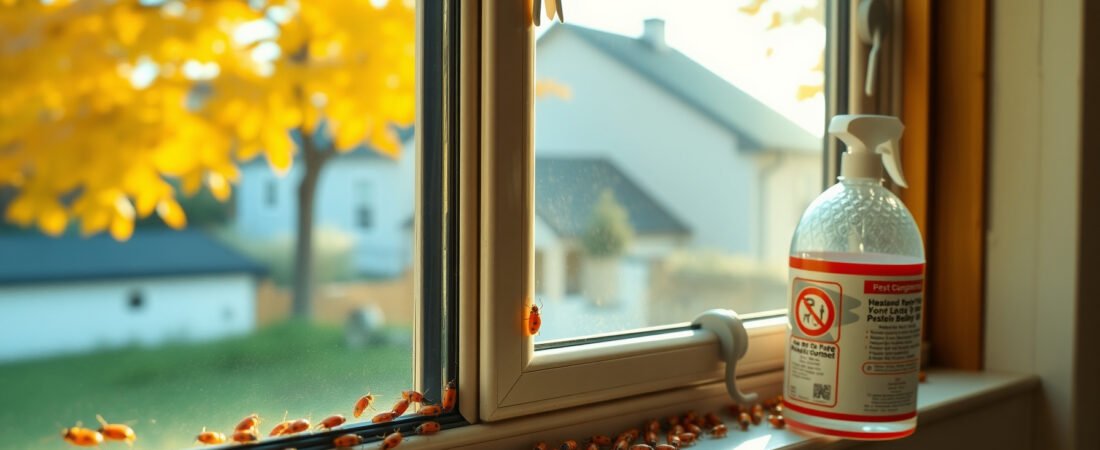
Roughly 200 million Asian lady beetles can emerge from a single overwintering site in a warm fall season — and the products most people reach for first are completely wrong for the job. Vacuum cleaners, standard insect sprays, and box-store beetle traps all get marketed to frustrated homeowners, but none of them address what actually drives a multicolored Asian lady beetle infestation: the beetles are already inside your wall voids and attic spaces before you ever notice them crawling across your ceiling. Killing the ones you can see does almost nothing when thousands more are tucked into every gap behind your siding.
Why Most Asian Lady Beetle Products Fail Before You Even Open the Box
Here’s the real problem that product reviews almost never talk about: Asian lady beetles (Harmonia axyridis) release a chemical distress signal called an aggregation pheromone when they’re disturbed or crushed. That smell — the musty, acrid odor you notice when you vacuum them up — actually attracts more beetles. It’s the pest control equivalent of shooting yourself in the foot. So when you spray a contact killer on a cluster of 50 beetles and watch them die on your windowsill, you’ve just broadcast an open invitation to the others hiding inside your walls.
The products that actually work against Asian lady beetles target three separate stages of the infestation: prevention at entry points before they cluster, treatment of void spaces where they overwinter, and trapping to intercept stragglers that emerge in late winter and early spring. No single product handles all three. If you buy just one item from the hardware store, you’re almost certainly only solving one-third of the problem.
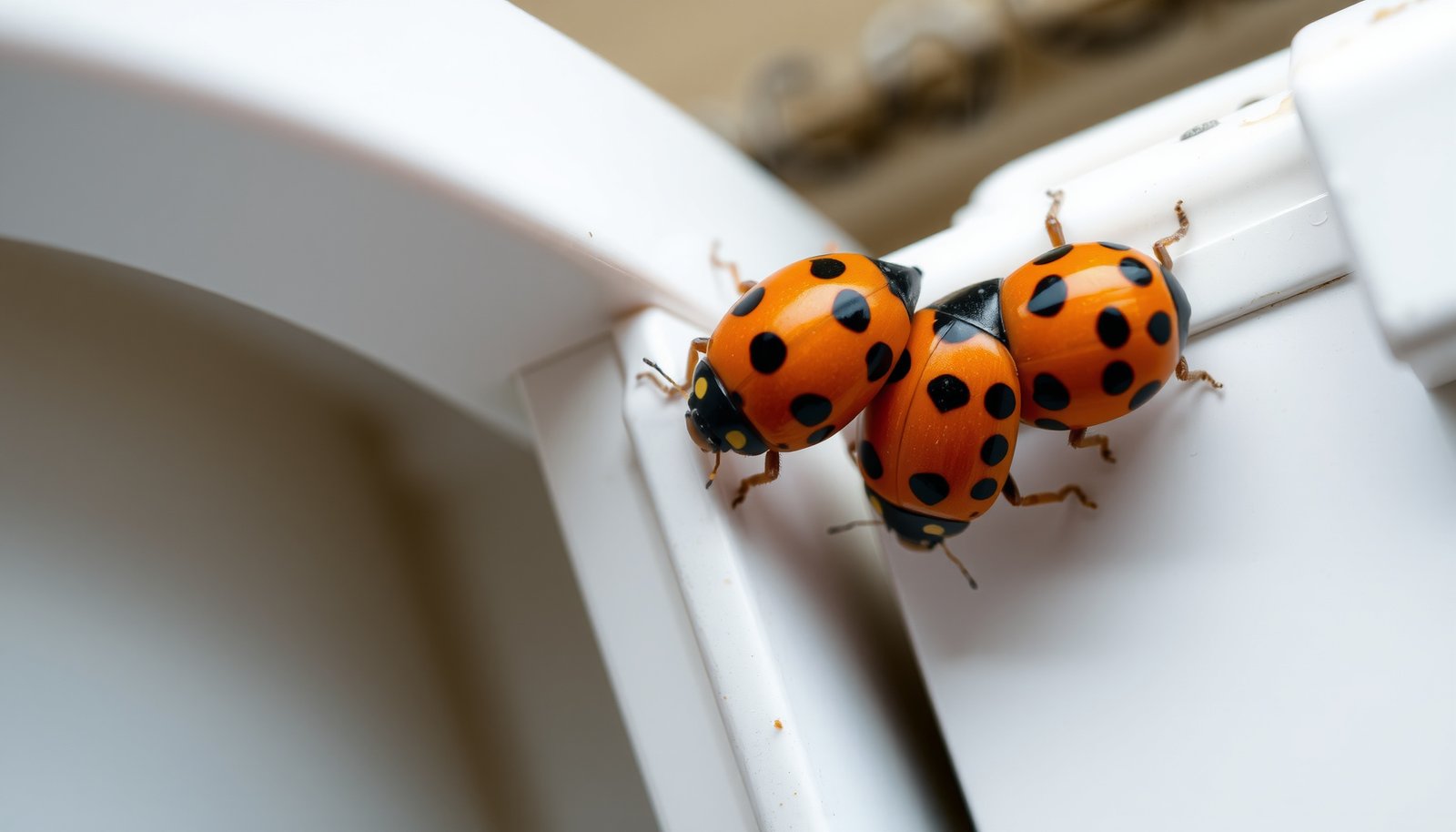
This close-up shows the telltale orange-yellow staining on a window frame left by beetle hemolymph — a sign that a large overwintering group has been disturbed repeatedly in that spot, which matters because that staining indicates exactly where you need to focus your product applications.
Which Exterior Barrier Products Actually Stop Beetles Before They Enter?
Timing is everything with exterior treatments, and most homeowners miss the window by about three weeks. Asian lady beetles begin searching for overwintering sites when daytime temperatures consistently drop below 65°F — typically mid-September to mid-October depending on your region. That’s your window. Apply a long-residual pyrethroid to the entire south- and west-facing exterior of your home during that period, and you can cut beetle entry by 70 to 90 percent before they ever find a way in.
The most effective active ingredients for exterior perimeter treatment are bifenthrin and lambda-cyhalothrin, both of which maintain residual activity for 4 to 8 weeks on non-porous surfaces like vinyl siding, brick, and painted wood. Products like Bifen IT (7.9% bifenthrin) and Demand CS (9.7% lambda-cyhalothrin) are widely available to homeowners and hold up well against light rain after a 24-hour cure period. Focus application on eaves, soffits, window frames, door frames, utility penetrations, and the first 2 to 3 feet of foundation wall — these are the beetle highways into your structure.
Pro-Tip: Don’t forget the gable vents. Asian lady beetles exploit screened attic vents more than almost any other entry point. A single torn screen mesh opening can admit hundreds of beetles per day during a peak aggregation event. Treat the vent frames and surrounding fascia with bifenthrin, and inspect all screens physically before the fall window opens.
What Are the Best Products for Beetles Already Living Inside Your Walls?
Picture this: it’s February, temperatures outside are still below freezing, but you’re finding 10 to 20 lady beetles crawling across your bedroom ceiling every single day. That’s not a new infestation — those beetles have been living inside your wall cavity since October, and they’re waking up prematurely because your home’s interior heat is fooling them into thinking spring has arrived. Contact sprays on your walls won’t reach them. What you need are void treatments that penetrate into the spaces where they’re actually clustered.
Dust formulations are the right tool here. Deltamethrin dust (Delta Dust is the most widely used professional-grade option available to homeowners) can be injected into wall voids through outlet covers, switch plates, and small drilled holes using a hand duster. It clings to surfaces and remains effective for up to 8 months in dry void conditions — long enough to kill beetles as they move through the space both when they cluster in fall and when they try to exit in spring. Diatomaceous earth is a non-toxic alternative that also works well in voids, though it loses effectiveness in humid conditions and needs reapplication if moisture is present.
| Product Type | Active Ingredient | Best Use Case | Residual Activity |
|---|---|---|---|
| Delta Dust | Deltamethrin 0.05% | Wall voids, attic spaces | Up to 8 months (dry) |
| Bifen IT | Bifenthrin 7.9% | Exterior perimeter spray | 4–8 weeks |
| Demand CS | Lambda-cyhalothrin 9.7% | Exterior perimeter, eaves | 4–6 weeks |
| CimeXa Dust | Amorphous silica gel 92.1% | Voids, attic floor, accessible cavities | 10+ years (dry) |
Do Asian Lady Beetle Light Traps and Pheromone Traps Actually Work?
The honest answer is: yes, but with conditions attached. Indoor light traps — the style that draws insects toward UV light and captures them on a sticky board or in a collection bag — genuinely work for intercepting beetles that have already made it inside and are wandering in search of light. The Rescue Non-Toxic Asian Lady Beetle Trap and similar designs work on this principle and can collect meaningful numbers of beetles in high-traffic rooms over the winter months. They won’t eliminate an infestation on their own, but they reduce the visible population and help you gauge how severe the problem inside the structure actually is.
Synthetic aggregation pheromone lures marketed for Asian lady beetles are a different story. The science behind them is real — beetles do respond to pheromone cues — but the commercial versions available at retail don’t replicate the full chemical complexity of the natural signal well enough to be meaningfully effective as standalone traps. Some university extension trials have shown capture rates that weren’t significantly different from unbaited controls. If you’re going to use a trap, the light-based designs consistently outperform pheromone-only products for interior use. For a different kind of pest with stronger trapping research behind it, the same design logic applies — similar to how Best Scorpion Repellents and Traps for Desert Homes breaks down why trap design matters more than the lure itself.
“Homeowners consistently underestimate how early they need to act with Asian lady beetles. By the time beetles are clustering visibly on south-facing exterior walls in early October, the early scouts have usually already found entry points two to three weeks prior. The window for effective exterior barrier treatment is narrower than people realize, and it closes fast once temperatures drop.”
Dr. Michael Waldvogel, Extension Specialist in Structural and Urban Entomology, NC State University
How Do You Handle a Heavy Infestation That’s Already Spread Through the House?
A fully established Asian lady beetle infestation — one where beetles are emerging from multiple rooms, staining fabrics and surfaces with their yellow defensive secretion, and triggering allergic reactions in household members — requires a layered approach. There’s no single “nuke it” product for this situation, and anyone who tells you otherwise is selling something. The sequence matters as much as the products themselves.
Follow this order of operations for a heavy infestation already inside the structure:
- Vacuum first, properly. Use a vacuum with a HEPA filter and place a nylon stocking inside the hose before the bag or canister — this lets you collect live beetles without killing them and triggering the pheromone release. Deposit the stocking full of beetles outside immediately, far from the structure.
- Treat accessible wall voids with Delta Dust or CimeXa. Inject dust into wall void spaces through switch plate and outlet openings using a hand bulb duster. Apply in short pulses — you want a thin coating on surfaces, not a visible cloud that will drift out into the living space.
- Apply an indoor residual aerosol to cracks and crevices. Products with pyrethrins plus a synergist (piperonyl butoxide) in aerosol form — like CB-80 Extra or PT 565 Plus XLO — work well for direct treatment of entry gaps, window channels, and door frame crevices where beetles enter from void spaces into living areas.
- Place indoor light traps in affected rooms. Position them in corners away from competing light sources, roughly 3 to 5 feet off the floor. Replace sticky boards weekly during peak emergence periods in late winter and early spring.
- Seal structural gaps with exterior-grade silicone caulk after treatment. Don’t seal before treating — you’ll trap live beetles inside and worsen the problem. Seal after the dust treatment has had at least 48 to 72 hours to work. Focus on window frame gaps, utility line penetrations, and gaps around fascia boards.
- Repeat exterior perimeter treatment the following fall. One season’s treatment won’t break the infestation cycle permanently. Asian lady beetles exhibit site fidelity — they return to the same structures year after year. A sustained two-year exterior spray program combined with sealing is what actually breaks the cycle.
What Should You Know Before Buying Any Asian Lady Beetle Product?
There’s a counterintuitive thing worth knowing about Asian lady beetles that almost every product guide skips: these are beneficial insects outdoors. They’re aggressive predators of aphids and soft-bodied plant pests, and they were deliberately introduced and released across the US starting in the 1970s and 1980s as a biocontrol agent. The infestation problem you’re dealing with is, in a technical sense, a government program that worked too well. That doesn’t make it any less miserable to have thousands of them in your attic, but it does explain why there’s no federally registered attractant-and-kill bait system for them the way there is for some other structural pests — their beneficial status complicates the regulatory picture around mass indoor control products.
What this means practically is that the product landscape for Asian lady beetles is thinner than you’d expect for such a widespread problem. You’re largely adapting general insecticide and exclusion products to this specific pest rather than buying something purpose-built for it. The exception is the RESCUE! Asian Lady Beetle Trap, which is one of the few products actually labeled and marketed specifically for this species. Beyond that, you’re working with pyrethroids, silica dusts, and light traps that were designed for broader use. The severity of your situation also matters — a home in the southern Appalachians or mid-Atlantic with genuine structural infestation is a very different challenge than someone in the Midwest who finds 15 beetles on a warm November afternoon. The products are similar, but the intensity of application and the need for professional void treatment differs significantly based on the structure type and infestation scale. If your pest problem goes beyond beetles and extends to multiple species using the same wall voids as entry corridors, understanding how void-dwelling pests operate generally is worth your time — concepts similar to what’s covered in How to Get Rid of Cockroaches in Walls You Can’t Reach apply directly to how you’d approach dusting and sealing for lady beetles too.
- Check the label for “structural pest” use. Not all pyrethroid concentrates are labeled for use on building exteriors — confirm the label explicitly covers structural perimeter treatment before purchasing.
- Avoid aerosol foggers (“bug bombs”) for this pest. Total-release foggers don’t penetrate wall voids where beetles actually cluster and create a chemical residue mess in living spaces for minimal benefit against lady beetles specifically.
- Buy a hand bulb duster separately if purchasing dust formulations. Delta Dust and CimeXa don’t come with application equipment — a dedicated duster (Bellow Duster or B&G Bulb Duster) is necessary for proper void application.
- Don’t waste money on ultrasonic repellers for this pest. No credible field data supports ultrasonic devices as effective against Harmonia axyridis, and the aggregation behavior that drives infestations is chemical and thermal, not acoustic.
- Note that some homeowners develop allergic reactions to lady beetle secretions. If household members are experiencing rhinitis, conjunctivitis, or asthma-like symptoms during winter months, the infestation is a health issue — not just a nuisance — and professional void treatment may be warranted rather than a DIY approach.
The most expensive mistake you can make with Asian lady beetles isn’t buying the wrong product — it’s treating them in the wrong season. Fall exterior barrier treatment, applied when daytime temps first drop into the mid-60s, is worth ten times what any winter indoor treatment will accomplish. Get the timing right, use a bifenthrin or lambda-cyhalothrin concentrate on the exterior, follow it with void dusting for what’s already inside, and then seal once you’ve given the products time to work. That sequence — done consistently over two consecutive fall seasons — is what actually ends an Asian lady beetle infestation, not any single product you can buy at the hardware store on a cold February morning when you’re already seeing them on the ceiling.
Frequently Asked Questions
what is the best spray to kill asian lady beetles inside the house?
Residual insecticide sprays containing deltamethrin, cyfluthrin, or lambda-cyhalothrin work best for killing asian lady beetles on contact and leaving a barrier that keeps killing for weeks. Apply along baseboards, windowsills, and door frames where they tend to cluster. Products like Tempo SC Ultra or Suspend SC are popular choices that pest control pros use and are available to homeowners online.
does diatomaceous earth work for asian lady beetle infestations?
Yes, food-grade diatomaceous earth works well as a non-toxic option — sprinkle it along entry points like window tracks, door thresholds, and wall voids where beetles squeeze through. It damages their exoskeleton and kills them within 48 hours of contact. It’s a good choice if you have pets or kids and want to avoid chemical sprays indoors.
what can I put around windows and doors to keep asian lady beetles from getting in?
Weatherstripping gaps and applying a residual insecticide barrier spray around the outside perimeter of your home before fall is your best defense — target eaves, window frames, and any crack wider than 1/16 of an inch. Caulking gaps in siding and around utility penetrations cuts off most of their entry points. Do this in late September or early October before temperatures drop below 50°F, which is when they start seeking shelter.
how do I get rid of asian lady beetles already inside my walls?
Beetle clusters inside wall voids are tough to treat directly — your best bet is vacuuming up any that emerge and using an aerosol insecticide with a crack-and-crevice tip, like PT Phantom or Temprid Aerosol, injected into gaps around outlets and baseboards. Don’t crush them, since they release a foul-smelling yellow fluid that can stain walls and carpets. If you’re seeing dozens per day coming through, it’s worth calling a pest control company to do a more thorough void treatment.
are asian lady beetle traps worth buying?
Light traps and sticky traps can help reduce populations indoors but they won’t solve a full-blown infestation on their own — they’re better used as monitoring tools or for catching stragglers after you’ve sealed entry points and applied a barrier treatment. The Black Flag or RESCUE! brand indoor insect light traps catch beetles passively and don’t require any chemicals. Use them alongside other asian lady beetle infestation products for the best results.