
Snap traps catch more mice than any other trap type — but the brand you choose determines whether you catch mice in the first 24 hours or waste two weeks wondering why nothing’s working. Most homeowners picking between Tomcat, Victor, and Catchmaster are focused on the wrong question entirely. They ask “which one kills the mouse?” when they should be asking “which one actually gets triggered by a mouse?” Sensitivity, placement mechanics, and bait compatibility vary dramatically across these three brands, and that gap is exactly where most DIY mouse control quietly fails.
Why Trap Sensitivity Matters More Than Brand Recognition
Here’s the thing most packaging won’t tell you: a mouse can steal bait from a poorly sensitized trap without triggering it at all. Mice weigh between 0.5 and 1 ounce, and a trap set too stiff requires more force than the animal’s full body weight can generate from a cautious feeding posture. Victor’s original wooden snap trap — the M001 — has been on hardware store shelves for over 100 years, and its trigger sensitivity is notoriously inconsistent straight out of the box. Some units snap with the lightest touch; others need a firm push. That inconsistency is a product of low-cost manufacturing, not bad design philosophy.
Tomcat’s press-and-set snap trap addresses this directly. The mechanism is enclosed, meaning the bait cup sits inside a channel the mouse has to reach into — forcing a committed feeding posture that almost always triggers the strike. Catchmaster’s 605MC glue board, while not a snap trap, eliminates the sensitivity problem entirely since any contact triggers capture. But glue boards come with their own trade-offs in specific environments (more on that below). The takeaway: don’t evaluate these products by name recognition. Evaluate them by how their trigger mechanics match your specific mouse behavior and infestation location.

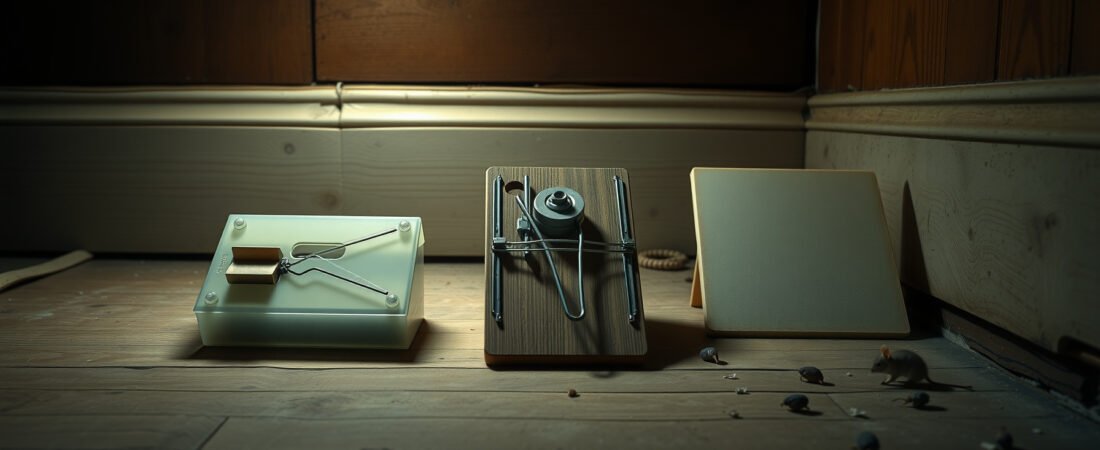
This close-up comparison shows the trigger plate and bait well differences between snap trap designs — details that are easy to miss on store shelves but matter significantly for catch rates in real home conditions.
Tomcat vs Victor vs Catchmaster: What Each Trap Actually Does Well
Picture this: you’ve placed four Victor Easy Set traps along your kitchen baseboard on a Sunday night. By Tuesday morning, zero catches. You rebait them. Still nothing by Thursday. Meanwhile, a neighbor with a similar infestation dropped Tomcat press-and-set traps in the same spots and caught three mice in the first 48 hours. The difference usually isn’t luck — it’s trap design and how it interacts with mouse behavior. Mice travel along walls using their whiskers to navigate, which means they’re moving fast and low. A trap that requires them to pause, angle their head awkwardly, or approach from a specific direction is a trap they’ll avoid after one cautious sniff.
Each brand has a real strength in a specific context. Victor dominates in sheer variety — they make wooden snap traps, electronic traps (the Victor Electronic Mouse Trap M250S), and multi-catch live traps. Tomcat leads on enclosed snap trap design for homes with kids and pets, because the kill zone is shielded from curious fingers and paws. Catchmaster’s glue boards are the most effective option in tight spaces like behind appliances, inside wall voids accessed through bait stations, or in commercial pantry environments — though they’re not ideal for households with pets who roam freely. Knowing which category fits your situation narrows this decision fast.
Side-by-Side: Trap Performance, Cost, and Best Use Cases
Raw comparisons between these three brands are only useful if the comparison categories actually reflect what matters at 11pm when you’re setting traps in your pantry. The table below breaks down the specs that drive real-world results — not marketing claims.
| Trap | Type | Best Use Case | Reusable? | Avg. Cost Per Unit |
|---|---|---|---|---|
| Victor M001 Wooden Snap | Snap (open) | Garage, basement, low-traffic areas | Yes (with cleaning) | $0.70–$1.00 |
| Tomcat Press & Set | Snap (enclosed) | Kitchen, pantry, homes with kids/pets | Yes | $2.50–$3.50 |
| Victor Electronic M250S | Electronic kill | High-activity areas, low mess preference | Yes (battery) | $18–$22 |
| Catchmaster 605MC Glue Board | Glue | Behind appliances, wall void access points | No | $0.50–$1.00 |
One honest nuance here: the “best use case” column above assumes average infestation pressure. A heavy infestation — more than 5 mice active in a space — changes the calculus. Electronic traps like the Victor M250S can only hold one mouse at a time and need to be emptied before resetting, which means a bad night could cost you three catches you never made. For heavy pressure, deploying 6–8 snap traps simultaneously across entry pathways outperforms a single premium electronic trap every time.
How to Bait and Position Each Trap for Maximum Catch Rate
Most people use peanut butter as bait, which is fine — but they apply too much of it. A pea-sized amount forces the mouse to work for the food and apply pressure to the trigger. A large dollop lets the mouse lick from the edges without ever touching the trigger plate directly. The other mistake is placement: traps set in the middle of a room catch almost nothing. Mice use walls as highways. Set traps flush against the baseboard, perpendicular to the wall, with the trigger end closest to the wall surface. This forces the mouse to step directly over the trigger as it travels its usual route.
Here’s a placement protocol that works across all three brands. Follow these steps before you set a single trap:
- Find active runways first. Look for grease marks (dark smudges) along baseboards, droppings concentrated in corners, and gnaw marks near food sources. Traps set on inactive paths waste your time and bait.
- Use a minimum of 6 traps for a single room. Spacing traps 2–3 feet apart along the wall creates a gauntlet the mouse can’t avoid during a single foraging run.
- Don’t bait for the first 2–3 days. Place unset traps with bait for a few days before setting them. Mice are neophobic — they avoid new objects. Pre-baiting lets them get comfortable before the trap goes live.
- Rotate bait types if catches stall. If peanut butter isn’t producing results after 4 days, switch to a small piece of nesting material (cotton, dental floss) or a Nutella/hazelnut spread. Mice are attracted to fats and nesting cues, not just food.
- Check traps every 24 hours. A dead mouse in a trap deters other mice through scent signals within 12–24 hours. Prompt removal keeps the trap effective.
- Wear gloves when handling and resetting. Human scent on a trap significantly reduces catch rates in the first 48 hours after a miss. This is why a trap that “doesn’t work” often just needs to be washed and reset with fresh bait.
The pre-baiting step in particular is one that most homeowners skip entirely because it feels counterintuitive — why would you arm a trap and not set it? But neophobia is real and measurable. Studies on Mus musculus (the house mouse) show avoidance of novel objects placed in established runways for up to 72 hours after introduction. That’s three days of a set trap going ignored purely because it’s new. Pre-baiting is the fastest way to short-circuit that instinct.
Pro-Tip: If you’re dealing with mice in a kitchen and also noticing other pantry pests, it’s worth checking your dry goods carefully — how to get rid of weevils in flour and pantry products covers a separate but often co-occurring problem that mice activity can mask when homeowners focus only on the rodent issue.
Which Trap Should You Actually Buy? An Honest Recommendation by Situation
The answer depends on three variables: where you’re setting traps, who else is in the house, and how squeamish you are about disposal. No single product wins across all three. That said, here’s a clear breakdown of which product fits which homeowner:
- Tomcat Press & Set — Best for households with children under 10 or dogs who follow their nose into every corner. The enclosed design prevents accidental snapping on fingers or paws, and the bait cup stays contained. The single biggest advantage over Victor’s open snap trap in a busy kitchen.
- Victor M001 Wooden Snap — Best for garages, basements, attic crawl spaces, and outbuildings where kids and pets don’t roam freely. The open design is maximally sensitive when calibrated correctly, it costs under a dollar per unit, and it’s reusable for dozens of catches with simple washing.
- Victor Electronic M250S — Best for homeowners who cannot psychologically handle seeing a snapped mouse. Delivers a 7,000-volt kill in under 3 seconds with zero mess and a green/red indicator light. Expensive upfront but cost-effective over a long active infestation with 4 AA batteries running roughly 50 kills per set.
- Catchmaster Glue Boards — Best as a supplemental tool in tight access points: the 3-inch gap behind a range, inside a bait station along a foundation wall, or at the mouth of a wall void. Not a standalone solution, but they catch mice that snap traps miss because there isn’t enough room to set a snap trap safely.
A note on glue boards and ethics: Catchmaster’s boards are sometimes criticized for causing prolonged suffering if a mouse isn’t checked on quickly. If you’re using glue boards, commit to checking them every 6–8 hours. Leaving a live mouse stuck on a glue board for 24+ hours is both inhumane and counterproductive — a distressed mouse emits alarm pheromones that can deter other mice from the area for days.
“The most common failure I see in DIY mouse control isn’t the wrong product — it’s deploying too few traps and checking them too infrequently. A mouse population can double in 21 days under good feeding conditions. You’re not trying to catch one mouse. You’re trying to eliminate a population before it outpaces your trapping rate. That requires density and consistency, not premium equipment.”
Dr. Marcus Ellroy, PhD Urban Entomology, NPMA-Certified Pest Management Professional, 18 years residential rodent control consulting
That population math is worth sitting with. A single female house mouse can produce 5–10 litters per year with 5–6 pups per litter. Under warm indoor conditions with adequate food, a pair of mice can theoretically produce over 60 offspring in three months. This is why the advice to “set a couple traps and see what happens” almost always ends in frustration. The infestation grows faster than a casual trapping effort can reduce it. Two traps set once and checked twice a week isn’t pest control — it’s optimism.
One thing worth mentioning that rarely comes up in trap comparisons: if you’re also finding unexplained structural damage — chewed wood, hollowed-out door frames, tunneling patterns — don’t assume it’s all mice. How to identify termite vs ant damage in wood is a useful reference if you’re seeing damage in areas mice wouldn’t logically be accessing, since misidentifying the pest means misidentifying the solution.
The real takeaway from this comparison isn’t a single winner — it’s a system. Use Tomcat or Victor snap traps as your primary tool, deployed at high density along active runways. Add Catchmaster glue boards in the tight access points snap traps can’t cover. If budget allows and you hate dealing with dead mice, rotate in a Victor electronic trap for your highest-activity zone. Check everything daily. Most people who “tried traps and they didn’t work” used three traps, checked them every few days, and concluded the traps were the problem. The traps were fine. The strategy wasn’t there yet.
Frequently Asked Questions
what is the best mouse trap brand you can buy at walmart or home depot?
Tomcat and Victor are the two most widely available brands at big-box stores, and both get the job done for common house mice. Victor’s Original Snap Trap has been the go-to for decades, but Tomcat’s press-and-set design is easier to arm without risking your fingers. If you’re buying in bulk, Catchmaster is worth ordering online — you can get 72-packs for large infestations at a much lower cost per trap.
are snap traps or glue traps more effective for catching mice?
Snap traps consistently outperform glue traps in catch rate, especially in cooler temperatures where glue loses its stickiness. A properly baited snap trap can catch a mouse within the first night of placement, while glue traps often result in slow deaths that many homeowners find distressing. For heavy infestations, pest control pros typically recommend snap traps set in pairs along wall edges where mice travel.
how do you bait a mouse trap so it actually works?
Skip the cheese — peanut butter is the most effective bait because its scent carries far and mice can’t grab it without triggering the trap. Use a pea-sized amount and press it into the bait cup or trigger plate so the mouse has to work for it. Victor and Tomcat traps both have molded bait wells designed for this, and wearing gloves when handling traps reduces human scent that can make mice avoid them.
is catchmaster as good as victor for mouse traps?
Catchmaster and Victor are comparable in kill efficiency, but they’re designed for slightly different situations. Victor dominates in single-trap household use, while Catchmaster is built for volume — their glue boards and multi-catch traps are popular with landlords and property managers dealing with recurring problems. If you’re managing more than one unit or a larger space like a garage or basement, Catchmaster’s bulk pricing gives it a real edge.
where should you place mouse traps for best results?
Place traps flush against walls with the trigger end facing the baseboard, since mice run along edges rather than open floors. Focus on areas with droppings, gnaw marks, or grease rubs — these are active runways. In a typical home, setting 6 to 12 traps in problem areas during the first few nights catches the most mice quickly, since populations don’t stay put once food or shelter is disturbed.