
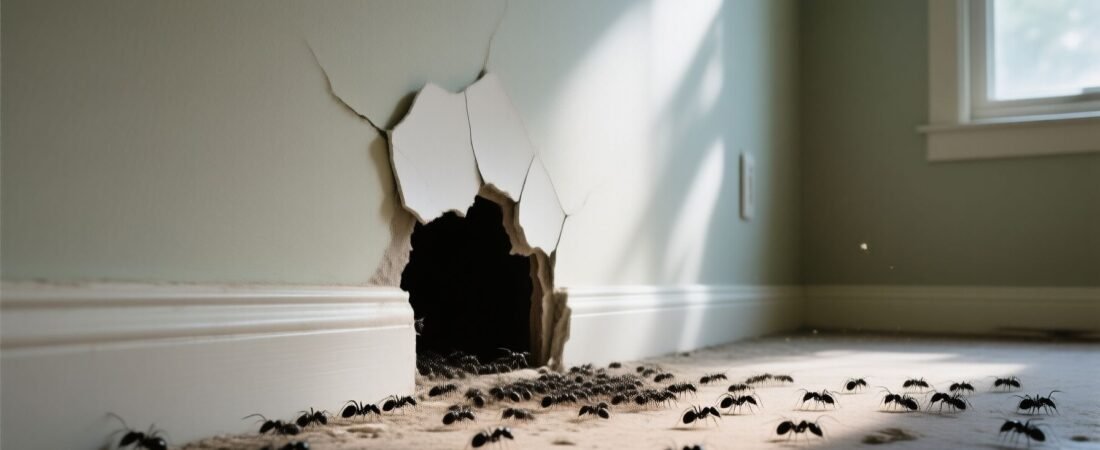
Killing the ants you can see does almost nothing when the colony is living inside your wall. That’s the single biggest mistake homeowners make — they grab a can of spray, hit every ant in sight, and assume the problem is handled. Three days later the trail is back, sometimes worse. The real colony — queen, brood, foragers, all of it — is sitting 6 to 18 inches behind your drywall, completely untouched, continuing to grow.
A mature ant colony inside a wall void can contain anywhere from 3,000 to over 100,000 workers depending on the species. The ants you’re seeing on your countertop or baseboard are just the foragers — roughly 10 to 20 percent of the total population — sent out to scout for food. Eliminating them triggers the colony to send more. You’re not solving the problem; you’re just rotating the shift.
The fix isn’t faster spraying. It’s understanding how ant colony feeding behavior works and using that against them. This article will walk you through how to confirm there’s a colony inside the wall, which treatments actually penetrate to the nest, and how to know when the infestation is genuinely gone — not just temporarily quiet.
How Do You Know Ants Are Actually Nesting in the Wall — Not Just Passing Through?
There’s a meaningful difference between ants using your wall as a highway and ants living inside it. Transient trails typically follow consistent paths along baseboards or windowsills and disappear seasonally. A nesting colony leaves different evidence: you’ll hear faint rustling or crackling sounds inside the wall, especially at night when the house is quiet. Carpenter ants in particular produce a dry, papery crunching — the sound of excavated wood being pushed through galleries.
The other sign is sawdust-like frass appearing at the base of the wall, near electrical outlets, or around window frames. Carpenter ants don’t eat wood — they excavate it to build galleries, and they push the debris out. Small piles of coarse, fibrous material near wall penetrations is a near-certain indicator of an established colony, not a passing trail. Odorous house ants and pavement ants that colonize wall voids won’t leave frass, but they will establish visible satellite trails that radiate outward from a fixed wall entry point, which you can map back to a single crack or gap.
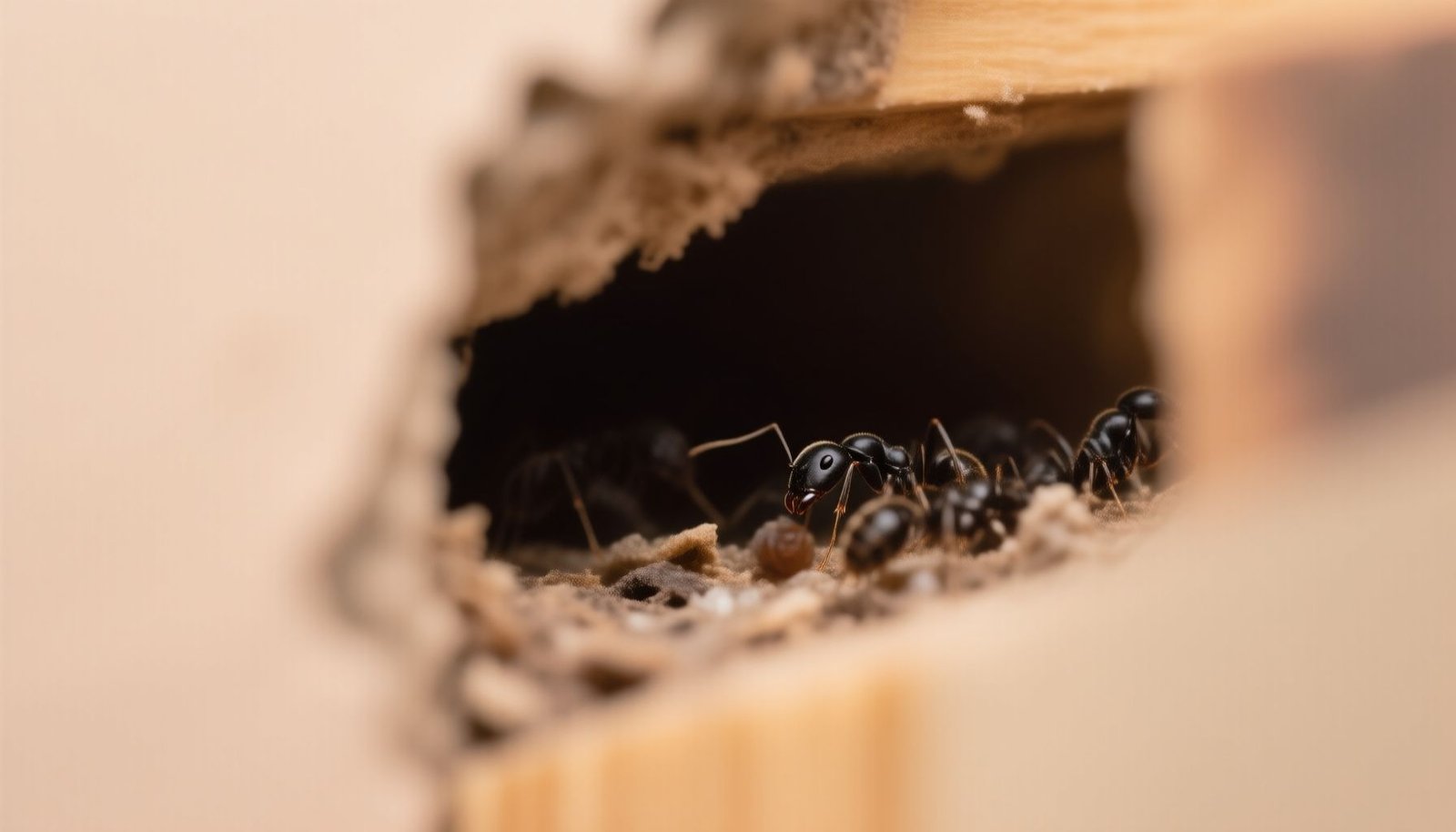
This close-up shows how ant galleries and brood clusters can fill a wall void — understanding what’s happening behind the drywall helps you choose the right treatment approach instead of guessing from the surface.
Why Spraying the Trail Makes a Wall Infestation Worse — Not Better
Contact insecticide sprays — even the ones marketed for ant control — are colony-level disasters when used incorrectly on a wall-nesting infestation. Here’s the mechanism: most repellent sprays like permethrin or pyrethrin-based aerosols don’t just kill ants on contact, they leave a chemical barrier that foragers detect and avoid. The colony reads this as a threat and does something called “budding” — the queen and part of the workers split off and relocate to a secondary location deeper in the wall or further along the structure.
You haven’t eliminated the colony. You’ve fragmented it into two smaller ones, both of which can independently grow back to full size within weeks. Pharaoh ants are the worst offenders here — they’re notorious budders, and a single misapplied spray event can turn one colony into a dozen satellite nests spread across an entire floor of a house. That’s not a hypothetical; it’s one of the most documented patterns in residential ant control, and it’s why professional pest managers are trained to avoid repellent products entirely when Pharaoh ants are suspected.
What Treatment Actually Reaches a Colony Inside a Wall?
The only treatment strategy that reliably eliminates a wall-nesting colony is one that exploits the colony’s own food-sharing behavior. Slow-acting bait — gel or granule formulations — gets picked up by foragers, carried back to the nest, and shared with the queen and brood through a process called trophallaxis. The colony essentially distributes the insecticide itself. For this to work, the active ingredient has to be slow enough that foragers don’t die before returning to the nest. Borate-based baits and indoxacarb formulations are designed with exactly this delay built in — typically 24 to 72 hours from ingestion to mortality.
Placement is everything. Bait needs to go directly on or within a few inches of the active foraging trail — not randomly around the kitchen or near the wall in general. Here’s a concrete approach that works for a wall-void situation specifically:
- Stop cleaning foraging trails for 48 hours before baiting. Pheromone trails are what guide foragers to bait. Mopping them away means ants can’t find your bait station efficiently.
- Place gel bait directly on the active trail — small pea-sized drops every 6 to 8 inches along the path ants are using. Don’t smear it; leave it as discrete drops they can surround and feed on.
- Drill 1/8-inch injection ports if necessary. For confirmed wall-void nests, you can inject non-repellent dust (diatomaceous earth or borate dust) directly into the void through small holes drilled at stud intervals. Patch the holes afterward with spackle.
- Apply a non-repellent liquid concentrate around the wall’s exterior entry points. Products containing fipronil or imidacloprid in non-repellent formulations let ants pass through treated areas and carry the active ingredient back — same principle as bait, but as a perimeter barrier.
- Don’t disturb the bait for at least 5 to 7 days. You’ll likely see more ants initially as forager activity increases around fresh bait. That’s a good sign — the colony is feeding. Removing bait early is the most common reason treatments fail.
- Monitor for 2 to 3 weeks before concluding the colony is gone. Brood cycles mean some eggs and larvae won’t be affected by the first round. A second bait application 10 to 14 days after the first significantly improves complete elimination rates.
Pro-Tip: If ants are ignoring the bait, switch the protein-to-sugar ratio. Ant colonies shift their dietary preferences based on internal needs — a colony actively rearing brood craves protein, while a colony in maintenance mode wants sugar. Rotate between a protein-based bait (like a peanut oil gel) and a sugar-based bait (like a borax-sucrose solution) every 3 to 4 days until you find what they’re actively taking.
Which Ant Species Are Most Likely to Nest in a Wall Void — and Does It Change the Approach?
Species ID genuinely changes your treatment plan, which is something a lot of generic “get rid of ants” guides skip over entirely. The three species most commonly found nesting inside wall voids in US homes are carpenter ants, odorous house ants, and Pharaoh ants — and each one requires a meaningfully different response. Carpenter ants are solitary-queen colonies that tend to have one primary nest, usually in wood with some moisture damage, and one or two satellite colonies. Odorous house ants are massive multi-queen, multi-colony networks that can span an entire block. Pharaoh ants are the ones that budget at the slightest provocation.
Here’s a quick reference for the practical differences:
| Species | Colony Size | Queen Structure | Best Treatment Approach |
|---|---|---|---|
| Carpenter Ant | 3,000–10,000 workers | Single queen per primary nest | Non-repellent dust injection into void + gel bait on trails |
| Odorous House Ant | 10,000–100,000+ workers | Multiple queens, interconnected colonies | Slow-acting gel bait (indoxacarb or borate); patience required — may take 4–6 weeks |
| Pharaoh Ant | 10,000–300,000 workers | Multiple queens, rapid budding | Bait ONLY — no sprays, no dusts near active areas; fipronil-based gel preferred |
Carpenter ants are often the easiest to eliminate with a targeted void injection because the colony structure is more contained. Pharaoh ants in a wall void, on the other hand, can take months of disciplined baiting to fully knock down — especially in multi-unit buildings where satellite colonies exist in adjacent units. The same logic applies in any shared living situation: just as dealing with bed bugs in a hotel room means accounting for what’s happening in the rooms next door, dealing with Pharaoh ants in an apartment means accepting that your neighbor’s untreated infestation can continuously repopulate yours.
“The hardest part of wall-void ant control isn’t the treatment itself — it’s convincing the homeowner not to spray. Every time someone grabs a can of Raid and hits the trail, they’re potentially setting off a budding response that undoes weeks of bait progress. Non-repellent baiting requires patience, but it’s the only method that gets to the queen. Without the queen, you’ve done nothing.”
Dr. Ellen Forsythe, Board-Certified Entomologist and Urban Pest Management Specialist, University Extension Services
How Do You Stop Ants From Re-Establishing a Nest in the Same Wall?
Even after a successful treatment, the same wall void is a target for re-colonization — especially if the conditions that made it attractive in the first place haven’t changed. Wall voids become nesting sites for two reasons: they’re warm and protected, and there’s usually a moisture or food source nearby. Ants don’t randomly pick walls. A colony inside a bathroom wall is almost always there because there’s a slow leak behind the tiles or a condensation problem on a pipe. A colony inside a kitchen wall is typically 12 to 18 inches from a food-grease buildup inside a wall cavity, often near an appliance.
Long-term prevention comes down to these specific actions:
- Fix any moisture issues behind the wall first. Ant colonies don’t need standing water — even the condensation on a cold pipe is enough to sustain a colony through dry months. A dehumidifier in a wall-adjacent basement or crawl space reduces this consistently.
- Seal every wall penetration where pipes, wiring, or conduit enter. A gap as small as 1/16 of an inch is enough for most ant species. Use fire-rated expanding foam or silicone caulk — not standard caulk that shrinks over time.
- Apply a non-repellent perimeter treatment to the foundation and lower exterior walls two to three times per year, particularly before summer and again in early fall when ant colonies are actively relocating.
- Don’t store firewood or landscape mulch against the house foundation. Both are primary satellite nesting sites for carpenter ants, and foragers move from those sites into wall voids through ground-level cracks within days.
- Check behind appliances annually. Grease and food debris accumulate behind refrigerators and stoves in ways that aren’t visible from the front. If you’ve had wall-void ants near the kitchen, what’s happening behind the refrigerator or stove matters more than you’d expect — that debris draws foragers inward and gives them a reason to establish nearby.
One honest caveat here: if you live in a region with warm winters — the Gulf Coast, Southern California, Florida — ant colonies don’t go dormant the way they do in northern climates. That means there’s no “off season” for colony pressure on your home’s exterior. Year-round perimeter maintenance is genuinely necessary in those climates, not just a pest control upsell. In colder regions, a treatment in late spring and one in early fall covers the active periods when colonies are expanding and relocating.
Once you’ve confirmed the colony is gone — no forager activity for at least two to three consecutive weeks, no new frass, no audible activity — do a final walk of the exterior and seal anything you found during treatment. That wall void will be colonized again within a season if it stays accessible and conditions stay favorable. Ants are patient. They’ll scout the same entry points repeatedly until something changes.
Frequently Asked Questions
how do I know if ants are nesting inside my walls?
The clearest signs are rustling or crinkling sounds inside the wall, especially at night, and seeing ants emerge from gaps around outlets, baseboards, or trim. You might also notice small piles of sawdust-like debris near the wall, which is common with carpenter ants. If you’re seeing 10 or more ants daily trailing along the same wall, there’s a good chance the nest is inside rather than just passing through.
what kind of ants nest inside wall voids?
Carpenter ants are the most common culprit — they hollow out wood to nest, so walls near moisture damage or wood framing are prime targets. Odorous house ants and pavement ants will also nest in wall voids, especially around insulation or near a heat source. Knowing which species you’re dealing with matters because carpenter ants require a different treatment approach than smaller sugar-seeking ants.
can I use ant bait to kill ants nesting inside a wall?
Yes, and bait is actually one of the best options for wall void infestations because you don’t need direct access to the nest. Gel baits like Advion or Terro placed along ant trails let foragers carry the slow-acting poison back to the colony, killing the queen and workers over 3 to 7 days. Don’t use repellent sprays at the same time — they’ll drive ants away from the bait and make it much harder to eliminate the nest.
how do I get rid of ants inside walls without opening the drywall?
Drill small 1/8-inch holes into the wall void and inject a non-repellent insecticide dust like Delta Dust or CimeXa directly into the cavity. This gets the product into the nest without major demolition and the dust stays effective for several months. You can seal the holes with paintable caulk after treatment so the repair is barely visible.
how long does it take to get rid of ants nesting in a wall?
With baiting alone, expect 1 to 3 weeks for full colony elimination — slower-acting baits are more effective because they give workers time to share the poison throughout the nest. Dust treatments injected directly into the wall void can work faster, often within a few days, but only if the product reaches the nest. If ant activity hasn’t dropped significantly after 3 weeks, you likely have multiple colonies or an untreated moisture problem that’s attracting them back.
Disclaimer: This article is for informational purposes only and isn’t a substitute for professional pest control advice. Always read and follow the product label instructions exactly — label directions are legally binding and vary by brand and active ingredient. Keep all pesticides, baits and traps away from children and pets, ventilate treated areas as directed, and consider calling a licensed pest control professional if an infestation is large, recurring, or involves a structural pest like termites or carpenter ants.