
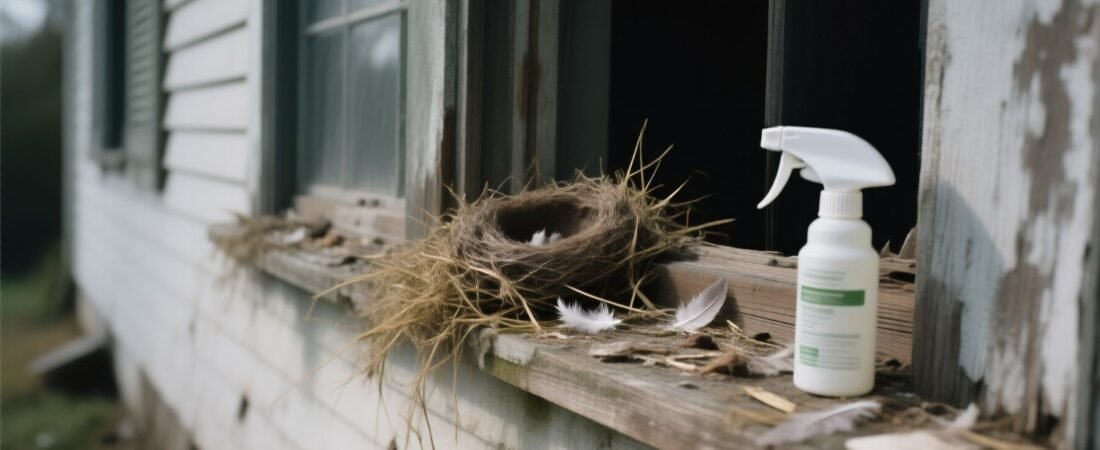
Removing the nest was the right call — but it’s what happens in the 72 hours after that determines whether you have a minor annoyance or a full-blown infestation inside your home. Most guides tell you to remove the nest, spray something, and move on. What they don’t tell you is that bird mites don’t stay outside after their host birds are gone. They actively migrate inward, following carbon dioxide and body heat, and they can push through wall gaps, ceiling voids, and window frames in numbers that are genuinely startling for something you can barely see. The nest removal didn’t end the problem — it started a clock.
Why Bird Mites Move Into Your Living Space After the Nest Is Gone
Bird mites — most commonly Dermanyssus gallinae (the chicken mite) or Ornithonyssus sylviarum (the northern fowl mite) — are obligate blood feeders. They need a warm-blooded host to survive, and for most of their lives, that host is a nesting bird. A typical starling or sparrow nest can harbor anywhere from 20,000 to 100,000 mites by the time the fledglings leave. When you remove that nest, you’re not removing the mites — most of them are already dispersed through the surrounding structure, and the ones that remain are now starving and motivated.
What makes this worse is the timing. Mites can survive without a blood meal for roughly 10 days under cool, humid conditions — but in a warm attic or wall void in summer, that window shrinks to 2 or 3 days. That urgency is what drives them toward your living space. They aren’t randomly wandering; they’re following thermal gradients and CO2 toward the nearest large warm-blooded animal, which is you.
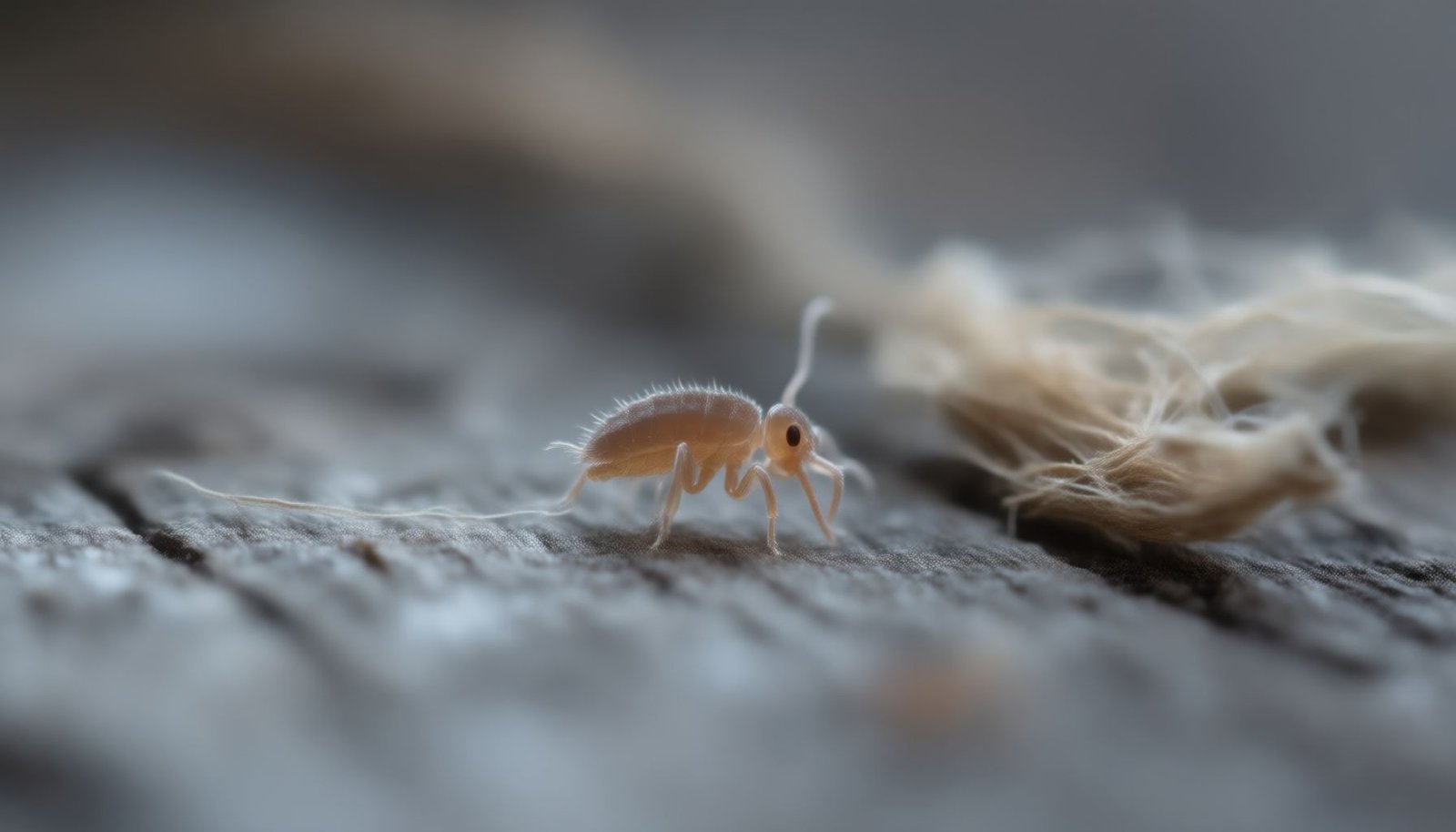
This close-up shows the semi-transparent, eight-legged body of a bird mite next to a common grain of rice for scale — understanding just how small these creatures are helps explain why a whole population can slip through a single crack in drywall without leaving a single visible sign until bites start.
How to Tell If the Bites You’re Getting Are Actually From Bird Mites
Picture this: you pull the old swallow nest off your porch eave on a Saturday afternoon, and by Sunday night everyone in the house is itching. Before you treat for anything, you need to confirm bird mites are actually the culprit — because the treatment is completely different from what you’d do for fleas, scabies, or even clover mites. Misidentification here wastes time and money, and it delays solving the real problem.
Bird mites are about 0.7–1 mm long, translucent to pale gray when unfed, and brick-red to dark brown immediately after feeding. You can sometimes spot them on white bedding or a white piece of paper — they look like tiny moving specks. The bites themselves tend to cluster on exposed skin (arms, neck, ankles) and produce a sharp pinprick sensation followed by intense, localized itching. Unlike bed bug bites, which often show up in linear patterns overnight, bird mite bites frequently happen during the day and in multiple rooms, because the mites are actively hunting rather than waiting in a harborage.
“One thing that consistently misleads homeowners is that bird mite bites don’t produce a distinctive enough rash to confirm ID on their own. Collect a sample — tape a mite to white paper or drop it in a small vial of rubbing alcohol — and get it confirmed by your local cooperative extension office or a licensed pest management professional before committing to a treatment plan. The biology of the pest should drive every decision.”
Dr. Patricia Oswald, Board-Certified Entomologist and Urban Pest Management Specialist, Midwest Extension Services
The Four-Zone Treatment Method That Actually Works
The single biggest mistake people make when treating for bird mites after a nest removal is focusing only on where they feel bites — usually the bedroom or living room. By the time mites reach those rooms, they’ve already established a dispersal pathway through the wall voids and ceiling cavities adjacent to the original nest site. Treating only the end point leaves the pipeline intact.
Effective treatment works outward from the nest site, covering four distinct zones in sequence. Skipping any zone — especially zone 2, the void space — is the reason people re-treat two and three times and still have a problem four weeks later.
- Zone 1 — Nest removal site: After removing the nest using gloves and a sealed bag, treat the immediate surface (eave, window ledge, roof soffit) with a residual pyrethroid spray labeled for mites. Products containing bifenthrin or cyfluthrin work well on porous wood surfaces. Let it dry completely before sealing anything.
- Zone 2 — Adjacent wall and ceiling voids: This is the zone most people skip entirely. Using a hand duster, apply a labeled pyrethrin or diatomaceous earth dust through any accessible gaps — weep holes, electrical knockouts, attic access panels — within 10 feet of the nest site. Mites travel through these voids before entering living space.
- Zone 3 — Interior entry points: Treat along baseboards, window frames, electrical outlet covers, and any area where interior walls meet the ceiling in the room closest to the nest site. A low-pressure residual spray or aerosol with a crack-and-crevice tip works best here to keep product off carpets and upholstery.
- Zone 4 — Personal and fabric surfaces: Wash all bedding, clothing, and soft furnishings on the hottest water setting the fabric allows. A 15-minute dryer cycle at high heat (above 130°F) kills mites and eggs in fabric. For items that can’t be washed, seal them in plastic bags for at least 10 days — that outlasts the mites’ survival window without a host.
Pro-Tip: After treating Zone 1 and sealing the nest-site opening, place a few pieces of double-sided tape along the baseboard of the nearest interior room. Check it every 24 hours for 5 days. Mites caught on the tape tell you whether the migration pipeline is still active and whether you need another round of void treatment before calling it done.
Which Products Work and Which Ones Are a Waste of Time
Not every product sold for “mite control” is effective against bird mites specifically, and some — particularly essential-oil-based sprays and ultrasonic devices — have no meaningful impact at all on an active infestation. Bird mites have a fast reproductive cycle (egg to adult in roughly 7 days at 77°F), which means a product needs to provide residual killing power, not just kill on contact, or you’re just playing whack-a-mole with each new generation.
Here’s an honest breakdown of the main product categories and how they actually perform in this specific situation:
| Product Type | Effective for Bird Mites? | Best Use Case |
|---|---|---|
| Pyrethroid sprays (bifenthrin, cyfluthrin) | Yes — strong residual | Exterior nest site, interior baseboards and entry points |
| Pyrethrin aerosols (contact kill) | Partial — no residual | Quick knockdown of visible mites, not enough alone |
| Diatomaceous earth (food-grade) | Yes — mechanical kill | Wall voids, attic spaces, dry harborage areas |
| Essential oil sprays (peppermint, clove) | No reliable evidence | Not recommended for active infestations |
One counterintuitive fact that almost never appears in bird mite articles: foggers (bug bombs) are largely ineffective for this pest. Mites hide in wall voids and ceiling crevices where aerosol from a fogger never penetrates. You’ll kill mites on exposed surfaces and feel like you’ve solved the problem, but the population in the void space remains untouched and will continue migrating inward. Save the fogger money and put it toward a quality residual spray and a good duster for void treatment instead.
How Long Does a Bird Mite Problem Last After Nest Removal — and What Slows It Down
This is honestly where people need some realistic expectations. In a straightforward case — one nest removed from an exterior eave with no entry into the wall void, treated promptly within 24–48 hours — the bird mite problem is typically resolved within 2 to 3 weeks, even without treatment, because the mites can’t reproduce on human blood and will die off. But “straightforward” is rarer than most resources suggest.
If the nest was located inside an attic, inside a wall void, or near a roofline vent that connects directly to interior space, the timeline stretches considerably. Those conditions also favor mite survival because voids stay humid and protected from temperature extremes. Worth noting: homes in the southeastern US and coastal regions face longer-lasting infestations because higher humidity extends mite survival between blood meals — what ends in two weeks in a dry Colorado climate can drag on for five to six weeks in Louisiana. Other animals in the area, like feral cats, rodents, or even opossums under a deck or crawl space, can serve as alternative hosts that sustain the mite population long after the bird nest is gone, which is a scenario almost no one thinks to check for.
The factors that predictably slow resolution are:
- Delayed treatment: Every day without treatment after nest removal gives the mites more time to disperse deeper into the structure.
- Multiple nests: A single property can have nests from several seasons stacked or adjacent. Treating for the visible one while a hidden nest stays in place resets the problem.
- Alternative wildlife hosts nearby: Rodents, squirrels, and other small mammals passing through can carry bird mites or sustain a related mite species. Similarly, if you’ve had groundhogs under a shed or porch, their burrowing activity can drive wildlife — and the parasites they carry — closer to entry points in your home’s foundation.
- Unsealed entry points: If the gap where the nest was located isn’t physically sealed after treatment, new bird activity (or continued mite migration) can resume from outside.
- High interior humidity: Mites survive longer in humid spaces. Running a dehumidifier in affected rooms, targeting 40–50% relative humidity, actively shortens their survival window.
One thing worth saying plainly: if you’ve treated correctly, sealed the entry point, and eliminated alternative host animals in the area, but bites and mite activity continue past 4 weeks, it’s time to call a licensed pest management professional for an inspection. At that point there’s either a second nest you haven’t found, an ongoing wildlife host issue, or — rarely — a different mite species altogether that requires a different treatment approach. Persistence after a solid treatment effort is always diagnostic. It’s telling you something you haven’t addressed yet.
The best thing you can do right now, before anything else, is seal the nest site physically after treatment and monitor with tape traps for five days. That one step tells you more about whether your treatment worked than any other method — and it costs almost nothing. Bird mites are a solvable problem, but only if you treat the structure, not just the symptoms.
Frequently Asked Questions
How long do bird mites live after a nest is removed?
Without a bird host, bird mites typically die within 1 to 3 weeks — they can’t survive long on human blood alone. However, if the infestation is large or the environment is humid, some mites may persist closer to that 3-week mark while searching for a new host. That’s why treating your home immediately after nest removal matters.
What kills bird mites instantly in your home?
Sprays containing permethrin or bifenthrin are your most effective options for killing bird mites on contact in infested rooms. You’ll want to treat baseboards, window frames, and any cracks near where the nest was located. For soft surfaces like bedding or furniture, washing items in hot water above 130°F and drying on high heat will kill mites effectively.
Can bird mites spread to other rooms in the house?
Yes, bird mites can absolutely spread beyond the room where the nest was if they’re left untreated. They’ll migrate toward warmth, light, and CO2 — which means they’ll follow people through hallways and into bedrooms. It’s smart to inspect and treat adjacent rooms within the first few days after you remove the nest.
Do I need to call an exterminator for bird mites or can I treat them myself?
Most bird mite infestations caught early can be handled with DIY treatments — permethrin-based sprays, thorough vacuuming, and hot washing of fabrics are usually enough. You should call a licensed pest control professional if symptoms persist after 3 to 4 weeks of treatment or if the infestation is widespread across multiple rooms. Professionals can apply stronger residual insecticides and confirm the mites are fully eliminated.
Why am I still getting bit after the bird nest was removed?
If you’re still feeling bites after nest removal, it’s likely because mites that were already in your home haven’t died off yet — remember, they can survive without a host for up to 3 weeks. It’s also worth double-checking that no secondary nests exist nearby, such as in your attic, soffits, or wall voids. Continuing to vacuum daily, treat with an appropriate spray, and seal any entry points where birds were nesting will help cut down the remaining population faster.
Disclaimer: This article is for informational purposes only and isn’t a substitute for professional pest control advice. Always read and follow the product label instructions exactly — label directions are legally binding and vary by brand and active ingredient. Keep all pesticides, baits and traps away from children and pets, ventilate treated areas as directed, and consider calling a licensed pest control professional if an infestation is large, recurring, or involves a structural pest like termites or carpenter ants.