
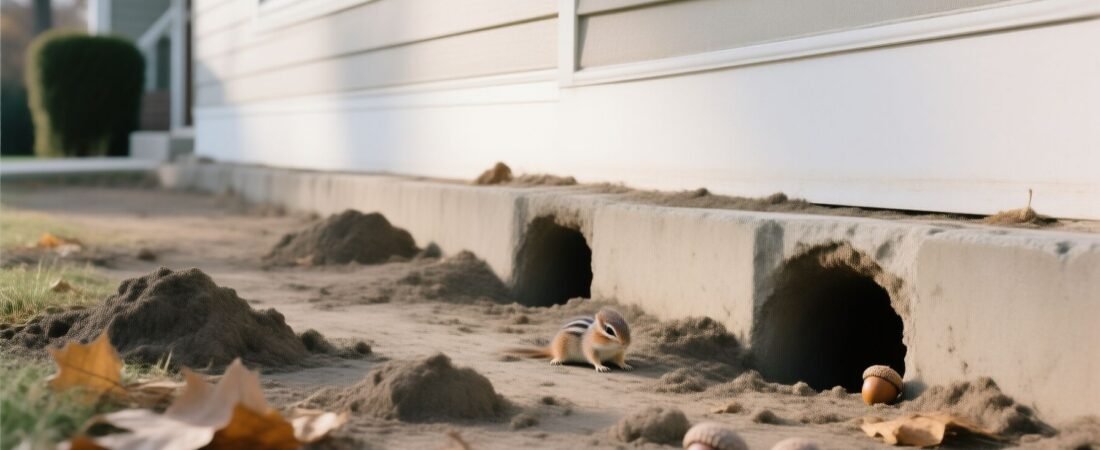
Chipmunks don’t actually damage your foundation — the tunnels they dig underneath it do. That distinction matters because most homeowners focus on the animal and ignore the soil engineering happening two feet below grade. A single chipmunk can excavate up to 30 feet of burrow tunnels, and those tunnels run directly beneath slabs, footings, and foundation walls. Over time, that void space causes soil subsidence — the slow, uneven settling that cracks concrete, shifts door frames, and costs thousands to repair. The animal is almost beside the point.
Why Chipmunks Target Foundations Specifically (and Not Just Your Garden)
Foundations offer something burrow-digging animals absolutely love: a stable, sheltered ceiling over their tunnel system. The concrete or block above acts as a roof that protects the burrow from frost heave, predator excavation, and flooding. That’s not a coincidence — chipmunks are actively selecting your foundation as a superior den site over open ground. They’re not wandering in by accident.
The warmth radiating from a conditioned basement or crawl space also raises the soil temperature a few degrees above ambient, which extends their foraging season and keeps food caches from freezing. Picture this: you notice your basement door is suddenly sticking in its frame, and your inspector finds a three-inch gap has opened between the footing and the slab. That’s not settling from age — that’s what months of active tunneling directly under a load-bearing corner looks like in real life.
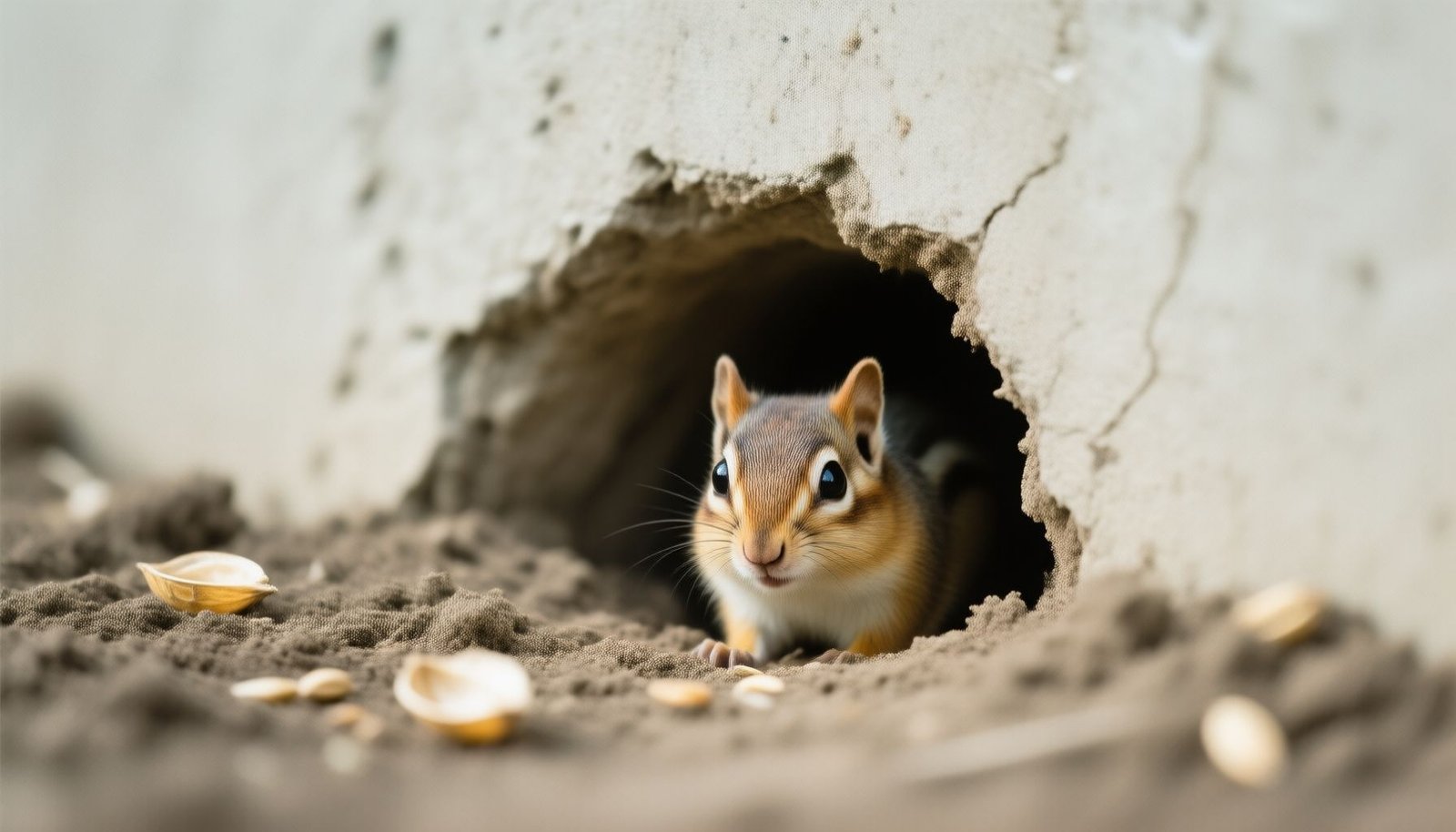
This close-up shows the soil displacement and tunnel entry points typical of chipmunk activity at a foundation perimeter — notice how the disturbed soil sits directly against the concrete, exactly where water and frost can exploit any void beneath.
How Do You Know It’s Actually Chipmunks Under Your Foundation?
Chipmunk burrow openings are small — roughly 1.5 to 2 inches in diameter — and notably clean at the entrance. Unlike moles or voles, chipmunks carry excavated soil away from the hole in their cheek pouches and deposit it elsewhere, so there’s no telltale dirt mound. That means the hole at your foundation line often looks almost surgically neat, and many homeowners walk right past it for weeks.
Here’s how to confirm chipmunks versus other burrowing animals before you spend money on the wrong solution:
- Hole diameter: 1.5–2 inches, round, clean-edged with no surrounding mound
- Location pattern: Entrances clustered within 6–12 inches of the foundation wall or under a step, not randomly across the yard
- Activity windows: Daytime movement only — chipmunks are strictly diurnal; if you see activity after dark it’s a different animal
- Seed or shell debris: Small shells, seed hulls, or berry pits near the entrance (they carry food to the cache below)
- Track size: Four-toed front prints and five-toed rear prints, each under an inch long, in dusty soil or mud near the hole
If you’re dealing with something larger pushing up raised ridges in your lawn, that’s a mole or vole problem — a genuinely different situation with different fixes. Chipmunks leave almost no surface trace beyond those tidy little openings.
What the Tunnels Are Actually Doing to Your Foundation Over Time
This is where most articles stop at “they’re a nuisance” and miss the actual stakes. A chipmunk burrow system isn’t just one tunnel — it typically includes a main entry, one or two concealed escape exits, a food cache chamber, and a nesting chamber. The total tunnel length averages 20 to 30 feet, with the main chamber sitting 2 to 3 feet below the surface. When that system runs under a concrete footing, it creates a hollow zone in the compacted soil that the footing depends on for load distribution.
Rainwater makes this dramatically worse. Water follows the path of least resistance, and an existing burrow is essentially a drain pipe running under your foundation. Soil erosion through the tunnel channel accelerates void formation. Freeze-thaw cycles then expand those voids. One honest nuance here: homes on solid bedrock or with deep frost footings in the northern states are less vulnerable than slab-on-grade construction in the South or homes with shallow rubble-stone foundations common in older northeastern housing stock — your risk level genuinely depends on your foundation type and local soil conditions.
“Most people are surprised to learn that chipmunk burrow damage is rarely immediate — it’s cumulative. The first season looks harmless. By the third or fourth year of active burrowing in the same location, we start seeing the soil consolidation failures that drive real structural repair costs. The animal control part is only half the job; you have to address the void left behind.”
Dr. Marcus Ellery, Wildlife Extension Specialist, University of Connecticut Integrated Pest Management Program
How to Get Rid of Chipmunks Under the Foundation Step by Step
The counterintuitive part of eliminating chipmunks at the foundation is that you should not start with trapping. You should start with a perimeter audit. Setting traps while active burrow exits remain open is like bailing a boat without plugging the hole — new chipmunks will simply move into the vacated territory within days. The sequence matters more than any individual method.
- Map all burrow openings. Walk the full foundation perimeter and mark every hole with a small flag or stone. Don’t assume there are only one or two — a mature chipmunk territory can have 4 to 6 distinct entrance and exit points around a single structure. Check under deck stairs, behind downspout splash blocks, and under any ground-level HVAC equipment.
- Remove all food attractants first. Bird feeders within 15 feet of the foundation are the single most common reason chipmunk populations spike near homes. Fallen fruit, unsecured compost, and accessible bulb plantings all function as food sources that make your foundation worth defending. Eliminate them before trapping — otherwise you’re fighting the pressure constantly.
- Set live traps at active entrances. Use a wire mesh trap (Havahart or equivalent) sized for squirrels — the chipmunk-specific traps are often too small and get bypassed. Bait with peanut butter mixed with rolled oats or sunflower seeds. Place the trap directly over the burrow opening or flush against the foundation wall at the hole. Check traps every 4 to 6 hours; chipmunks are daytime animals so morning and midday checks are most productive. Relocate captured animals at least 5 miles away — anything less and they navigate back.
- Install a perimeter exclusion barrier. Once trapping pressure has dropped activity for 7 to 10 consecutive days with no new captures, install a buried hardware cloth barrier. Use ¼-inch galvanized hardware cloth, 24 inches wide. Bury the bottom 12 inches in an L-shape (the foot of the L points outward, away from the foundation) and secure the top 12 inches against the foundation wall. The outward-facing foot prevents animals from digging straight down at the wall.
- Fill and compact abandoned burrows. Don’t leave old tunnels open — they collect water and invite the next occupant. Pack them with compactable fill (a mix of coarse gravel and soil works better than soil alone because it resists re-excavation). For any burrow that ran directly under a footing, have a contractor assess whether foam injection or compaction grouting is warranted. This step is non-optional if you’ve had active tunneling for more than one season.
- Apply a granular repellent as a maintenance layer. Products containing predator urine (fox or coyote) or capsaicin-based granules applied in a 3-foot band along the barrier line can deter re-establishment. Reapply after rain. This isn’t a primary control method — it’s a deterrent layer after the population has been reduced.
The same patient, sequential logic applies when dealing with other burrowing animals near structures. If you’ve dealt with something larger using similar spots, the approach in How to Get Rid of Groundhogs Under a Shed or Porch covers the exclusion barrier mechanics in more detail — many of the techniques translate directly, scaled up for a larger animal.
Which Chipmunk Control Methods Actually Work — and Which Ones Waste Your Time
There’s a lot of noise in the advice space on this topic — ultrasonic repellers, mothballs, human hair stuffed in burrows, and various folk remedies get recommended constantly. None of them hold up under actual use conditions at a foundation. Ultrasonic devices have no meaningful effect on outdoor burrowing rodents because soil attenuates the signal within inches, and chipmunks don’t respond to human-range ultrasound the way the marketing claims. Mothballs volatilize quickly outdoors, reach non-toxic concentrations within hours in open air, and are a registered pesticide not approved for this use — putting them in burrows is an EPA violation, not just an ineffective one.
Here’s a direct comparison of methods that actually matter:
| Method | Effectiveness for Foundation Use | Important Limitation |
|---|---|---|
| Live cage trapping | High — directly reduces local population | Requires consistent daily monitoring; relocation must be 5+ miles |
| Lethal snap traps (rat-size) | High — faster resolution than live trapping | Must be placed inside a covered bait station to prevent non-target catches |
| Buried hardware cloth exclusion | Very high for long-term prevention | Only works after active population is removed; doesn’t solve existing burrows |
| Granular repellents (capsaicin/predator urine) | Low to moderate as a standalone | Degrades rapidly in rain; temporary deterrent only |
Pro-Tip: If you’re using snap traps near a foundation where pets or wildlife might access them, place the trap inside a short section of 4-inch PVC pipe (capped on one end, open on the other, positioned at the burrow entrance). Chipmunks will enter freely; cats, dogs, and birds physically can’t get to the trigger. It’s cheap, reusable, and takes about 90 seconds to set up.
One underappreciated factor: timing matters enormously. Chipmunks enter a torpor-like dormancy in late fall and don’t truly hibernate — they wake periodically to eat from their underground cache. Attempting to trap in November through February is largely wasted effort because they’re rarely above ground. The highest-impact windows are early spring (when they emerge hungry and before they’ve had a chance to expand existing burrows) and late summer before they start caching food aggressively. Running a control program during these windows cuts the total time to resolution roughly in half compared to starting mid-summer. This is the kind of timing detail that most generic pest control advice skips entirely — and it’s the difference between a two-week fix and a three-month frustration.
It’s also worth noting that the same strategic thinking that applies to chipmunks shows up in other surprising contexts. Dealing with How to Get Rid of Japanese Beetles on Plants and Lawns similarly requires understanding the pest’s life cycle and hitting the right window — reactive spraying without timing is almost always disappointing.
Chipmunks under a foundation are a solvable problem — but solving it correctly means treating the soil and structure as part of the equation, not just the animal. Get the sequence right, close the gaps physically, and address any void left behind, and you won’t be back here searching for answers next spring.
Frequently Asked Questions
how do I know if chipmunks are under my foundation?
Look for small burrow entrances about 2 inches in diameter near your foundation, usually without a dirt mound nearby since chipmunks scatter the excavated soil. You might also notice cracks forming in concrete, settling near the foundation, or chipmunks repeatedly disappearing along the same section of your home’s base.
what is the fastest way to get rid of chipmunks under the foundation?
Live traps baited with sunflower seeds or peanut butter, placed directly over burrow entrances, are one of the quickest hands-on methods — check them every 24 hours and relocate caught chipmunks at least 5 miles away. If you’re dealing with more than 3 or 4 burrows, combining trapping with an L-shaped hardware cloth barrier buried 12 inches deep will stop the problem from coming back.
can chipmunks under the foundation cause structural damage?
Yes, they can. A single chipmunk tunnel system can extend up to 30 feet long and 3 feet deep, and when multiple burrows run beneath a foundation, the soil displacement can lead to voids, settling, and cracked concrete over time. It’s not an overnight problem, but an unchecked colony under a foundation for a full season can do real damage that’s expensive to fix.
what repellents work for chipmunks under the foundation?
Granular repellents containing capsaicin or predator urine (fox or coyote) sprinkled around the foundation perimeter can discourage chipmunks from burrowing, but they need to be reapplied every 2 to 4 weeks and after rain. Repellents work best as a prevention tool or to push chipmunks toward traps — they’re rarely effective on their own once a burrow system is already established.
should I call an exterminator for chipmunks under my foundation?
It’s worth calling a pest control professional if you’ve got more than 5 or 6 active burrow entrances, signs of foundation damage, or if trapping on your own hasn’t worked after 2 to 3 weeks. Some states also restrict how you can relocate or kill chipmunks, so a licensed pro will know the local rules and can pair removal with exclusion work to seal off future entry points.
Disclaimer: This article is for informational purposes only and isn’t a substitute for professional pest control advice. Always read and follow the product label instructions exactly — label directions are legally binding and vary by brand and active ingredient. Keep all pesticides, baits and traps away from children and pets, ventilate treated areas as directed, and consider calling a licensed pest control professional if an infestation is large, recurring, or involves a structural pest like termites or carpenter ants.