
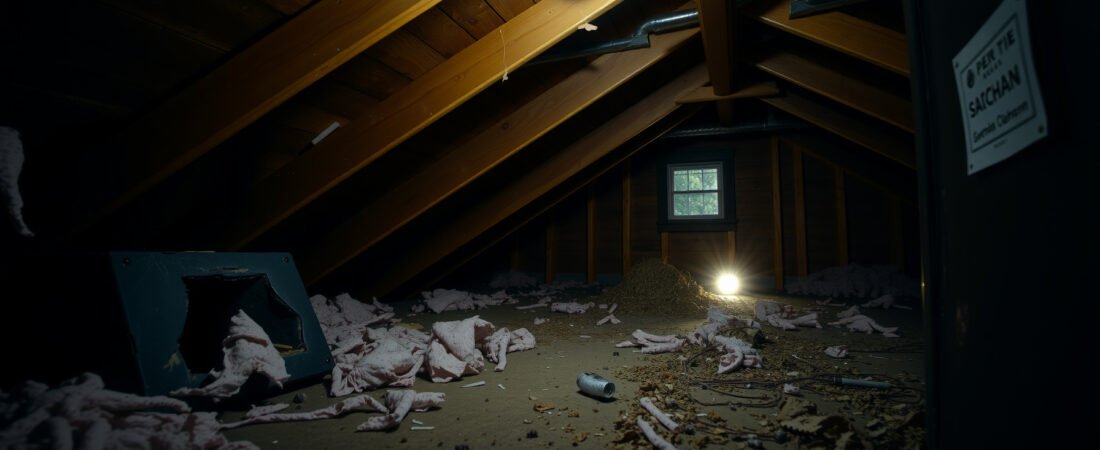
Trapping raccoons feels like the obvious solution — until you realize it almost never solves the actual problem. A female raccoon doesn’t just wander into your attic randomly. She’s chosen it specifically because it’s warm, dry, secure, and close to food. Remove her by trap, and within a season you’ll likely have a new tenant, because nothing about your attic has changed. Getting rid of raccoons without trapping isn’t a workaround — it’s the more permanent fix, and it starts with understanding why she’s there in the first place.
Why Raccoons Choose Your Attic (and Why Eviction Fails Without This Knowledge)
Raccoons are not opportunistic in the way mice are. A mouse will squeeze through a gap as small as 1/4 inch and colonize virtually any structure. Raccoons are deliberate. A female in search of a denning site — typically in late winter through early spring — will investigate multiple entry points on a home, test their structural integrity, and return to the one that gives way. She’s not desperate; she’s selective.
The entry point is almost always something that was already failing: a rotted fascia board, a lifted soffit panel, an uncapped gable vent with a rusted screen, or a roof-to-wall joint that’s lost its flashing. Raccoons can pull back materials with roughly 5 to 8 pounds of gripping force in their forepaws. That sounds modest until you realize most builder-grade attic vents are held in place with staples and caulk that’s been weathering for a decade.
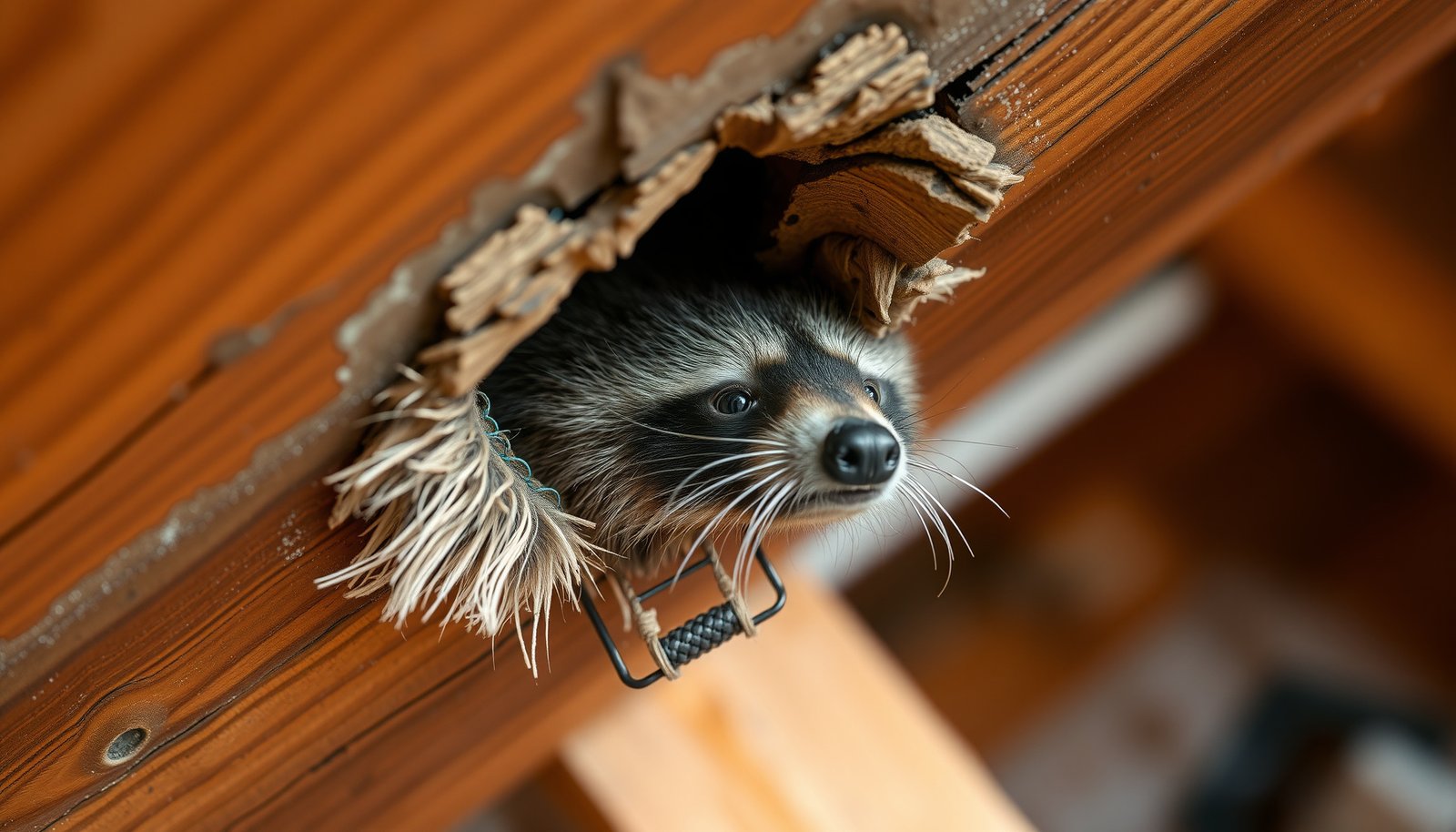
This close-up shows a compromised soffit vent — exactly the kind of weak point raccoons test and exploit, and the type of structural vulnerability that makes any eviction method temporary until it’s addressed.
How to Tell If You Have One Raccoon or a Litter — It Changes Everything
Before you do anything else, you need to figure out whether you’re dealing with a single adult or a nursing female with kits. This is the step most online guides skip straight past, and it’s the one that determines your entire approach. If there are kits in the attic — typically 2 to 5 per litter, born between March and June — using one-way exclusion doors or harassment techniques without removing them first is a serious problem. The mother will tear through almost any barrier to get back to her young, often causing more structural damage than her original entry did.
Listen carefully during the day and just after dusk. A single raccoon moves with a heavy, deliberate thumping — think slow footsteps. A nursing female with kits produces a different soundscape: chattering, trilling, and a kind of rolling chirp that the kits make almost constantly when she leaves. If you hear those high-pitched vocalizations in addition to adult movement, you’ve got a family situation on your hands. Wait until the kits are at least 8 weeks old and mobile before attempting any exclusion — at that point, the family begins moving in and out together and one-way doors become viable.
Does Raccoon Harassment Actually Work? What the Evidence Shows
Harassment-based eviction — using lights, sounds, smells, and temperature to make the attic inhospitable — genuinely works, but only under specific conditions. The window is narrow: it’s most effective during the denning period before kits are too large to move easily, and it requires sustained pressure over 4 to 10 days, not a single night of flashing a light. The core logic is sound. A mother raccoon is not deeply attached to a particular space; she’s attached to the security it provides. Make the space feel actively threatening, and she’ll relocate the family herself.
Here’s the counterintuitive part that most articles bury: raccoons are actually more sensitive to smell than to sound or light. Electronic predator-noise devices and strobe lights do have some effect, but ammonia-soaked rags or commercially available raccoon eviction fluid — which contains male raccoon urine and gland secretions — trigger a threat response that’s hardwired. A nursing female perceives male raccoon scent as a direct danger to her kits, since adult males are known to kill young raccoons. That instinct is powerful enough to override her attachment to the den site.
“Most homeowners focus entirely on sealing the structure, which is correct — but they do it too early. Harassment needs to run its full course first, or you risk sealing a mother away from her young, and then you have a much bigger, messier problem on your hands. The biology has to drive the timeline, not impatience.”
Dr. Marcus Pellegrini, Urban Wildlife Biologist, Cooperative Extension Wildlife Specialist
A full harassment protocol looks like this, applied consistently for at least five to seven consecutive nights:
- Place bright lights directly in the denning area — a battery-powered work light or plug-in shop light left on continuously disrupts the raccoon’s preference for dark, safe spaces.
- Add a radio tuned to a talk station — human voices work better than music because they simulate an occupied, active space. Leave it running through the night.
- Apply raccoon eviction fluid near the nest site — soak cotton rags and place them within 2 to 3 feet of the nest. Reapply every 48 hours, since the scent compounds break down quickly in heat.
- Place ammonia-soaked rags in a secondary location — near the entry point itself to discourage return trips even after the family has moved out.
- Do not skip nights — a single quiet night resets a raccoon’s threat assessment. She’ll decide the disturbance is intermittent and manageable rather than permanent.
- Confirm departure before sealing — stuff the entry point loosely with newspaper for two consecutive nights. If it’s undisturbed after 48 hours of confirmed raccoon-active weather (above 40°F, no heavy rain), the attic is clear.
Sealing the Entry Points Permanently — The Part That Actually Prevents the Next Raccoon
Picture this: you’ve run a full harassment protocol, confirmed the raccoon family is gone, and then sealed the entry point with a sheet of hardware cloth zip-tied to the soffit. Six months later, you’ve got a new raccoon. This is the most common failure mode in DIY raccoon eviction — people seal the point of entry but ignore every other vulnerable spot on the structure. Raccoons don’t return to the same hole because they remember it; they return because your roofline still has the same profile of weaknesses it always had.
Proper exclusion means a perimeter assessment, not just patching the obvious gap. You’re looking for anything a raccoon could reasonably compromise with her forepaws. Galvanized steel hardware cloth — 1/2-inch mesh, 16-gauge minimum — is the standard material. It weathers, it doesn’t corrode quickly, and raccoons cannot pull it free if it’s secured with screws and washers rather than staples. Spray foam, wood filler, and builder’s caulk are not raccoon-proof. They’re fine as supplemental gap fillers behind hardware cloth, not as primary barriers.
Pro-Tip: After sealing all identified entry points, do a roofline inspection from the ground using binoculars on a dry day when light is at a low angle — early morning or late afternoon. Shadows will reveal gaps, buckled flashing, and lifted panels that a straight-on midday look completely misses. This is how wildlife exclusion professionals find the secondary entry points that homeowners miss every time.
| Vulnerable Area | Correct Sealing Material | Common Mistake |
|---|---|---|
| Gable vents | 16-gauge galvanized hardware cloth, screwed over vent from inside | Replacing vent cover with identical builder-grade plastic vent |
| Roof-fascia gap | Steel flashing + hardware cloth backing | Spray foam alone — raccoons chew or pull it free within days |
| Soffit panels | Re-secure with screws, add hardware cloth backing on vulnerable sections | Re-stapling loose panels — raccoons defeat staples easily |
| Chimney (uncapped) | Commercial steel chimney cap with attached wire cage | No cap, or a lightweight aluminum cap raccoons can knock off |
What to Do About Raccoon Waste, Parasites, and Attic Contamination After They’re Gone
Raccoons don’t use your attic insulation the way a mouse does — randomly, dispersed throughout. They establish a latrine site, returning to the same area repeatedly over the course of weeks. By the time you’ve successfully evicted a family, that latrine can contain a concentrated mass of feces several inches deep. This matters for a reason most people don’t think about: raccoon feces can carry Baylisascaris procyonis, a roundworm whose microscopic eggs become airborne when the feces dry and are disturbed. These eggs are extraordinarily resistant — they survive in soil for years and standard household disinfectants don’t reliably kill them.
The cleanup protocol is not optional and it’s not something you do with a shop vac and a dust mask. The relevant steps depend on how long the raccoons were present and how extensive the latrine site is, but there are a few non-negotiables regardless of severity:
- N95 respirator minimum, P100 preferred — airborne eggs are the primary exposure risk during cleanup, not direct contact.
- Disposable coveralls and gloves — bag everything used in the attic before bringing it through living spaces.
- Remove all contaminated insulation — it cannot be decontaminated in place. Any insulation within 3 feet of the latrine site should be bagged and removed.
- Boiling water or steam on hard surfaces — these are the only reliably effective treatments against Baylisascaris eggs. Bleach does not kill them.
- Check for secondary pest activity — raccoon dens frequently harbor fleas, ticks, and occasionally bat bugs. Once the host animal is gone, these parasites will seek alternatives, sometimes moving into living spaces. If you’re spending any time outdoors near your roofline or in the attic during cleanup, the same precautions used for tick protection in wooded areas apply here — you can find a breakdown of what actually works in our guide to Best Tick Repellents for Yard and Clothing: Permethrin vs DEET.
- Replace contaminated insulation with blown-in cellulose or new batts — this is also the right moment to improve attic insulation if it was already degraded before the raccoons arrived.
One honest nuance worth stating plainly: if the raccoons were present for more than four to six weeks — which is common when the infestation goes undetected — the contamination level and structural assessment may warrant a licensed wildlife remediation company rather than a full DIY cleanup. This isn’t about the eviction itself, which you can reasonably manage without trapping. It’s about the attic restoration, which in severe cases involves tens of square feet of insulation removal, treated wood surfaces, and biohazard disposal. Knowing where the line is will save you a re-do.
One thing worth noting for renters who end up in a situation involving wildlife and habitability disputes: the laws governing landlord responsibilities around pest and wildlife infestations — and what qualifies as a habitability issue — vary significantly by state. If you’re dealing with a raccoon situation in a rental property, the same framework that governs How Bed Bug Laws Differ by State: A Renter’s Quick Reference applies conceptually — state law determines who bears responsibility for remediation and under what timeline.
Getting raccoons out without trapping is genuinely achievable for most homeowners, but the long-term result depends entirely on what happens after they leave. Seal every weakness in the roofline before the next denning season starts — raccoons scout entry points as early as January in most of the US — and your attic stops being a viable den site permanently. That’s the outcome trapping alone never delivers.
Frequently Asked Questions
What smells will keep raccoons out of the attic?
Raccoons hate the smell of ammonia, cayenne pepper, and predator urine — coyote urine granules are especially effective and available at most garden centers. Soak rags in ammonia and place them near entry points, or sprinkle cayenne pepper along the roofline. You’ll need to reapply every 3 to 5 days, especially after rain, or the smell fades and stops working.
How do I get raccoons to leave my attic on their own?
Raccoons are sensitive to light and noise, so installing a bright strobe light in the attic and placing a loud radio near their nesting area can make the space uncomfortable enough that they’ll leave within a few days. Make sure there are no babies present first — a mother won’t abandon her young no matter how much she’s bothered. Once you confirm they’re gone, seal every opening larger than 4 inches to prevent them from coming back.
Is it legal to get rid of raccoons without trapping them?
Using harassment methods like lights, noise, and repellents to encourage raccoons to leave on their own is legal in all 50 states. What varies by state is whether you’re allowed to trap and relocate them yourself — many states require a wildlife control license for that. Always check your local wildlife regulations before doing anything beyond exclusion and deterrence.
How do I find where raccoons are getting into my attic?
Walk the perimeter of your roof and look for torn or bent soffit panels, gaps where the roof meets the fascia, and damaged vents — raccoons can pry open aluminum vents and tear through weak wood in under a minute. Entry points are usually at least 4 inches wide and often show dark grease marks, fur, or scratch damage around the edges. Doing this inspection at dusk when raccoons are leaving to forage makes it easier to spot the exact opening.
What to do after raccoons leave the attic?
Once you’re sure they’re gone, seal every entry point with heavy-gauge hardware cloth or metal flashing — don’t use foam, wood, or plastic, because raccoons can chew or claw through all of those. You’ll also need to clean up their nesting area, since raccoon feces can carry raccoon roundworm, which is dangerous to humans and pets. Wear an N95 mask, disposable gloves, and goggles during cleanup, and bag all contaminated insulation for disposal.
Disclaimer: This article is for informational purposes only and isn’t a substitute for professional pest control advice. Always read and follow the product label instructions exactly — label directions are legally binding and vary by brand and active ingredient. Keep all pesticides, baits and traps away from children and pets, ventilate treated areas as directed, and consider calling a licensed pest control professional if an infestation is large, recurring, or involves a structural pest like termites or carpenter ants.