
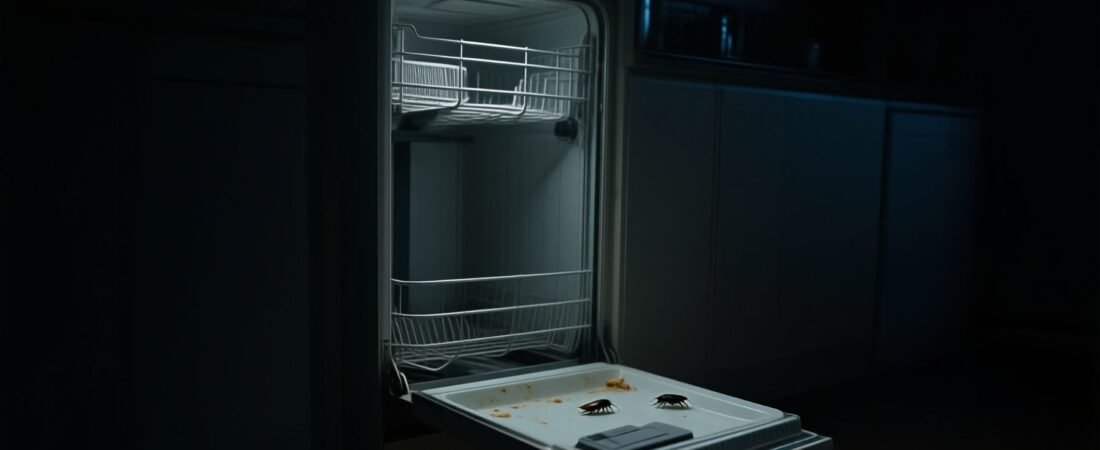
Your dishwasher runs at 140°F and blasts everything with detergent — and roaches are living inside it anyway. That’s the part that throws people off. The machine isn’t the problem. The machine is just where they’re hiding. The real issue is almost always behind and underneath it, where a warm motor, a dripping water line, and a dark cavity create conditions roaches find more comfortable than most places in your kitchen. Killing the roaches you see inside the tub won’t fix anything if you don’t address the harborage zone around the appliance itself.
Why Are Roaches Living in Your Dishwasher Specifically?
The dishwasher motor generates consistent heat — typically between 110°F and 130°F on the exterior casing during a cycle — and then cools down to a stable 80–90°F range while idle. That temperature swing is actually ideal for German cockroaches, the species most commonly found in kitchen appliances. They’re not seeking out your dishwasher because it’s dirty. They’re seeking it out because the thermal profile and humidity level happen to match their reproductive sweet spot almost perfectly.
There’s also a food angle most people overlook. The drain hose, the door gasket, and the filter basket all trap tiny amounts of food residue — starchy water, grease film, protein particles — that roaches can subsist on indefinitely. A female German cockroach produces 30–40 eggs per capsule and can generate up to 8 capsules in her lifetime, meaning a single pregnant female that moved in behind your dishwasher can produce hundreds of offspring without ever needing to venture far for resources.
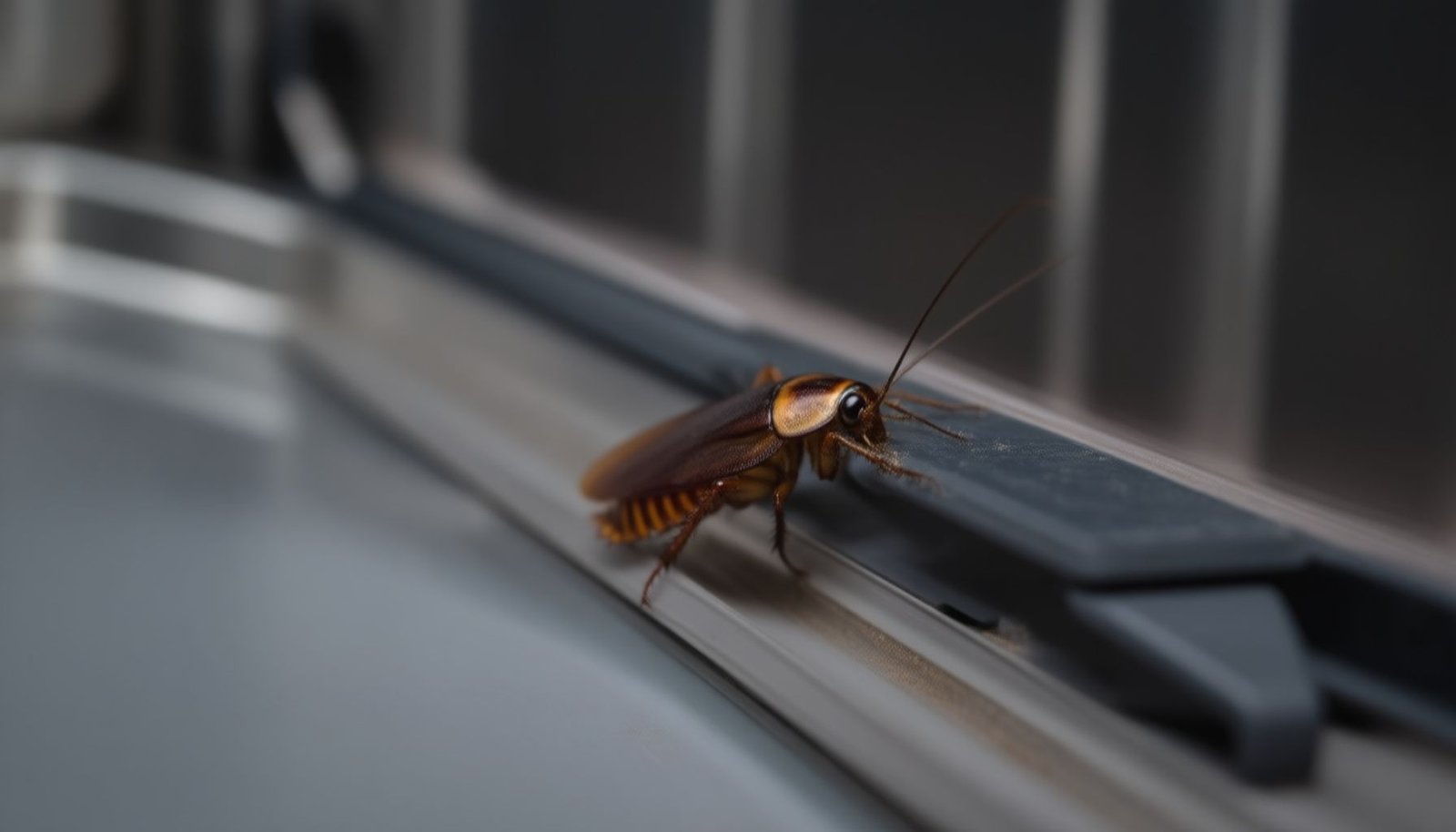
This close-up shows the door gasket and lower cavity area of a dishwasher — the two spots where roaches most often hide and deposit egg cases, and the exact areas most homeowners miss during treatment.
What Most People Get Wrong About Treating Roaches in a Dishwasher
The single biggest mistake is treating the inside of the dishwasher tub and calling it done. People wipe down the interior, maybe spray something, run a hot cycle, and assume the problem is solved. It almost never is. Roaches don’t actually live inside the wash basin — they shelter in the insulation blanket wrapped around the tub exterior, behind the kick plate at the base, around the motor housing, and along the water supply and drain lines where they connect to the cabinet wall. The tub is where you see them. The infestation is somewhere else entirely.
The second mistake is using spray insecticide near or inside the dishwasher. Residual sprays inside a food appliance are a contamination risk, but more practically, the moisture from the machine degrades pyrethroid-based sprays within 24–48 hours, making them nearly useless in that environment. Gel bait is the right chemistry for this specific situation — roaches consume it, return to harborage, and die there, which also triggers secondary kill as other roaches feed on the carcasses. Spray in the wrong place and you actually scatter roaches deeper into the wall void, which makes the problem significantly harder to resolve.
“German cockroaches in kitchen appliances are one of the most underestimated infestations we see. Homeowners focus on the appliance surface, but the colony is almost always in the structural void directly adjacent to it — behind the unit, inside the toe-kick cavity, or in the wall where the drain line penetrates. Until you treat that harborage zone, you’re just displacing the population.”
Dr. Michael Kayne, Board-Certified Entomologist and NPMA-Certified Pest Management Professional
How to Actually Get Roaches Out of a Dishwasher: Step-by-Step
This is a situation where sequence matters as much as product choice. Doing things in the wrong order — like pulling the dishwasher out before baiting — can scatter roaches into wall voids and make the infestation two or three times harder to resolve. Follow this order specifically.
- Remove the kick plate and inspect with a flashlight. The toe-kick panel at the base of the dishwasher pops off without tools on most models. Shine a light in and look for egg cases (dark brown, rectangular, about 1/4 inch long), roach feces (tiny dark specks that look like ground pepper), or live roaches clustered near the motor or pump housing. This tells you how established the harborage is before you do anything else.
- Apply gel bait — do not spray. Place small dots of gel bait (a pea-sized amount per application point) along the back wall of the toe-kick cavity, around the base of the motor housing, along the edges of the door hinge area, and inside the gap where the drain hose exits into the cabinet wall. Advion, Vendetta, or Invict Gold are effective options. Do not apply bait inside the wash tub.
- Clean the dishwasher filter and door gasket thoroughly. Pull the filter basket out from the tub floor and rinse it under hot water to remove food debris that’s feeding the population. Use a stiff brush along the door gasket folds — egg cases are frequently glued to this rubber seal and need to be physically scrubbed out, not just rinsed.
- Apply boric acid dust to the wall void behind the unit. If you can access the gap around the drain line or water supply line where they enter the wall, lightly dust this area with boric acid. The dust clings to roaches as they pass through and kills them via abrasion to their exoskeleton and ingestion during grooming. Don’t over-apply — a light visible film is more effective than a heavy pile.
- Monitor with glue traps for 7–10 days. Place glue trap monitors directly against the wall on both sides of the dishwasher. The catch count over the first week tells you whether the population is declining, stable, or growing. If you’re catching 10+ roaches per trap per night after day 5, the infestation is larger than the appliance zone and you likely have a wall void colony that needs additional treatment.
- Replace or refresh bait at 2 weeks. Gel bait dries out and loses attractiveness, especially in a warm environment like behind a dishwasher. Replace all bait points at the two-week mark regardless of whether the original dots appear depleted. The second application catches the next generation of roaches that hatched after your initial treatment.
Picture this: you follow every step above, trap counts drop sharply by day 4, and you think you’re done — then three weeks later they’re back. That’s usually not a re-infestation from outside. It’s a second harborage point you didn’t treat, often the cabinet directly under the kitchen sink or inside a neighboring appliance like a refrigerator. Roaches in a dishwasher are frequently a symptom of a broader kitchen infestation, not an isolated colony, and that distinction changes your whole approach.
Pro-Tip: Don’t run the dishwasher for at least 6–8 hours after placing gel bait. The heat from a wash cycle will dry out fresh bait almost immediately and kill its attractiveness before roaches have a chance to find it. Bait in the evening, skip the overnight cycle, and let the bait cure for a full day before resuming normal use.
How to Tell If the Infestation Has Spread Beyond the Dishwasher
There’s a counterintuitive reality about dishwasher roach problems: the appliance is rarely the origin point. Roaches typically enter from a wall void, a shared drain line in a multi-unit building, or a utility penetration in the cabinet — and the dishwasher just becomes one node in a larger network. The same behavior pattern shows up with ants moving through subslab plumbing; if you want a comparison, the way pest pressure travels through hidden structural pathways in How to Get Rid of Ants Under a Concrete Slab is remarkably similar to how cockroach colonies expand outward from a central harborage through adjacent voids.
Signs the problem has moved beyond the dishwasher zone include finding roach feces inside cabinet drawers more than 3 feet from the appliance, seeing roaches during daylight hours (which indicates overcrowding in the primary harborage), or catching roaches near the refrigerator compressor or stove igniter area. Roaches exposed to light during the day are often being pushed out by population pressure — it’s not random exploration, it’s displacement.
| Sign | What It Likely Means | Response |
|---|---|---|
| Roaches only seen near dishwasher at night | Localized harborage, early-stage infestation | Gel bait + boric acid in kick-plate cavity; monitor with traps |
| Roaches seen in multiple kitchen zones at night | Infestation has spread to adjacent appliances or cabinets | Expand bait placement to all appliances; treat cabinet wall voids |
| Roaches seen during daytime | Large, overcrowded colony; severe infestation | Professional treatment likely needed; wall void inspection required |
| Egg cases found in door gasket or filter area | Active reproduction inside the appliance zone | Physically remove all egg cases before baiting; clean gasket thoroughly |
How to Stop Roaches From Returning to the Dishwasher
Sealing the pathways roaches use to access the dishwasher zone is more effective long-term than any ongoing chemical treatment. The drain line, water supply line, and electrical conduit that run through the cabinet wall into the dishwasher cavity are almost always surrounded by gaps — sometimes 1/2 inch or more — that were never properly sealed during installation. Roaches can exploit a gap as small as 1/16 inch, so these open penetrations are essentially open invitations. Fill them with DAP or a similar non-shrinking caulk, or use copper mesh packing material for larger irregular gaps before sealing over it.
Maintenance habits matter too, though they’re not a substitute for sealing. Here’s what actually reduces the ongoing food and moisture signals that attract roaches back to this zone:
- Clean the filter basket weekly — even a small accumulation of starchy debris in the mesh filter is enough food to sustain a cockroach population indefinitely.
- Check the door gasket monthly — wipe it down with a damp cloth and inspect the folds for egg cases, which look like small dark brown tic-tacs glued into the rubber creases.
- Fix drips at the water supply connection — even minor condensation or a slow drip under the dishwasher creates the moisture gradient roaches actively seek out.
- Leave the dishwasher door slightly ajar after cycles — this reduces the interior humidity that builds up after a hot cycle, making the appliance zone less hospitable as a harborage overnight.
- Don’t store items in the toe-kick cavity — some dishwasher models have a drawer in this space; if yours doesn’t, leaving it clear and inspectable is better than using it for storage that creates hiding spots and limits your ability to monitor.
One honest nuance worth acknowledging: if you live in a multi-unit building — an apartment, condo, or townhouse with shared walls — your ability to fully eliminate a dishwasher roach problem is genuinely limited by what’s happening in adjacent units. German cockroaches travel freely through shared plumbing chases and wall voids, and a treated unit can be re-colonized within days from a heavily infested neighboring unit. This is a building management issue as much as a pest control one, and individual unit treatment alone may only suppress rather than eliminate the problem in those situations. It’s the same dynamic that makes bed bug remediation so complicated in multi-unit housing — something worth understanding if you’ve ever dealt with persistent re-infestations despite thorough treatment, similar to the challenges described in resources like How to Get Rid of Bed Bugs in a Hotel Room You’re Staying In, where the source of the problem is shared infrastructure you can’t fully control.
Roaches in a dishwasher feel uniquely violating — it’s the one appliance you trust to be sanitary — but the fix is entirely achievable if you go after the harborage zone rather than the visible surface. Treat the cavity, seal the penetrations, and monitor consistently for three weeks. If the population doesn’t decline sharply within 10 days of your first bait application, expand your inspection to every appliance in the kitchen before you assume the dishwasher is the whole story. The one that shows you the roaches is rarely the one that’s harboring them.
Frequently Asked Questions
Why are roaches in my dishwasher?
Dishwashers are a perfect roach magnet because they offer three things roaches need to survive: moisture, warmth, and food residue. Even a clean-looking dishwasher has food particles stuck in the drain filter, door gasket, and around the heating element. Roaches also love the dark, enclosed space when the appliance isn’t running.
Is it safe to use a dishwasher that has roaches in it?
You shouldn’t run dishes through a roach-infested dishwasher until you’ve treated and cleaned it thoroughly. Roaches carry bacteria like Salmonella and E. coli on their bodies, and those pathogens can transfer to your dishes, utensils, and glassware. Once you’ve eliminated the infestation and run a full sanitizing cycle, the dishwasher is safe to use again.
What kills roaches in a dishwasher?
Gel bait like Advion or Combat placed around the exterior base and under the door is one of the most effective treatments — roaches carry the bait back to the nest, which kills others. Don’t spray insecticide inside the dishwasher itself since it can contaminate surfaces that touch your dishes. You should also clean out the drain filter and door gasket with hot soapy water to remove the food sources drawing them in.
how do I know if roaches are living in my dishwasher?
The most obvious signs are seeing live or dead roaches inside the tub, around the door seal, or near the bottom panel. You might also notice small dark droppings that look like black pepper or coffee grounds along the door gasket or inside the filter area. A musty or oily smell coming from the dishwasher when it’s not running is another common indicator of a roach presence.
how do I keep roaches from coming back to my dishwasher?
Clean the drain filter at least once a month and wipe down the door gasket regularly — food buildup in those two spots is the biggest reason roaches keep returning. Run your dishwasher every 2 to 3 days so water doesn’t sit stagnant, and fix any leaks under the sink nearby since even a slow drip creates the moisture roaches are looking for. Storing dish soap and sponges away from the base of the appliance also removes additional food and scent sources.
Disclaimer: This article is for informational purposes only and isn’t a substitute for professional pest control advice. Always read and follow the product label instructions exactly — label directions are legally binding and vary by brand and active ingredient. Keep all pesticides, baits and traps away from children and pets, ventilate treated areas as directed, and consider calling a licensed pest control professional if an infestation is large, recurring, or involves a structural pest like termites or carpenter ants.