
Dust mite allergies affect roughly 20 million Americans — yet most of them are washing their sheets every week and still waking up congested, itchy, and miserable. Here’s the part nobody tells you: washing your bedding kills surface allergens, but it does almost nothing about the 1.5 million dust mites that may be living inside your mattress right now. The mistake isn’t skipping laundry. The mistake is thinking laundry is enough.
Getting mites out of your bed and bedroom for real means attacking the environment they depend on — not just the mites you can see (which, for the record, you can’t, since they’re 0.2–0.3mm long). This article focuses on what actually works at the source level, and why most advice you’ve read stops one step too short.
What Kind of Mites Are Actually in Your Bed?
Before you treat anything, you need to know what you’re dealing with — because “mites in bed” is not one problem, it’s at least three different problems with three different solutions. The most common culprit is the house dust mite (Dermatophagoides pteronyssinus or D. farinae), an invisible creature that feeds on shed human skin cells and thrives in the warm, humid microclimate of your mattress. A second possibility is bird mites or rodent mites — tiny, visible specks that bite and are almost always traced back to a bird nest in a soffit or a mouse problem in the walls. Third, there are scabies mites, which are a medical issue, not a pest control issue, and require a prescription treatment from a doctor.
The distinction matters enormously because dust mites don’t bite — their damage is allergenic, caused by their fecal particles and shed exoskeletons, not by direct contact. If you’re waking up with actual bite marks or visible crawling specks on your sheets, you’re probably not dealing with dust mites at all. Getting the right ID saves you weeks of treating the wrong pest with the wrong approach.
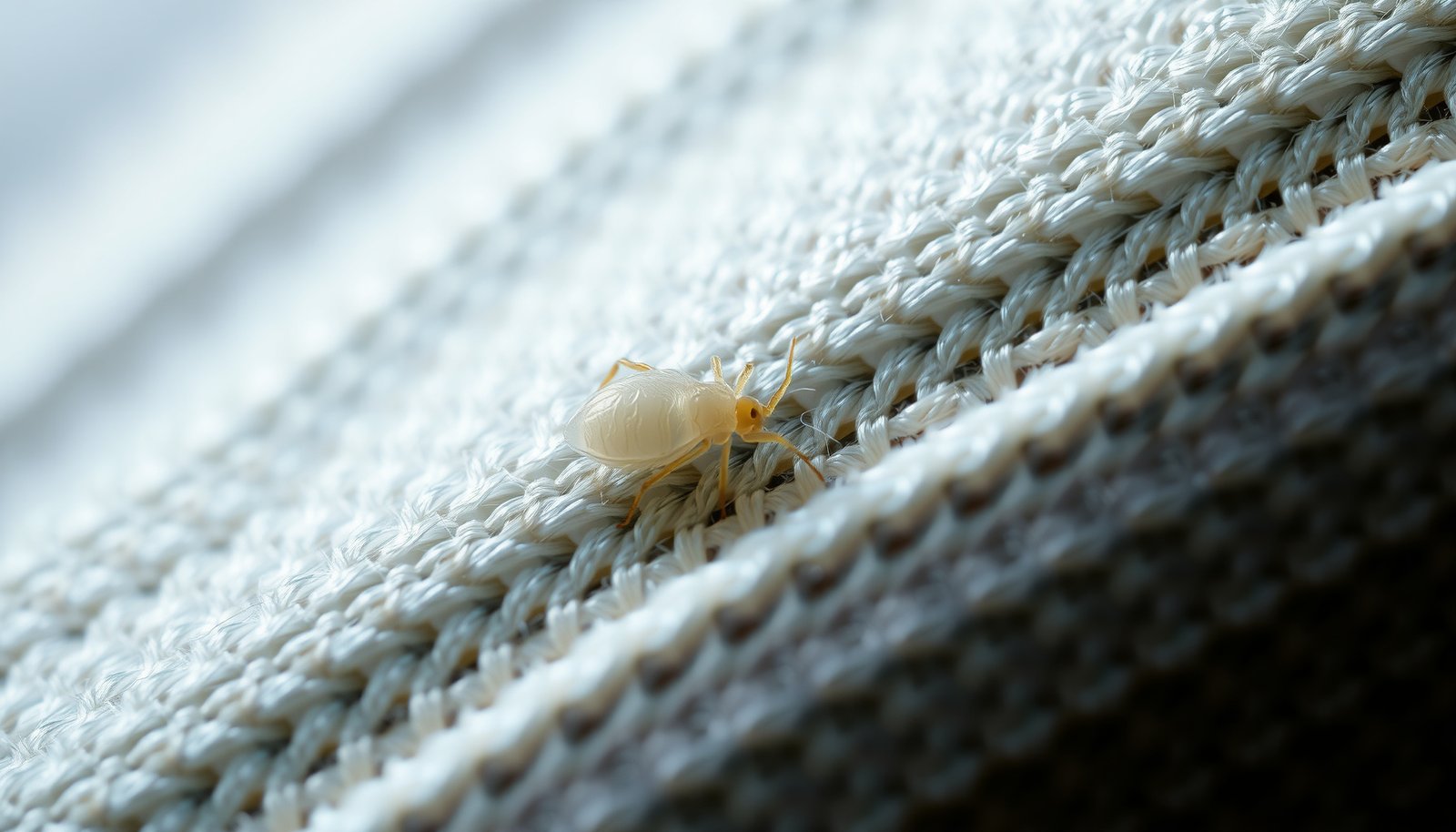
This microscope-level view of a dust mite illustrates why standard cleaning misses them entirely — at under a third of a millimeter, they live deep in mattress fibers and pillow fill where no vacuum or spray can realistically reach without the right tools.
Why “Wash Your Sheets” Advice Only Solves 10% of the Problem
Hot washing kills dust mites on contact — you need water at or above 130°F to reliably kill them, and most home washing machines hit that if you use the “sanitize” cycle. The problem is that your sheets account for a small fraction of the total mite population in your sleep environment. Studies from academic allergy research programs consistently show that the mattress itself holds the bulk of the colony, and a standard mattress has no laundry cycle.
Picture this: a couple has been diligently washing their sheets every week for months, yet one of them keeps waking up wheezing. They eventually have their home tested and discover the allergen load in their mattress is 47 times higher than in the sheets they’ve been cleaning. That’s not unusual — it’s typical. The mattress is where dust mites spend most of their lifecycle, where females lay eggs (each female produces 1–3 eggs per day for up to 70 days), and where the fecal particles accumulate for years. Washing the sheets without encasing the mattress is like mopping the floor while the ceiling is leaking.
“Dust mite allergen reduction requires a layered approach targeting the mattress, pillows, and room humidity simultaneously. Single-intervention strategies — like washing alone — rarely produce clinically meaningful allergen reduction because they ignore the primary reservoir. Encasements combined with humidity control below 50% relative humidity are consistently the highest-impact interventions we see.”
Dr. Sandra Kowalczyk, board-certified allergist and clinical researcher, Midwest Allergy and Asthma Institute
How to Actually Eliminate Dust Mites From Your Mattress and Pillows
The most effective, evidence-backed sequence attacks dust mites through three mechanisms: physical barrier, thermal kill, and humidity starvation. None of these alone is sufficient. Together, they cut allergen exposure by 80–90% in most bedrooms within 4–8 weeks, which is the time it takes the remaining population to die off and for your immune system to start noticing the difference.
Follow these steps in order — sequence matters because you don’t want to seal allergens in under an encasement without reducing the existing population first:
- Vacuum the mattress surface thoroughly using a vacuum with a HEPA filter, focusing on seams and tufting where mites concentrate. Do this before you do anything else — you’re reducing the starting population before sealing it in.
- Apply a steam treatment to the mattress using a handheld steamer that produces vapor at least 200°F at the nozzle. Move slowly — about 1 inch per second — to allow heat penetration. Mites die at 130°F, so you have a meaningful kill margin, but speed kills your coverage.
- Let the mattress dry completely — at least 2–3 hours with a fan running — before covering it. Moisture trapped under an encasement creates a mold problem on top of your mite problem.
- Encase the mattress AND box spring AND all pillows in allergen-proof, zippered encasements with a pore size of 6 microns or less. This physically blocks mites from entering or exiting. Do not skip the box spring — it holds a substantial secondary population.
- Wash all bedding the same day at 130°F or higher, then dry on high heat for at least 30 minutes. If your washer doesn’t reach 130°F, the dryer heat cycle alone (above 130°F for 15+ minutes) can substitute for the wash phase’s kill step.
- Drop bedroom humidity below 50% and keep it there. Dust mites cannot survive long-term in environments below 45–50% relative humidity — they desiccate and die because they absorb moisture from the air rather than drinking water. A $25 hygrometer and a dehumidifier handle this step completely.
Pro-Tip: If you’re using a whole-room heat treatment device for mites related to a broader infestation concern, check out the Best Bed Bug Heaters for Whole Room Treatment — several of these units run hot enough to kill mites throughout an entire room, not just surface level, and can be a faster option than the steamer-plus-encasement sequence when you’re dealing with severe infestations.
What About Biting Mites — Bird Mites and Rodent Mites in Bed?
If you’re waking up with small red bites, noticing tiny moving dots on your sheets, or experiencing intense crawling sensations that you can’t attribute to any visible insect, dust mites are not your problem. Biting mites — almost always bird mites (Dermanyssus gallinae or Ornithonyssus sylviarum) or rodent mites (Ornithonyssus bacoti) — invade from the outside when their primary host disappears. A bird nest that fledged and emptied in the soffit above your bedroom, or a mouse that died in the wall, sends hundreds of starving mites migrating toward the nearest warm-blooded alternative: you.
The counterintuitive thing here is that spraying your mattress is almost useless until you find and eliminate the source. Mites will keep flooding in from the nest or harborage faster than any spray can kill them at the bedroom level. The fix is removing the nest, sealing the entry point, and then treating the migration path — typically baseboards and window frames — with a residual insecticide labeled for mites. Only after you stop the source infestation does bedroom treatment make sense.
| Mite Type | Do They Bite? | Visible to Naked Eye? | Primary Fix |
|---|---|---|---|
| Dust Mites | No — allergenic only | No (0.2–0.3mm) | Encasements + humidity control |
| Bird Mites | Yes — small red bites | Barely — tiny moving dots | Remove nest + residual spray |
| Rodent Mites | Yes — intense irritation | Barely — dark specks | Eliminate rodent source + treat migration path |
| Scabies Mites | Yes — burrow in skin | No | Prescription medication from doctor |
How to Keep Your Bedroom Inhospitable to Mites Long-Term
Killing mites once is genuinely achievable. Keeping them from rebuilding their population is where most people fall off because it requires a few permanent habit changes, not just a one-time cleaning blitz. The good news is that dust mites have a specific set of environmental needs — temperature, humidity, and food source — and you can control all three without chemicals.
Here’s what sustainable mite prevention actually looks like in a real bedroom:
- Run a dehumidifier year-round in humid climates, or seasonally in drier regions where summer humidity spikes. Set it to 45% and let it run — this is your single highest-leverage long-term tool.
- Replace your mattress encasement every 3–5 years or immediately if you notice any micro-tears. A torn encasement offers no protection.
- Wash stuffed animals, decorative pillows, and throw blankets monthly at 130°F — these are overlooked mite reservoirs that many people never think to treat.
- Replace carpeting in the bedroom with hard flooring if at all possible. Carpet holds up to 100 times more allergen than a hard surface and is essentially impossible to fully remediate. In severe allergy cases, this single change produces dramatic symptom reduction.
- Use a HEPA-filtered vacuum on bedroom floors and upholstered furniture weekly. Standard vacuums without HEPA filtration actually aerosolize mite allergen particles rather than capturing them, making your air quality worse during the cleaning process.
One honest nuance worth acknowledging: how aggressive you need to be with all of this genuinely depends on your specific situation. Someone in Phoenix with naturally low indoor humidity and hard floors already lives in a mite-unfriendly environment and may only need encasements to see significant relief. Someone in coastal Florida with carpet, high indoor humidity, and a family member with severe asthma may need to implement every item on this list and still benefit from consulting an allergist about supplemental medications. The environment you’re working with changes the calculus significantly. If you’re in a condo or apartment building where humidity control is shared or restricted, it’s worth understanding your rights around modifications — the HOA and Condo Pest Responsibility: Who Pays in Shared Buildings? guide covers situations where building-wide humidity or pest issues affect individual units.
The longer you maintain a low-humidity, encased sleeping environment, the more the mite population in your bedroom approaches zero — not because you’re killing them constantly, but because you’ve removed every condition they need to survive. That’s not pest control. That’s habitat elimination, and it’s the only approach that actually sticks.
Frequently Asked Questions
how do I know if I have mites in my bed?
You usually can’t see dust mites directly — they’re only about 0.3 millimeters long. What you’ll notice instead are symptoms like sneezing, a runny nose, itchy eyes, or waking up congested. If those symptoms ease up when you’re away from home for a few days, mites in your bed are a likely culprit.
what temperature kills mites in bedding?
Washing your bedding in water that’s at least 130°F (54°C) kills dust mites on contact. If your washer doesn’t get that hot, run items through a dryer on high heat for at least 15 minutes — that’ll do the job too. Do this every 1 to 2 weeks to keep mite populations from rebuilding.
can mites in bed bite you?
Dust mites don’t bite — they feed on dead skin cells, not blood. If you’re waking up with actual bite marks or red welts, you’re likely dealing with a different pest like bed bugs or bird mites instead. It’s worth inspecting your mattress seams and box spring carefully to rule those out.
does vacuuming your mattress get rid of mites?
Vacuuming helps reduce mite allergens on the surface, but it won’t eliminate mites living deeper in the mattress. Use a vacuum with a HEPA filter and go over the entire mattress slowly, including the sides. Pair it with a dust-mite-proof mattress encasement for much better long-term results.
what humidity level stops dust mites from surviving?
Dust mites struggle to survive when indoor humidity drops below 50%. Keeping your bedroom between 35% and 50% humidity — using a dehumidifier if needed — makes the environment far less hospitable for them. A basic digital hygrometer costs under $15 and lets you monitor your levels easily.
Disclaimer: This article is for informational purposes only and isn’t a substitute for professional pest control advice. Always read and follow the product label instructions exactly — label directions are legally binding and vary by brand and active ingredient. Keep all pesticides, baits and traps away from children and pets, ventilate treated areas as directed, and consider calling a licensed pest control professional if an infestation is large, recurring, or involves a structural pest like termites or carpenter ants.