

Psocids aren’t a sign that your home is dirty — they’re a sign that your home is humid, and that’s a distinction that matters enormously for how you respond. Most people who find these tiny pale insects crawling across old books, cardboard boxes, or wallpaper assume they’ve got a hygiene problem. They scrub surfaces, throw things out, and wonder why the bugs come back. The bugs come back because the moisture was never addressed. That’s the real story with psocids, and it changes everything about how you identify, confirm, and ultimately fix the problem.
What Do Psocids Actually Look Like Up Close?
Psocids — commonly called booklice, though they’re not true lice at all — are extraordinarily small. Adults typically measure between 1/32 and 1/8 of an inch, which puts them right at the edge of what most people can see with the naked eye without glasses. They’re soft-bodied, pale white to grayish-tan in color, and move with a distinctive jerky, scurrying motion that people often describe as “dust that moves on its own.”
Under a magnifying glass, you can make out a disproportionately large head relative to body size, long thin antennae, and chewing mouthparts. Wings may or may not be present depending on the species — indoor species are almost always wingless, while outdoor species frequently have two pairs of wings held tent-like over their body when at rest. The abdomen is slightly rounded and the legs are pale and thread-thin, giving them an almost translucent appearance in bright light.
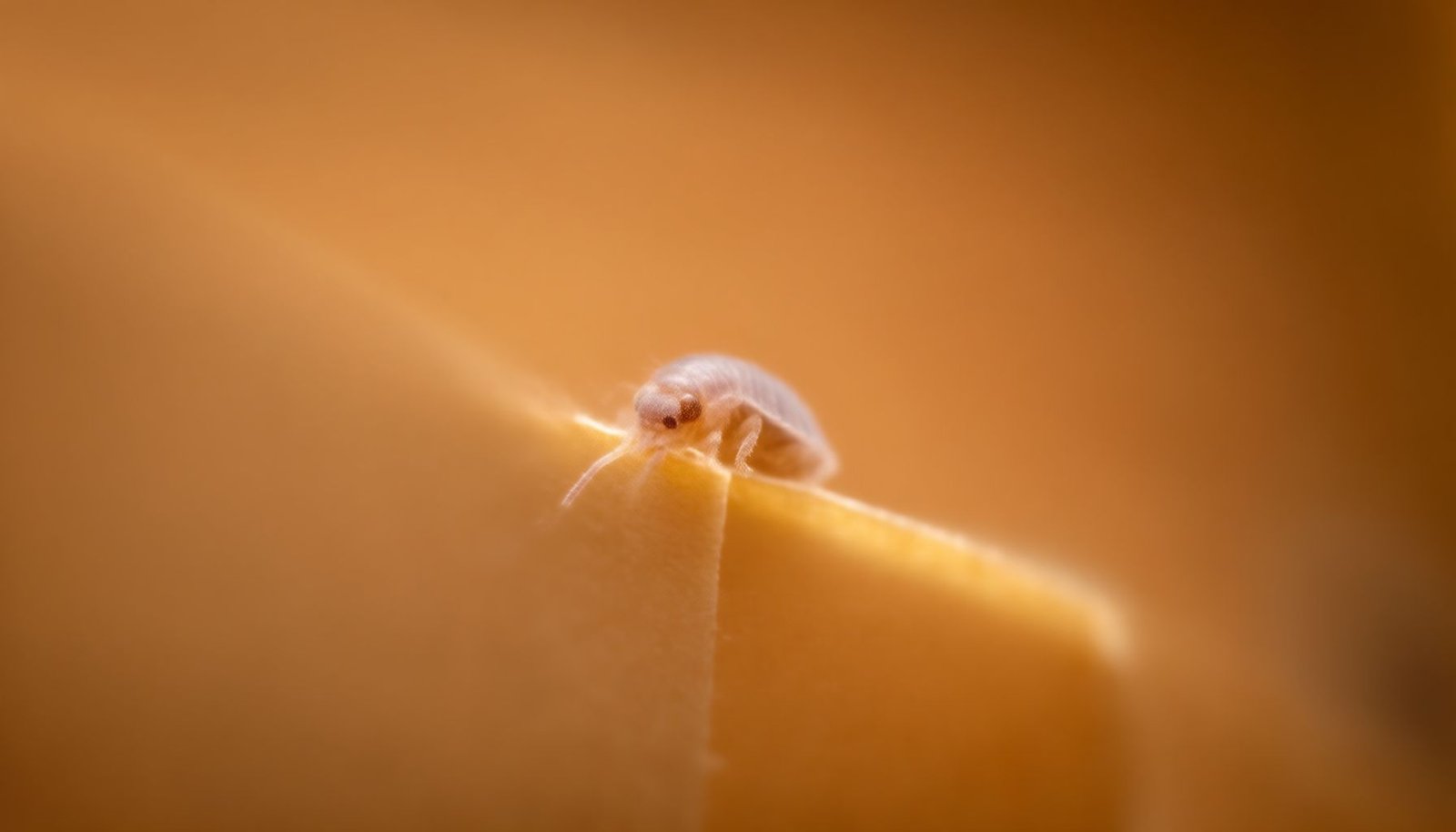
This close-up view shows the enlarged head, long antennae, and pale segmented body that distinguish psocids from other tiny household insects — details that are nearly impossible to see without magnification but make a confident identification possible once you know what you’re looking for.
How Do You Tell Psocids Apart From Other Tiny Pale Bugs?
This is where most people get stuck, and honestly, it’s a fair place to be confused. At 1/16 of an inch, a psocid looks similar at first glance to several other common household pests — springtails, mold mites, and even newly hatched nymphs of other species. The difference lies in behavior, body shape, and where exactly you find them. Springtails jump when disturbed; psocids don’t jump, they run. Mold mites are rounder and much slower. Psocids have that distinctive large head that, once you see it magnified, is hard to mistake.
Location is also a critical clue. Psocids are almost always found in tight association with paper, cardboard, stored grain products, or damp wall surfaces. You’ll find them between the pages of books that have been stored in a humid basement, along the edges of wallpaper that’s begun to lift, or clustering on cardboard boxes that have gotten damp. If a tiny pale bug you’re seeing is on a plant or jumping, it’s almost certainly not a psocid.
| Bug | Size | Jumps? | Typical Location |
|---|---|---|---|
| Psocid (booklouse) | 1/32–1/8 inch | No — runs in short bursts | Books, cardboard, damp walls, stored grains |
| Springtail | 1/16–1/8 inch | Yes — launches into air | Soil, drains, damp concrete floors |
| Mold mite | Under 1/32 inch | No — crawls very slowly | Cheese, stored food, extremely damp surfaces |
| Grain mite | Under 1/32 inch | No | Flour, cereals, dried pet food |
Where in Your Home Are Psocids Most Likely Hiding?
Picture this: you’re moving boxes out of a storage room that’s been sealed up for a couple of years, and when you lift one box off the floor, dozens of tiny pale specks scatter in every direction. That’s a classic psocid encounter. They concentrate wherever humidity stays consistently above 55% — and inside walls, behind baseboards near plumbing, and in poorly ventilated storage spaces, that threshold gets crossed easily without you ever knowing it.
Here’s the specific list of locations worth checking if you suspect psocids:
- Cardboard boxes stored on concrete basement or garage floors (concrete wicks moisture upward constantly)
- Books and paper stored in rooms without climate control, particularly older paperbacks with paste-based glue bindings
- Behind and beneath wallpaper — especially older homes where wallpaper paste provides both food and moisture retention
- Inside wall voids near leaking pipes or condensation-prone cold water lines
- Pantry areas with bags of grain, flour, or dried herbs stored longer than a few months
- Newly built or recently renovated rooms where building materials still contain residual moisture from construction
That last one surprises people. A brand-new home can have a psocid problem within weeks of construction if the framing lumber wasn’t fully dried before installation. Psocids don’t need an old, neglected house — they need moisture and a food source, and both are readily available in new construction.
What Are Psocids Actually Eating Inside Your Walls?
Understanding what psocids eat explains why they appear in such specific spots and why eliminating them without fixing the underlying conditions never works long-term. Their primary food source is mold and mildew — specifically the microscopic fungal spores and hyphal threads that grow on damp organic material. The “book” in booklice comes from the historical association with the starch-based paste used in old bookbindings, which would grow mold in humid conditions. The psocids weren’t eating the books; they were eating the mold growing on the books.
They’ll also consume algae, pollen, dead insect fragments, and the naturally occurring mold on damp wallboard or wood. This is the counterintuitive fact that most pest control articles skip entirely: a psocid infestation is often a biological indicator that mold is growing somewhere in your home, even if you can’t smell it or see it yet. Finding psocids in a wall void is sometimes an earlier warning sign than the mold itself becoming visible. If you’re dealing with black beetles showing up indoors, it’s worth comparing the moisture conditions in those areas — many fungus-feeding insects cluster in the same high-humidity zones.
Pro-Tip: Before you do anything else, buy an inexpensive digital hygrometer (under $15 at most hardware stores) and check the relative humidity in the room where you’re finding psocids. If it reads above 55%, you’ve confirmed the driving condition. Psocid populations can grow rapidly at 65–80% humidity — a female can lay up to 100 eggs in her lifetime, and under warm, humid conditions, a new generation matures in as little as 3–4 weeks. Lowering humidity below 50% collapses the population far more effectively than any spray.
How Do You Confirm a Psocid Identification With Certainty?
A confident identification comes from combining body shape, behavior, location, and the presence of favorable conditions. Here’s a step-by-step approach that works without sending specimens to a lab:
- Collect a sample — Press a piece of clear tape over the area where you see the bugs. The tape picks up individuals without crushing them, and you can examine them against a white background under a magnifying glass or phone camera macro mode.
- Check the head size — Psocids have a notably large, rounded head relative to their body. This is visible under 10x magnification and is the single most reliable visual marker.
- Look for the antennae — Long, thin, and segmented antennae (often longer than the body) are characteristic. Mites don’t have antennae at all, which rules them out immediately.
- Observe movement — Psocids move in a rapid, jerky scurry, stop briefly, then move again. They don’t jump, they don’t fly (indoors), and they don’t wriggle like larvae.
- Test the humidity — Confirm relative humidity is above 55% in the affected area. If it’s bone dry, reconsider your identification — psocids cannot reproduce in dry conditions.
- Check for mold — Look for visible mold growth on nearby paper, cardboard, or drywall. Even light surface mold or a musty smell in the area strongly supports a psocid identification.
One honest nuance worth acknowledging: if psocids are appearing in a finished living area with no obvious moisture source and no mold smell, the problem may be inside the wall cavity — which requires a moisture meter or infrared camera to confirm. In that scenario, a pest professional or building inspector with moisture-detection tools is genuinely worth calling, because the psocids are telling you something your eyes can’t easily verify. The situation is different in a basement or garage where the source is obvious — but in a finished bedroom wall or kitchen backsplash area, the investigation gets more technical. Some infestations in grain products, like flour or oats showing signs of insect activity, look similar at first glance to pantry moth situations — it helps to cross-reference with the signs of a pantry moth infestation to rule that out before committing to a treatment approach.
“Psocids are one of the most misidentified indoor insects I encounter in the field. Homeowners either mistake them for lice — which causes enormous unnecessary anxiety — or they treat them like a typical insect infestation with pesticides and can’t understand why nothing works. The real intervention is moisture control. Get the relative humidity below 50% and maintain it, and in most cases the population dies off within four to six weeks without a single spray. Pesticides have almost no role in a psocid response unless you’re dealing with a severe structural moisture issue that can’t be fixed quickly.”
Dr. Ellen Maret, Ph.D. Entomology, University Extension Specialist — Stored Product and Structural Insects
The distinction between psocids and true lice matters beyond just accuracy. True lice — head lice, body lice, pubic lice — are parasites that live on human or animal hosts and feed on blood. Psocids don’t bite, don’t infest people, don’t transmit disease, and have zero interest in you as a host. They’re entirely focused on the mold and organic debris on your surfaces. That’s genuinely reassuring once you’ve confirmed the identification, because it means the problem is environmental, not personal, and it’s fixable without the kind of whole-household treatment protocols that true lice require.
Once you’ve confirmed psocids, the identification work isn’t done — it’s actually just beginning. The next question is whether you’re dealing with a surface-level population concentrated in one spot (common after a minor moisture event, like a leaky pipe that’s since been repaired) or an ongoing infestation fed by a persistent moisture source still active somewhere in the structure. Surface populations respond quickly to dehumidification. Persistent infestations keep recruiting new individuals from that moisture source, and no amount of cleaning or spraying makes a dent until you find and fix the source. The bugs are telling you something true about your home’s condition — the identification is just the first step in listening to what they’re saying.
Frequently Asked Questions
what do psocids booklice look like?
Psocids are tiny, pale insects — usually white, gray, or light brown — measuring between 1/16 and 1/8 inch long. They have soft bodies, a large rounded head, and chewing mouthparts. Some species have wings, but the ones you’ll find indoors are usually wingless and easy to mistake for baby lice or dust particles moving around.
how do I know if I have booklice or bed bugs?
Booklice are much smaller than bed bugs, typically under 1/8 inch, and they don’t bite humans or feed on blood. Bed bugs are reddish-brown, flat, and apple-seed shaped, while booklice are pale, soft-bodied, and usually found near damp walls, old books, or stored food — not in mattresses or bed frames. If you’re not seeing bite marks and the bugs are near moisture sources, booklice are far more likely.
where do psocids hide in your house?
Psocids are almost always found near moisture — think bathroom walls, basement corners, window sills, and anywhere condensation builds up. They also show up in stacks of old books, cardboard boxes, stored grains, and behind wallpaper that’s started to peel. If your home’s relative humidity is consistently above 50-60%, you’re giving them exactly what they need to thrive.
are booklice harmful to humans or pets?
No, booklice don’t bite, sting, or transmit disease to people or pets. They’re considered a nuisance pest rather than a health threat. That said, a large infestation can contaminate stored food like flour, cereals, and grains, so you’ll want to deal with them if numbers get out of hand.
what causes a sudden psocid infestation in my home?
The most common trigger is a spike in indoor humidity, often after plumbing leaks, flooding, or poor ventilation in bathrooms and basements. Psocids feed on mold, mildew, fungi, and algae, so anywhere moisture is sitting long enough to grow even a thin layer of mold becomes an attractive habitat. Bringing in secondhand books, cardboard boxes, or infested dry goods is another common way they enter a home.