
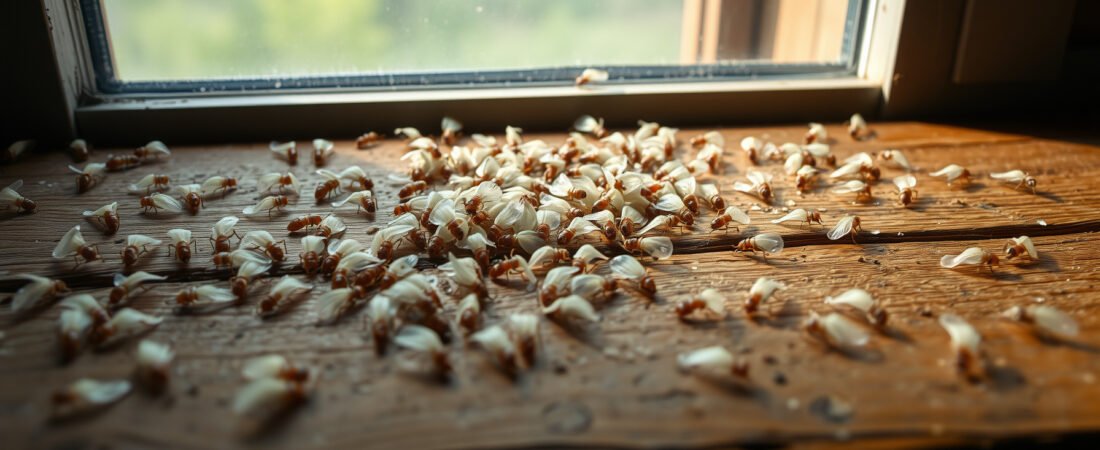
Swarmers without their wings are the evidence most homeowners throw away. You vacuum up a pile of shed wings near a windowsill, assume a bug flew in from outside, and move on — never realizing those translucent slivers were the single clearest sign that termites have already colonized somewhere inside your home. The wings come off within seconds of landing, and what’s left behind is a small, soft-bodied insect that looks almost nothing like the winged termite you’d recognize from a photo. That’s the gap that costs people thousands of dollars in structural damage.
What Do Termite Swarmers Actually Look Like Once the Wings Are Gone?
Once a termite swarmer lands and sheds its wings — which happens within 30 to 60 seconds of touching down — it transforms into something unrecognizable to most people. The body is roughly 3/8 of an inch long, soft, creamy-white to pale tan in color, and has a distinctly thick waist. That last detail matters: unlike ants, termites have no pinch between the thorax and abdomen. The body goes straight through like a tiny sausage.
The head is slightly darker than the body — sometimes a warm brown — and the antennae are straight and beaded, almost like a tiny strand of pearls. You won’t see any visible segmentation on the abdomen at a glance. People frequently mistake these wingless swarmers for maggots, white ants, or even small beetle larvae, which is exactly why they don’t trigger any alarm. By the time you find three or four of them crawling slowly near a baseboard, the colony that sent them has likely been established for three to five years.
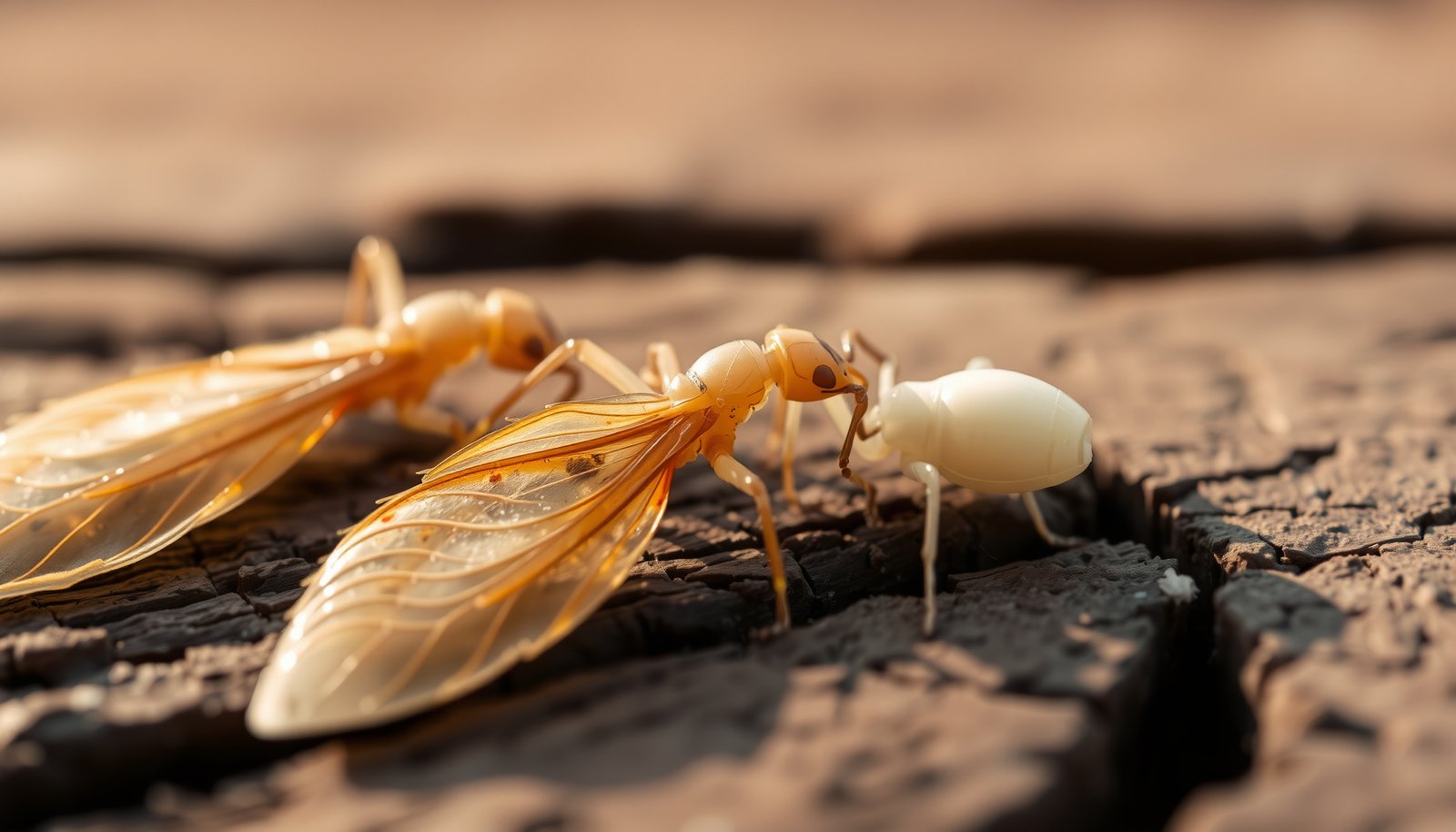
This close-up shows the thick, unwaisted body and beaded antennae of a termite swarmer after wing-drop — the exact features that distinguish it from a winged ant at the moment most homeowners need to make that call.
Why Do Termite Swarmers Shed Their Wings So Fast — and Where Do Those Wings Go?
The wing-shedding isn’t accidental or gradual — it’s a deliberate biological mechanism. Termite swarmers have a pre-formed breaking point at the base of each wing called a basal suture. When the swarmer lands and finds a suitable mate, it deliberately flexes its wings downward until they snap off cleanly at that weak point. The whole process takes less than a minute, and the four shed wings are often all left in the same small cluster because the insect rarely travels far before dropping them.
This is why the wings are your best physical evidence — and why you should never vacuum them up immediately. A pile of equal-length, translucent wings with visible veining near a door frame, window ledge, or light fixture is a calling card. Subterranean termite swarmers leave wings that are roughly 1/4 to 3/8 of an inch long, and all four wings are nearly identical in size. Drywood termite swarmer wings tend to be slightly larger — up to 1/2 inch — and have a more pronounced vein pattern along the front edge. That wing morphology is one of the few ways to identify the termite species from the evidence left behind, which matters for how you respond.
How Is a Wingless Termite Swarmer Different From a Worker Termite?
This is the question that trips up even attentive homeowners. Both are small, pale, and soft-bodied — but they are not the same insect doing the same job, and finding one versus the other tells you something very different about what’s happening in your walls. A termite swarmer after landing is a reproductive — its entire biological purpose is to pair up, find new wood, and start a new colony. It is not eating your house right now. The workers actively chewing through your structure are slightly smaller, completely blind, and never leave the wood or soil voluntarily.
Here’s the distinction that matters most practically: swarmers found indoors almost always means the parent colony is inside your structure, not in a yard tree or a neighbor’s fence. Subterranean termites can swarm from underground colonies near a foundation, but if you’re finding wingless swarmers crawling on your interior walls or floors, they didn’t travel far. They emerged from somewhere close — often within 10 to 15 feet of where you spotted them.
| Feature | Termite Swarmer (After Landing) | Termite Worker |
|---|---|---|
| Body color | Creamy white to pale tan, head slightly darker | Creamy white, virtually no color variation |
| Eyes | Small but visible compound eyes | No functional eyes (blind) |
| Body length | ~3/8 inch (subterranean), up to 1/2 inch (drywood) | ~1/4 inch |
| What finding them means | Active reproductive colony nearby, likely indoors | Structural damage actively occurring |
Pro-Tip: If you find a wingless swarmer, don’t crush it — capture it in a small zip-lock bag or sealed container. A pest control professional can identify the termite species from the body alone, which directly determines what treatment approach is appropriate. Photos work too, but the physical specimen is better.
What Should You Actually Do in the First 24 Hours After Finding Them?
Picture this: it’s a warm Saturday morning in spring, you open your blinds, and there are two dozen translucent wings piled on the window sill and three small pale insects moving slowly across the glass. Your instinct is to clean it up and Google pest control companies. That instinct is half right. Clean nothing until you’ve documented it — photograph the wings in place, photograph any insects you can see, and note the exact location in the home. Termite colonies can contain over 1 million individuals, and a swarming event is one of the only times the colony announces itself to you. Don’t waste it.
After documentation, here’s a practical sequence to follow:
- Preserve the evidence. Collect a few wings and at least one swarmer body in a sealed bag. Label the location and date.
- Check all windows, door frames, and light fixtures on the same floor and the floor immediately above. Swarmers are drawn to light and often congregate in multiple spots.
- Look for mud tubes. If you have a crawl space or exposed foundation, check for pencil-width mud tubes running along concrete, wood, or pipes — the most definitive sign of subterranean termite presence.
- Tap suspect wood. Door frames, baseboards, and window sills that sound hollow when tapped firmly may already have galleries eaten through them. Healthy wood sounds solid.
- Contact a licensed pest inspector within 48 hours. Swarming season is brief — typically a few weeks in spring or fall depending on your region — and the urgency isn’t the swarmers themselves but what they confirm about the established colony.
One honest nuance here: finding swarmers doesn’t automatically mean your home is catastrophically infested. A young colony that’s only been established for a year or two will swarm, but may have caused minimal structural damage so far. A colony that’s been active for five or more years is a different situation entirely. The inspector’s job is to tell you which scenario you’re actually in — don’t try to guess from the swarmers alone.
Can You Tell Subterranean From Drywood Termite Swarmers After They Land?
Yes — and it’s worth knowing, because the treatment approach for these two species is completely different. Subterranean termite swarmers that have shed their wings are paler overall, slightly smaller, and if you look carefully with a magnifying glass, their antennae have a slight curve or elbow near the base. Drywood swarmers are a bit more robust in the body, often have a faintly reddish-brown tinge to the head and thorax, and are found more often inside finished spaces — because drywood colonies live entirely within the wood they’re consuming, with no soil contact required.
“Most homeowners focus on whether they have termites, but the smarter question is which termite. Finding a drywood swarmer inside a second-floor bedroom is a completely different problem from finding a subterranean swarmer near a basement window. One requires localized wood treatment; the other may require a whole-structure approach. The swarmer’s body, even without wings, carries enough information to point you in the right direction — if you know what to look for.”
Dr. Michael Cheng, Board-Certified Entomologist and Urban Pest Management Specialist, University Extension Program
Geography plays a role too, and this is where a lot of generic pest advice falls apart. If you’re in the southeastern United States, you have to account for the Formosan subterranean termite — a particularly aggressive invasive species whose swarmers are larger than native subterranean species and often swarm in the evening around lights, sometimes in massive numbers. Homeowners in coastal areas of the Gulf States and Hawaii deal with a different scale of problem than someone in, say, Montana. The swarmer’s physical appearance is similar enough that you likely can’t distinguish it yourself, but a professional can, and that identification determines whether standard bait station treatment is sufficient or whether a more aggressive liquid barrier approach is warranted.
Here’s what to look for when comparing the two species’ swarmers after they’ve landed and shed wings:
- Body size: Drywood swarmers are typically larger — up to 1/2 inch — while subterranean swarmers average 3/8 inch or slightly under
- Coloration: Subterranean swarmers are uniformly pale cream; drywood swarmers often show reddish-brown on the head and thorax
- Location found: Subterranean swarmers tend to appear near ground-level entry points; drywood swarmers are found anywhere in the structure, including upper floors and attics
- Associated evidence: Subterranean infestations leave mud tubes; drywood infestations leave frass — tiny, hard, hexagonal pellets that look like fine sawdust or coffee grounds
- Antennae shape: Subterranean swarmers have slightly elbowed antennae; drywood swarmers have straighter, more uniformly beaded antennae
If you’re renting your home and you’ve found termite swarmers, it’s worth knowing that your landlord’s obligations in this situation are governed by state habitability laws. Habitability Laws and Pest Infestations: What Renters Should Know breaks down exactly what landlords are required to do — and what happens when they don’t. A termite infestation found during your tenancy almost universally falls under the landlord’s responsibility to remediate, but the documentation you collect in those first 24 hours becomes critical evidence if there’s any dispute.
On the homeowner side, if a pest inspector recommends a recurring monitoring contract after a termite swarming event, go in with clear eyes about what you’re agreeing to. Pest Control Contracts: Are Monthly Plans Worth the Money? walks through when those agreements genuinely protect you and when they’re structured primarily to benefit the company. Termite monitoring is one of the more defensible cases for an ongoing plan — but only if the contract specifies retreatment guarantees, not just monitoring visits.
The counterintuitive reality about termite swarmers is that their appearance after landing — small, pale, wingless, slow-moving — makes them look harmless, almost accidental. They’re not. They’re the most expensive insect you’ll likely ever find in your home, and the fact that they look like nothing is exactly what lets termite damage compound quietly for years before anyone notices. Treat a pile of shed wings near a windowsill the same way you’d treat a smoke alarm going off: assume it’s real until you can prove otherwise.
Frequently Asked Questions
what do termite swarmers look like after they land?
After they land, termite swarmers shed their wings almost immediately, so you’ll often find pairs of equal-length wings on windowsills or floors before you spot the insects themselves. The wingless termites are creamy white to dark brown depending on species, about 1/4 to 3/8 inch long, with a thick waist and straight antennae. Finding discarded wings is usually the clearest sign that swarmers have landed nearby.
do termite swarmers lose their wings after landing?
Yes, termite swarmers shed their wings within minutes of landing — it’s a normal part of their mating process, not a sign of injury. They twist their bodies to snap the wings off at a preset breaking point, which is why you’ll find neat piles of wings all roughly the same size. If you’re seeing small, uniform wings but no live insects, the swarmers have already moved on to find a nesting site.
how long do termite swarmers live after they land?
Most termite swarmers die within a few hours to a couple of days after landing if they can’t find a mate or suitable soil to start a colony. Worker termites need moisture and protection to survive, so swarmers that land on dry indoor surfaces typically don’t make it long. However, any pair that lands in moist wood or soil can survive, mate, and potentially start a new colony, so finding them indoors still warrants a pest inspection.
what is the difference between termite swarmers and flying ants after landing?
After landing, the easiest way to tell them apart is the wings — termite swarmers leave behind two pairs of equal-length wings, while flying ants have a larger front pair and a smaller rear pair. Termites also have a straight, thick waist and straight beaded antennae, whereas ants have a pinched waist and elbowed antennae. If you’re unsure, save a few of the discarded wings or dead insects in a bag and compare them or show them to a pest professional.
where do termite swarmers go after they land indoors?
Termite swarmers that land indoors are disoriented and usually head toward light sources like windows and light fixtures. They can’t establish a colony inside most homes without direct access to moist wood or soil, so they typically die within a day or two. That said, if your home has moisture damage, a crawl space, or wood-to-soil contact, a swarming pair could potentially find a viable spot — which is why an indoor swarm should always be followed up with a professional inspection.