
Signing a pest control contract won’t protect you from pests — it protects you from the anxiety of thinking you might have them. That’s not cynicism; it’s the honest reason most contracts get sold, and understanding it changes how you evaluate whether one is worth your money.
Here’s the bottom line upfront: a monthly or quarterly pest control contract makes financial sense for a narrow slice of homeowners — primarily those in high-pressure environments like the humid Southeast, homes with crawl spaces, or properties with documented recurring infestations. For everyone else, you’re very likely paying for peace of mind on a schedule that doesn’t match how pests actually work. The rest of this article explains exactly how to tell which category you’re in.
What Pest Control Companies Don’t Tell You When They’re Selling the Contract
The sales pitch almost always goes the same way: the technician finds something — a cobweb, a few ant trails, a palmetto bug near the garage — and uses it to frame a monthly plan as the responsible choice. What they rarely mention is that the typical general pest plan covers a short list of common insects and does nothing for the pests most likely to cause serious structural or health damage, including termites, bed bugs, and rodents. Those are add-ons, often priced separately.
The exclusions in a standard contract matter more than the inclusions. Read one carefully and you’ll typically find language limiting coverage to “accessible areas,” excluding certain seasonal pests, and requiring you to report problems within a specific window to get a free retreatment. The contract is written to protect the company’s service schedule, not to guarantee your home stays pest-free. That’s a distinction most homeowners miss until they actually need to use it.

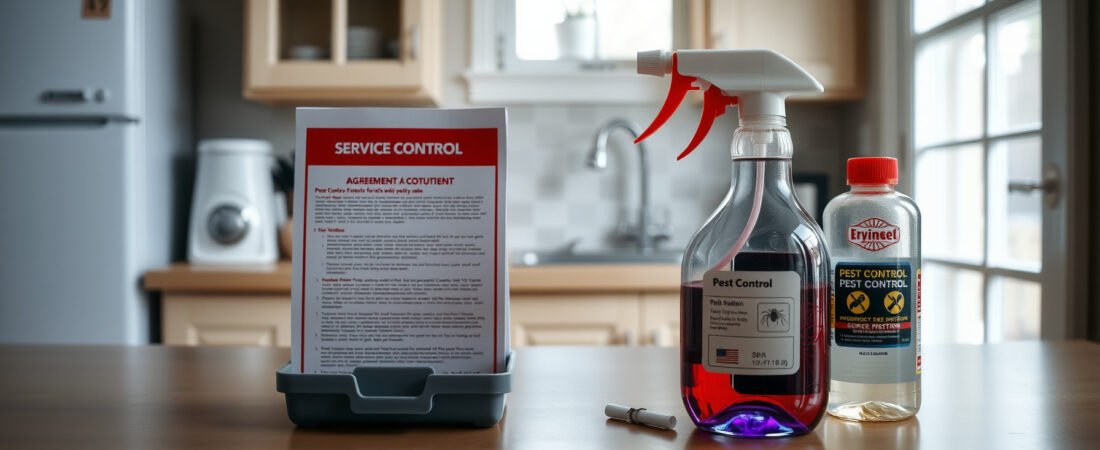
This is a close-up look at a standard residential pest control service agreement — the fine print sections around exclusions and retreatment guarantees are exactly where most homeowners get surprised, so knowing what to look for before you sign saves real money and frustration.
How Pest Control Contracts Are Actually Structured (And Why the Pricing Feels Confusing)
Most companies offer two or three tiers: monthly, bi-monthly (every other month), and quarterly. The pricing difference between them is smaller than you’d expect, which is intentional — the goal is to get you on the more frequent schedule. A monthly plan might run $40–$60 per visit, while a quarterly plan averages $100–$150 per visit, but the annual total for monthly service ($480–$720) almost always exceeds what you’d pay for quarterly ($400–$600) plus one or two one-time spot treatments.
There’s also a setup fee — usually called an “initial treatment” — that can range from $100 to $300, sometimes waived if you commit to a year-long contract. That fee is doing a lot of work: it’s the actual intensive treatment, and the subsequent visits are largely preventive maintenance. Picture this: you pay $250 upfront for the real work, then $55 a month for a 15-minute perimeter spray that the technician is doing at 11 houses that day. That’s not a complaint about technicians — it’s just the math of how the business model functions.
| Plan Type | Typical Cost Per Visit | Annual Total (Est.) | Best For |
|---|---|---|---|
| Monthly | $40–$65 | $480–$780 | High-pressure zones, active infestations |
| Bi-Monthly | $60–$90 | $360–$540 | Moderate risk, warm climates |
| Quarterly | $100–$150 | $400–$600 | Low-risk homes, preventive only |
Which Homes Actually Benefit From a Recurring Pest Control Plan?
Geography is the single biggest factor most contract evaluations ignore. If you live in Florida, coastal Georgia, Louisiana, or Texas, a recurring plan is a more defensible investment — not because the companies are better there, but because pest pressure is genuinely relentless year-round. Cockroaches in those states aren’t a sign of a dirty house; American cockroaches will enter any structure through gaps as small as 1/4 inch, and they do it constantly because outdoor conditions push them inside. Monthly treatments create a chemical barrier that breaks down before the next season in colder climates, but in the humid South, that barrier is doing real work every single week.
Beyond climate, certain home types carry structural risk that warrants ongoing monitoring even when you don’t see active pests. Homes with crawl spaces, older slab foundations with multiple utility penetrations, wood-framed additions, or properties adjacent to wooded lots or bodies of water face recurring pressure from termites, moisture ants, and rodents. A licensed NPMA-certified professional can inspect and give you an honest read on whether your specific home justifies recurring service — and that assessment is worth more than the contract itself.
“The homes I see with the worst infestations usually had contracts at some point and cancelled them because they didn’t see bugs for a few months. They thought the contract worked so well they didn’t need it anymore — when really, the lack of activity was the contract working. There’s an irony to that. But I also see plenty of low-risk homes in temperate climates where a quarterly inspection and one targeted treatment annually would accomplish the same thing for half the cost.”
Marcus Delray, BCE — Board Certified Entomologist and licensed pest management consultant with 18 years of residential and commercial experience
What Does a Pest Control Contract Actually Cover — And What Doesn’t It?
This is where homeowners consistently get burned. The standard general pest plan covers what pest control companies call “common household pests” — a list that typically includes ants, spiders, roaches, silverfish, earwigs, and centipedes. It does not cover bed bugs, fleas, termites, wildlife, mosquitoes, or stinging insects unless you’ve purchased specific add-on coverage. Fleas in particular are a recurring gap: a flea infestation inside a home, even one without pets (flea eggs can persist in carpeting for weeks after a prior occupant’s pet), requires a completely different treatment protocol. If you’re dealing with a flea problem in a house without a pet, your standard contract almost certainly won’t cover it.
Retreatment guarantees sound reassuring, but the fine print often limits free callbacks to a 30-day window, requires you to have maintained interior access, and applies only to pests explicitly listed in the contract. If a German cockroach population explodes — and a single female German cockroach can produce 30–40 eggs per egg capsule, cycling through multiple generations in a single season — you may find that your contract covers a spray visit but not the gel bait placements or void treatments that would actually solve the problem. Always ask specifically: “What happens if I still have an active infestation 60 days after treatment?” and get the answer in writing.
Pro-Tip: Before signing any pest control contract, ask for a written list of every pest species and situation that is explicitly excluded. Reputable companies will provide this without hesitation. If the sales rep hedges or says “we cover everything,” that’s your cue to read the actual contract language before your pen touches paper.
How to Decide Between a Contract, One-Time Treatments, and DIY Maintenance
The right answer depends on three variables most decision guides skip: your actual pest pressure, your home’s structural vulnerability, and your own tolerance for hands-on maintenance. If you’re in a low-humidity northern climate, in a newer home with solid construction, and you’ve never had a serious infestation, a quarterly inspection plus targeted one-time treatments when problems arise is almost always cheaper and equally effective. There’s no pest control science that says a monthly spray prevents infestations better than a quarterly one in low-pressure environments — the treatment frequency is about the service model, not entomological necessity.
DIY maintenance fills a genuine gap for certain pest categories, especially preventive monitoring. For common pantry pests, fruit flies, and low-level ant activity, well-chosen consumer products handle the job effectively and cost a fraction of recurring service fees. A well-designed fruit fly trap, for example, outperforms a technician’s quarterly spray visit for that specific pest every time, because the spray doesn’t target their breeding sites. Knowing which pests respond to DIY solutions and which genuinely require professional-grade products or techniques is what separates smart pest management from just spending money regularly.
Here’s a straightforward decision framework based on the factors that actually matter:
- Assess your climate zone first. Year-round warmth and humidity (zones 8–10 in the US) genuinely justifies more frequent professional treatment. Temperate and northern climates with hard winters provide natural pest suppression that contracts don’t account for in their pricing.
- Audit your home’s construction. Crawl spaces, aging slab penetrations, and wood-to-soil contact points are high-risk features that warrant professional monitoring regardless of whether you’ve seen pests yet. Termite colonies can reach over 1 million individuals before you notice visible damage.
- Identify exactly which pests you’re dealing with. General contracts aren’t designed for targeted infestations. If you have a specific, identified pest problem, a one-time targeted treatment is almost always more effective — and cheaper — than enrolling in a general plan and hoping it covers your issue.
- Read the cancellation terms before you sign. Many contracts auto-renew and charge a cancellation fee — sometimes equivalent to one or two months of service — if you leave before the contract term ends. Know what you’re committing to.
- Ask about a quarterly plan before accepting monthly. Most companies offer quarterly service but lead with monthly because the annual revenue is higher. A quarterly plan with a free callback guarantee often delivers nearly identical outcomes at significantly lower annual cost.
There’s one honest nuance worth sitting with: if you’ve had a severe infestation — say, a German cockroach colony that required multiple treatments to knock back — a 12-month recurring service contract during the first year after treatment is genuinely worth it. The biology is the reason. Cockroach egg capsules (oothecae) are resistant to most pesticides, and eggs that survive initial treatment can hatch 24–48 days later, restarting the cycle. Regular retreatment during that window catches emerging populations before they reestablish. After that first year of clean inspections, you can reassess whether continued service at that frequency still makes sense.
Here’s what to look for in a contract before committing:
- A specific written list of covered pests (not just “general household pests”)
- Clear retreatment policy: timeframe, conditions, and whether callbacks are free or discounted
- Cancellation terms: notice period required, any early termination fees
- Auto-renewal language — and whether you’ll get a renewal notice in advance
- Documentation of what treatment was applied and where, provided after each visit
- Whether the same technician services your property consistently (continuity matters for site familiarity)
The counterintuitive thing about pest control contracts is this: the homeowners who need them most are often the ones who’d benefit from a single aggressive one-time treatment and better exclusion work — sealing entry points, fixing moisture issues, removing harborage — more than they’d benefit from 12 monthly spray visits. Spraying a perimeter that has a 1/4-inch gap under the garage door is a treadmill, not a solution. The best pest control companies know this and will tell you. The ones worth hiring are the ones who sometimes talk you out of the contract.
Frequently Asked Questions
How much do pest control contracts cost per month?
Most monthly pest control contracts run between $40 and $70 per month for a standard single-family home, though prices vary by region, home size, and pest types covered. Annual prepay plans are often cheaper, sometimes dropping to $30–$45 per month when you pay upfront. Always ask what’s included — some plans cover only general pests like ants and roaches, while others add termites, mosquitoes, or rodents for an extra fee.
can you cancel a pest control contract early
Yes, but most contracts charge an early cancellation fee, typically $150 to $200 or a percentage of your remaining balance. Some companies waive the fee if you cancel within the first 30 days, so read the fine print before you sign. It’s worth calling to negotiate — many companies will reduce or drop the fee if you’re moving or genuinely unhappy with service.
is a monthly pest control plan worth it or just one time treatment
It depends on what you’re dealing with — for ongoing pests like ants, cockroaches, or mice, a monthly or quarterly plan usually makes more financial sense than paying $150–$300 each time you call for a one-time visit. One-time treatments work fine for isolated incidents, but they don’t include free re-service calls if the problem comes back. If you’ve had repeat infestations or live in a high-pest area, a contract tends to pay for itself within a few months.
what pests are not covered by pest control contracts
Most standard pest control contracts exclude termites, bed bugs, and wildlife like squirrels or raccoons — these typically require separate specialized treatments. Some plans also don’t cover carpenter ants, fleas, or ticks unless you pay for an upgraded tier. Always ask for the full pest list in writing before signing, because exclusions are rarely advertised upfront.
how often does pest control come with a monthly contract
Despite being called ‘monthly’ plans, most pest control contracts actually schedule treatments every 1 to 3 months — the monthly fee is just how you pay, not how often they show up. Quarterly service (every 90 days) is the most common setup for general pest control. In between scheduled visits, you’re usually entitled to free re-service calls if pests return, which is one of the main perks of being under contract.
Disclaimer: This article is for informational purposes only. Pest control costs, timelines, and outcomes vary widely depending on the pest, the severity of the infestation, your location, and the company you hire. Always get multiple quotes and ask for a written inspection report before agreeing to a treatment plan.