
A demand letter to your landlord about pests fails — not because you forgot to be polite or because you didn’t sound legal enough — but because it lacks the one thing that actually creates legal pressure: documented proof that your landlord had notice and did nothing. Most tenants write an angry email describing roaches or mice, and landlords ignore it completely. The letter you write has to function as a paper trail that a housing court judge can read and immediately understand, not a complaint that disappears into an inbox.
Why Most Pest Demand Letters Get Ignored (And What Changes That)
The uncomfortable truth is that “I have roaches and you need to fix it” is not a demand letter — it’s a complaint, and landlords have learned to ignore complaints. A real demand letter works because it signals that you understand your legal rights, you’ve documented the problem thoroughly, and you’re prepared to act on what you’re asking for. That shift in tone and structure is what separates a letter that gets a repair crew scheduled within 72 hours from one that gets filed in a drawer.
The other thing most tenants don’t realize: the letter itself doesn’t need to be long or written in legal jargon. It needs to be specific, timestamped, and tied directly to the habitability obligations spelled out in your state’s landlord-tenant law. Vague is forgettable. Specific is actionable — and far harder to dismiss.
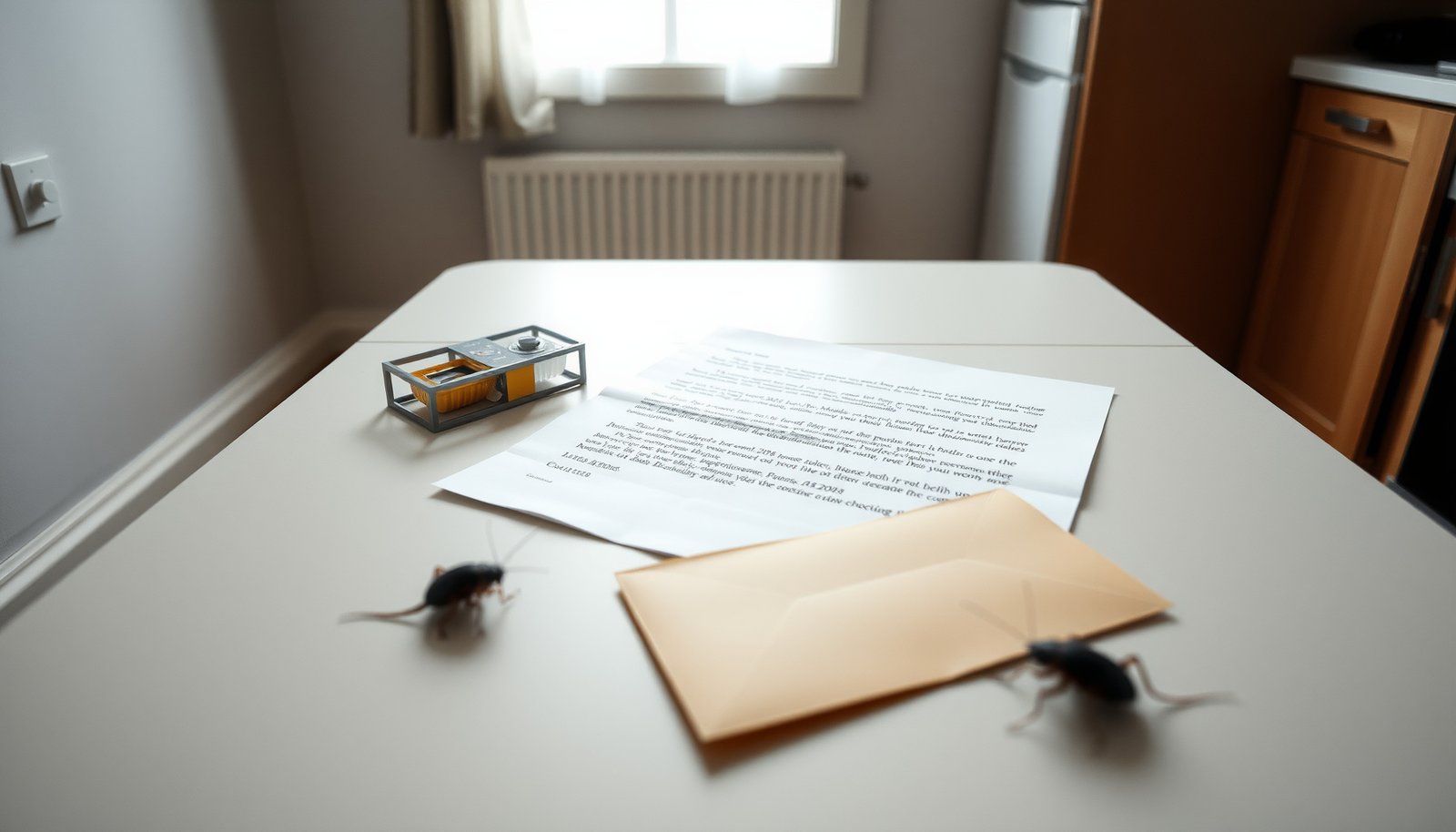
This shows a close-up of a properly structured pest demand letter alongside supporting documentation — the combination of written notice and physical evidence is exactly what gives your letter legal weight in a housing dispute.
What Specific Information Must Go in the Letter?
Think of your demand letter as answering four questions a judge would ask: What pest? When did it start? What did you already tell the landlord? What do you want done, and by when? Every other detail in the letter exists to support those four answers. Here’s what that looks like in practice — in order:
- Your full name, unit number, property address, and the date the letter was written. Courts care about exact dates. Don’t just write “recently” — write the specific date you first saw evidence of pests.
- A clear identification of the pest. “Bugs” won’t work. Say German cockroaches, mice, bed bugs, or whatever you’ve confirmed. A German cockroach infestation moves fast — a single female produces up to 40 eggs per capsule and can generate hundreds of offspring in a matter of weeks — so specificity about the pest species also signals the urgency.
- The locations affected inside the unit. Kitchen cabinets, bathroom walls, bedroom baseboards — name them all. The more specific you are, the harder it is for a landlord to claim the problem is minor or isolated.
- Every prior notice you’ve given and when. Include dates of verbal complaints, emails, texts, or maintenance requests. This is the critical piece most tenants forget — landlord liability in habitability cases almost always hinges on whether they had notice and failed to act.
- A citation to your state’s implied warranty of habitability or relevant pest control statute. You don’t need to be a lawyer to look this up. Search “[your state] implied warranty of habitability pest control” and copy the statute number directly into the letter.
- A clear deadline and a stated remedy. Give the landlord a specific number of days — typically 14 to 30 depending on your state — to schedule a licensed exterminator. State clearly what you intend to do if they don’t: withhold rent, repair-and-deduct, or file with the housing authority.
That last point matters more than people expect. A demand letter with no stated consequence is just a strongly worded request. Landlords respond to consequences, not frustration.
How Do You Prove the Infestation Well Enough to Back Up the Letter?
Your letter is only as strong as the evidence attached to it. Written descriptions help, but physical documentation is what survives a landlord’s denial. Before you send anything, spend 20 minutes building an evidence file you can attach or reference in the letter.
Photos and videos with timestamps are the foundation — photograph droppings, shed skins, egg cases, or live pests. Roach egg cases (called oothecae) are about 8mm long and dark brown; mouse droppings are roughly 1/4 inch and rod-shaped with pointed ends. Those aren’t interchangeable with “something gross under the sink.” Specificity in your evidence directly strengthens your letter’s credibility. If you’ve been dealing with a secondary pest problem during this period — say, drain flies showing up while your landlord ignored a moisture issue — photograph those too. Knowing how to get rid of drain flies in a kitchen sink yourself doesn’t excuse a landlord from fixing the underlying condition that’s causing them.
Save every related communication in a folder. Forward text messages to your email so you have a dated record. If you made a verbal complaint, follow it up immediately in writing — even a quick email that says “As I mentioned when I called today about the mice” creates a timestamped record of the prior notice. That matters enormously if this ends up in housing court.
“In habitability disputes, the documentation gap almost always hurts the tenant, not the landlord. Judges want to see that the tenant gave written notice, gave a reasonable time to respond, and only escalated after that window passed. A demand letter that checks those three boxes is the single most important document in a pest-related housing case.”
Marcus Tillman, Tenant Rights Advocate and Licensed Property Law Paralegal, 14 years specializing in housing code enforcement cases
What Tone and Format Actually Gets Results?
Here’s something counterintuitive: a calm, formal tone in a demand letter is more threatening to a landlord than an angry one. Anger reads as emotional. Calm and factual reads as someone who has already talked to a lawyer or knows exactly where this is going. You want your landlord to feel mild dread, not irritation.
Format the letter like a business document. Use a standard font, include a date at the top, address it formally to the property management company or landlord by name, and sign it. Send it in two ways: email (so you have a timestamp) and certified mail with return receipt requested (so you have proof of delivery). That combination eliminates any “I never received it” defense. Keep the body of the letter to one page if possible — dense multi-page letters get skimmed; tight, organized single-page letters get read.
Pro-Tip: Write one sentence near the end of the letter that says something like: “I am retaining a copy of this letter and all supporting documentation for my records.” It signals you’re organized, you’re serious, and this isn’t going away — and it costs you nothing to add.
What Remedies Can You Actually Demand — and Which Ones Have Legal Teeth?
The remedy section of your letter is where most tenants go too vague or too aggressive, and both backfire. Demanding “immediate” action with no defined timeline gives the landlord wiggle room to stall indefinitely. Threatening to stop paying rent in the first letter without knowing whether your state allows rent withholding for pest issues can actually weaken your position legally.
Here’s a realistic breakdown of what you can demand, and which options hold up depending on the situation:
| Remedy You Can Request | When It Has Legal Support | What to Know First |
|---|---|---|
| Licensed exterminator dispatched within 14–30 days | Most states, for documented habitability violations | Verify your state’s required response timeline — some set specific windows by statute |
| Rent reduction or rent escrow during infestation | States with strong habitability laws (CA, NY, IL, WA, etc.) | Rent withholding without following exact legal process can lead to eviction proceedings |
| Repair-and-deduct (hire exterminator, deduct cost from rent) | About half of U.S. states explicitly allow this | Usually capped at one month’s rent; requires prior written notice and reasonable time to respond |
| Lease termination without penalty | Severe infestations that make the unit uninhabitable | Requires strong documentation; works best when landlord has ignored multiple written notices |
The honest nuance here: which remedy applies depends heavily on your state, how long the infestation has been present, and whether you’ve already given prior written notice. A first demand letter in a state with weaker tenant protections looks different from a third-notice escalation letter in California or New York. Know your state’s rules before you commit to a specific consequence in writing.
One thing that applies almost everywhere: you cannot demand the landlord use a specific pest control company or a particular treatment method. You can demand they use a licensed exterminator and that the treatment be effective — and you can put in the letter that you expect written confirmation of the scheduled appointment and the treatment used. Landlords who drag their feet or attempt cosmetic fixes (painting over evidence, setting a single glue trap, scattering boric acid powder without addressing the source) are not meeting their habitability obligations. For context on what proper evidence-collection looks like before calling in professionals — trapping is often the first step — knowing which glue traps actually work for mice and insects helps you document activity levels before and after any landlord-ordered treatment, which is useful if you need to show the treatment failed.
The last piece of advice most articles skip entirely: follow up your demand letter in writing within 48 hours of the deadline passing, whether your landlord responded or not. If they acted, send a short email confirming what was scheduled. If they didn’t act, send a second brief letter stating the deadline has passed, you received no response, and you’re now proceeding with the remedy you outlined. That second document is often what triggers actual action — and if it doesn’t, it’s the document that makes your housing authority complaint or small claims filing clean and airtight. The goal of a demand letter isn’t to win an argument. It’s to build a record that wins the situation for you.
Frequently Asked Questions
what should I include in a demand letter to my landlord about pests?
Your demand letter should include your full name and rental address, the specific pest problem (cockroaches, bed bugs, rodents, etc.), the dates you first noticed the infestation, and every time you notified your landlord about it. You’ll also want to reference your state’s implied warranty of habitability, set a clear deadline for repairs — typically 14 to 30 days — and state what action you’ll take if they don’t respond, like withholding rent or contacting local housing authorities.
how do I prove a pest infestation for a demand letter?
Photos and videos with timestamps are your strongest evidence — document every room affected and capture the pests themselves if possible. You should also save any written communication with your landlord, pest sighting logs with dates, and if you can, get a written inspection report from a licensed pest control company confirming the infestation.
what deadline should I give my landlord in a pest complaint letter?
Most tenants give landlords between 14 and 30 days to respond or begin remediation, but check your state’s landlord-tenant laws since some states set specific timeframes. For severe infestations like bed bugs or rats, 14 days is reasonable; for less urgent issues, 30 days is standard and harder for a landlord to dispute as unreasonable.
can I withhold rent if my landlord won’t fix a pest problem?
In many states, yes — rent withholding is legal if your landlord fails to maintain a habitable unit, and a pest infestation often qualifies as a habitability violation. The rules vary a lot by state though, so before you withhold a single payment, look up your specific state’s rent withholding statutes or talk to a tenant’s rights attorney to avoid being hit with an eviction notice.
should I send a demand letter to my landlord about pests via email or certified mail?
Send it both ways — email creates an instant timestamp and a digital paper trail, while certified mail with return receipt gives you legal proof that your landlord physically received it. Never rely on a verbal complaint alone; if you end up in court or small claims, written documentation is what actually holds up.
Disclaimer: This article is for general informational purposes only and does not constitute legal advice. Landlord-tenant laws and pest-related disclosure or habitability requirements vary significantly by state and even by city, and they change over time. Before withholding rent, breaking a lease, or taking other legal action over a pest infestation, consult a licensed attorney or your local tenant rights organization familiar with the laws in your area.